SUBSCRIBE TO OUR FREE NEWSLETTER
Daily news & progressive opinion—funded by the people, not the corporations—delivered straight to your inbox.
5
#000000
#FFFFFF
To donate by check, phone, or other method, see our More Ways to Give page.
Daily news & progressive opinion—funded by the people, not the corporations—delivered straight to your inbox.
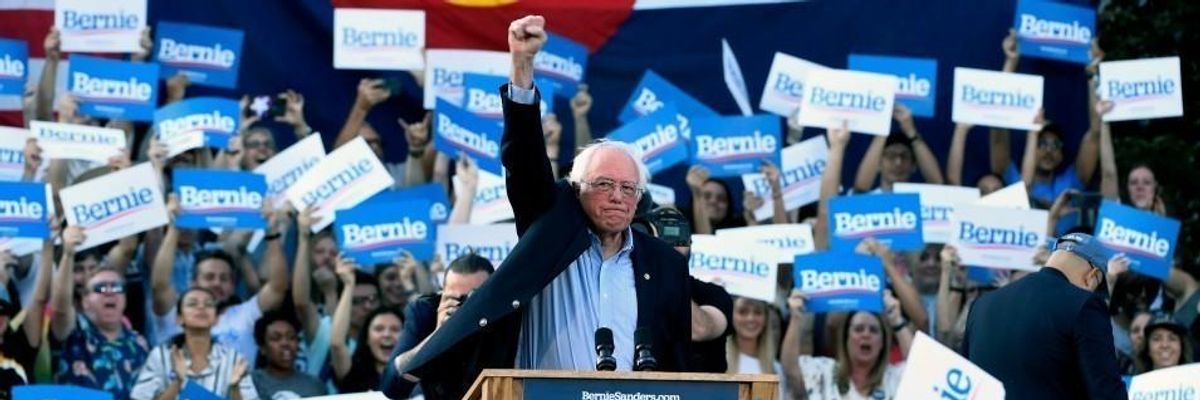
Whoever wins the presidency, the millions of people who voted and worked for Bernie Sanders will need to plow their energies and talents into creating serious political pressure to win gains for climate action, health care access, people power, workers' rights, corporate accountability, and much more. (Photo: Helen H. Richardson/MediaNews Group/The Denver Post via Getty Images)
With a deep sigh opening his "Thank you" video to supporters on April 8, following a brutally bizarre Wisconsin primary clouded by voter suppression and endangerment amid the COVID-19 pandemic, Senator Bernie Sanders ended his once mightily promising bid for the presidency.
It's another sad, tough moment for progressive politics. But, as Sanders himself pointed out, progressives have every reason to stay vigilantly engaged in the struggle and causes he has lifted to the forefront of American politics.
The need for a unified national alliance or coalition that can mobilize around a Sanders-style agenda--while building and retaining local and regional movements and autonomy--is more urgent than ever.
Even as Sanders's campaign folds up its tent, the long-term fight is just beginning: How do progressives, social movements, and the many marginalized communities most in need of change harness the tremendous energy, inspiration, and momentum of the Sanders campaign?
First, a quick tally of the vast support for Sanders and his transformative agenda is in order. He has received 7.6 million votes, 914 delegates, and his campaign has had more than two million individual donors, averaging $18 apiece. It's worth noting, Sanders remains on the ballot in the twenty-eight states and territories that have yet to vote, meaning he will continue to pile up more delegates.
Whenever the Democratic primaries wind down, and Sanders brings his mass of support to the Democratic National Convention (now slated for mid-August), two big questions loom:
First, how will Sanders's supporters vote in a general election that is likely to be at once depressingly devoid of ideas and perilously close?
And, of equal if not greater importance, can the fire, energy, passion, and compassion generated by his campaign go toward building a lasting movement that can contend for power and create real change in people's lives?
Bill Fletcher Jr., the longtime labor leader and author, says in an interview that while electoral campaigns "do not necessarily result in viable organizations" or movements, Sanders's platform "is in many ways a good unity statement for progressives. We need to take that kind of unity and spirit into the convention and beyond."
It's abundantly clear that Sanders and progressives have shifted the national discussion in ways that could lead to significant change. As Sanders said in suspending his campaign, "Together we have transformed American consciousness as to what kind of nation we can become."
Sanders added, "[N]ot only are we winning the struggle ideologically, we are also winning it generationally. The future of our country rests with young people."
Indeed, winning strong majority support for transformative policies like Medicare for All and a Green New Deal gives these essential ideas a fighting chance for years to come.
As the political action committee Democracy for America tweeted, Sanders has in recent years "fundamentally altered the range of what is possible in American politics, and the progressive movement is stronger now than it has ever been because of it."
Stephen O'Hanlon, a spokesperson for the Sunrise Movement, said Sanders's "bold policies have won the argument, they're beloved by young people, and they're supported by a broad majority of the American people. His campaign represents the future of American politics."
Aracely Jimenez, also with the Sunrise Movement, concurred: "We need to see this moment as a wake-up call. Our ideas are winning, but we're not going to win overnight. We need to recommit to the hard, long-term work of building a fighting force capable of taking on Wall Street and the political establishment to win the change Bernie campaigned on."
In fall 2016, Sanders's previous presidential near-miss was accompanied by an upwelling of new national electoral organizations such as Brand New Congress, Our Revolution, and Justice Democrats, all devoted to building more political representation and power for progressive ideas. That movement included rising progressive stars (and perhaps future presidential hopefuls) such as Rep. Alexandria Ocasio-Cortez.
Once the current political mourning is over, progressives must build Sanders's inspiring campaign and movement into greater power and leverage.
As we can see from the grim and worsening facts on the ground, there is no time to lose. The COVID-19 pandemic is laying bare the inequalities and injustices that Sanders campaigned so hard to change. The crisis is clarifying, in painfully deadly ways, the dire need for universal single-payer health care, a $15 national minimum wage, and a Green New Deal that creates millions of living-wage jobs to heal our climate crisis and help rescue our cratering economy.
It's clear there won't be just one movement or institution carrying this platform. It won't be the Democratic Party, even as progressives push and pressure it to step up to the moment.
Likewise, the need for a unified national alliance or coalition that can mobilize around a Sanders-style agenda--while building and retaining local and regional movements and autonomy--is more urgent than ever.
Whoever wins the presidency, the millions of people who voted and worked for Bernie Sanders will need to plow their energies and talents into creating serious political pressure to win gains for climate action, health care access, people power, workers' rights, corporate accountability, and much more.
The upcoming war for justice and survival demands all of our attention. It's a battle we can't afford to lose. So even while mourning, as the saying goes, keep organizing.
Dear Common Dreams reader, It’s been nearly 30 years since I co-founded Common Dreams with my late wife, Lina Newhouser. We had the radical notion that journalism should serve the public good, not corporate profits. It was clear to us from the outset what it would take to build such a project. No paid advertisements. No corporate sponsors. No millionaire publisher telling us what to think or do. Many people said we wouldn't last a year, but we proved those doubters wrong. Together with a tremendous team of journalists and dedicated staff, we built an independent media outlet free from the constraints of profits and corporate control. Our mission has always been simple: To inform. To inspire. To ignite change for the common good. Building Common Dreams was not easy. Our survival was never guaranteed. When you take on the most powerful forces—Wall Street greed, fossil fuel industry destruction, Big Tech lobbyists, and uber-rich oligarchs who have spent billions upon billions rigging the economy and democracy in their favor—the only bulwark you have is supporters who believe in your work. But here’s the urgent message from me today. It's never been this bad out there. And it's never been this hard to keep us going. At the very moment Common Dreams is most needed, the threats we face are intensifying. We need your support now more than ever. We don't accept corporate advertising and never will. We don't have a paywall because we don't think people should be blocked from critical news based on their ability to pay. Everything we do is funded by the donations of readers like you. When everyone does the little they can afford, we are strong. But if that support retreats or dries up, so do we. Will you donate now to make sure Common Dreams not only survives but thrives? —Craig Brown, Co-founder |
With a deep sigh opening his "Thank you" video to supporters on April 8, following a brutally bizarre Wisconsin primary clouded by voter suppression and endangerment amid the COVID-19 pandemic, Senator Bernie Sanders ended his once mightily promising bid for the presidency.
It's another sad, tough moment for progressive politics. But, as Sanders himself pointed out, progressives have every reason to stay vigilantly engaged in the struggle and causes he has lifted to the forefront of American politics.
The need for a unified national alliance or coalition that can mobilize around a Sanders-style agenda--while building and retaining local and regional movements and autonomy--is more urgent than ever.
Even as Sanders's campaign folds up its tent, the long-term fight is just beginning: How do progressives, social movements, and the many marginalized communities most in need of change harness the tremendous energy, inspiration, and momentum of the Sanders campaign?
First, a quick tally of the vast support for Sanders and his transformative agenda is in order. He has received 7.6 million votes, 914 delegates, and his campaign has had more than two million individual donors, averaging $18 apiece. It's worth noting, Sanders remains on the ballot in the twenty-eight states and territories that have yet to vote, meaning he will continue to pile up more delegates.
Whenever the Democratic primaries wind down, and Sanders brings his mass of support to the Democratic National Convention (now slated for mid-August), two big questions loom:
First, how will Sanders's supporters vote in a general election that is likely to be at once depressingly devoid of ideas and perilously close?
And, of equal if not greater importance, can the fire, energy, passion, and compassion generated by his campaign go toward building a lasting movement that can contend for power and create real change in people's lives?
Bill Fletcher Jr., the longtime labor leader and author, says in an interview that while electoral campaigns "do not necessarily result in viable organizations" or movements, Sanders's platform "is in many ways a good unity statement for progressives. We need to take that kind of unity and spirit into the convention and beyond."
It's abundantly clear that Sanders and progressives have shifted the national discussion in ways that could lead to significant change. As Sanders said in suspending his campaign, "Together we have transformed American consciousness as to what kind of nation we can become."
Sanders added, "[N]ot only are we winning the struggle ideologically, we are also winning it generationally. The future of our country rests with young people."
Indeed, winning strong majority support for transformative policies like Medicare for All and a Green New Deal gives these essential ideas a fighting chance for years to come.
As the political action committee Democracy for America tweeted, Sanders has in recent years "fundamentally altered the range of what is possible in American politics, and the progressive movement is stronger now than it has ever been because of it."
Stephen O'Hanlon, a spokesperson for the Sunrise Movement, said Sanders's "bold policies have won the argument, they're beloved by young people, and they're supported by a broad majority of the American people. His campaign represents the future of American politics."
Aracely Jimenez, also with the Sunrise Movement, concurred: "We need to see this moment as a wake-up call. Our ideas are winning, but we're not going to win overnight. We need to recommit to the hard, long-term work of building a fighting force capable of taking on Wall Street and the political establishment to win the change Bernie campaigned on."
In fall 2016, Sanders's previous presidential near-miss was accompanied by an upwelling of new national electoral organizations such as Brand New Congress, Our Revolution, and Justice Democrats, all devoted to building more political representation and power for progressive ideas. That movement included rising progressive stars (and perhaps future presidential hopefuls) such as Rep. Alexandria Ocasio-Cortez.
Once the current political mourning is over, progressives must build Sanders's inspiring campaign and movement into greater power and leverage.
As we can see from the grim and worsening facts on the ground, there is no time to lose. The COVID-19 pandemic is laying bare the inequalities and injustices that Sanders campaigned so hard to change. The crisis is clarifying, in painfully deadly ways, the dire need for universal single-payer health care, a $15 national minimum wage, and a Green New Deal that creates millions of living-wage jobs to heal our climate crisis and help rescue our cratering economy.
It's clear there won't be just one movement or institution carrying this platform. It won't be the Democratic Party, even as progressives push and pressure it to step up to the moment.
Likewise, the need for a unified national alliance or coalition that can mobilize around a Sanders-style agenda--while building and retaining local and regional movements and autonomy--is more urgent than ever.
Whoever wins the presidency, the millions of people who voted and worked for Bernie Sanders will need to plow their energies and talents into creating serious political pressure to win gains for climate action, health care access, people power, workers' rights, corporate accountability, and much more.
The upcoming war for justice and survival demands all of our attention. It's a battle we can't afford to lose. So even while mourning, as the saying goes, keep organizing.
With a deep sigh opening his "Thank you" video to supporters on April 8, following a brutally bizarre Wisconsin primary clouded by voter suppression and endangerment amid the COVID-19 pandemic, Senator Bernie Sanders ended his once mightily promising bid for the presidency.
It's another sad, tough moment for progressive politics. But, as Sanders himself pointed out, progressives have every reason to stay vigilantly engaged in the struggle and causes he has lifted to the forefront of American politics.
The need for a unified national alliance or coalition that can mobilize around a Sanders-style agenda--while building and retaining local and regional movements and autonomy--is more urgent than ever.
Even as Sanders's campaign folds up its tent, the long-term fight is just beginning: How do progressives, social movements, and the many marginalized communities most in need of change harness the tremendous energy, inspiration, and momentum of the Sanders campaign?
First, a quick tally of the vast support for Sanders and his transformative agenda is in order. He has received 7.6 million votes, 914 delegates, and his campaign has had more than two million individual donors, averaging $18 apiece. It's worth noting, Sanders remains on the ballot in the twenty-eight states and territories that have yet to vote, meaning he will continue to pile up more delegates.
Whenever the Democratic primaries wind down, and Sanders brings his mass of support to the Democratic National Convention (now slated for mid-August), two big questions loom:
First, how will Sanders's supporters vote in a general election that is likely to be at once depressingly devoid of ideas and perilously close?
And, of equal if not greater importance, can the fire, energy, passion, and compassion generated by his campaign go toward building a lasting movement that can contend for power and create real change in people's lives?
Bill Fletcher Jr., the longtime labor leader and author, says in an interview that while electoral campaigns "do not necessarily result in viable organizations" or movements, Sanders's platform "is in many ways a good unity statement for progressives. We need to take that kind of unity and spirit into the convention and beyond."
It's abundantly clear that Sanders and progressives have shifted the national discussion in ways that could lead to significant change. As Sanders said in suspending his campaign, "Together we have transformed American consciousness as to what kind of nation we can become."
Sanders added, "[N]ot only are we winning the struggle ideologically, we are also winning it generationally. The future of our country rests with young people."
Indeed, winning strong majority support for transformative policies like Medicare for All and a Green New Deal gives these essential ideas a fighting chance for years to come.
As the political action committee Democracy for America tweeted, Sanders has in recent years "fundamentally altered the range of what is possible in American politics, and the progressive movement is stronger now than it has ever been because of it."
Stephen O'Hanlon, a spokesperson for the Sunrise Movement, said Sanders's "bold policies have won the argument, they're beloved by young people, and they're supported by a broad majority of the American people. His campaign represents the future of American politics."
Aracely Jimenez, also with the Sunrise Movement, concurred: "We need to see this moment as a wake-up call. Our ideas are winning, but we're not going to win overnight. We need to recommit to the hard, long-term work of building a fighting force capable of taking on Wall Street and the political establishment to win the change Bernie campaigned on."
In fall 2016, Sanders's previous presidential near-miss was accompanied by an upwelling of new national electoral organizations such as Brand New Congress, Our Revolution, and Justice Democrats, all devoted to building more political representation and power for progressive ideas. That movement included rising progressive stars (and perhaps future presidential hopefuls) such as Rep. Alexandria Ocasio-Cortez.
Once the current political mourning is over, progressives must build Sanders's inspiring campaign and movement into greater power and leverage.
As we can see from the grim and worsening facts on the ground, there is no time to lose. The COVID-19 pandemic is laying bare the inequalities and injustices that Sanders campaigned so hard to change. The crisis is clarifying, in painfully deadly ways, the dire need for universal single-payer health care, a $15 national minimum wage, and a Green New Deal that creates millions of living-wage jobs to heal our climate crisis and help rescue our cratering economy.
It's clear there won't be just one movement or institution carrying this platform. It won't be the Democratic Party, even as progressives push and pressure it to step up to the moment.
Likewise, the need for a unified national alliance or coalition that can mobilize around a Sanders-style agenda--while building and retaining local and regional movements and autonomy--is more urgent than ever.
Whoever wins the presidency, the millions of people who voted and worked for Bernie Sanders will need to plow their energies and talents into creating serious political pressure to win gains for climate action, health care access, people power, workers' rights, corporate accountability, and much more.
The upcoming war for justice and survival demands all of our attention. It's a battle we can't afford to lose. So even while mourning, as the saying goes, keep organizing.