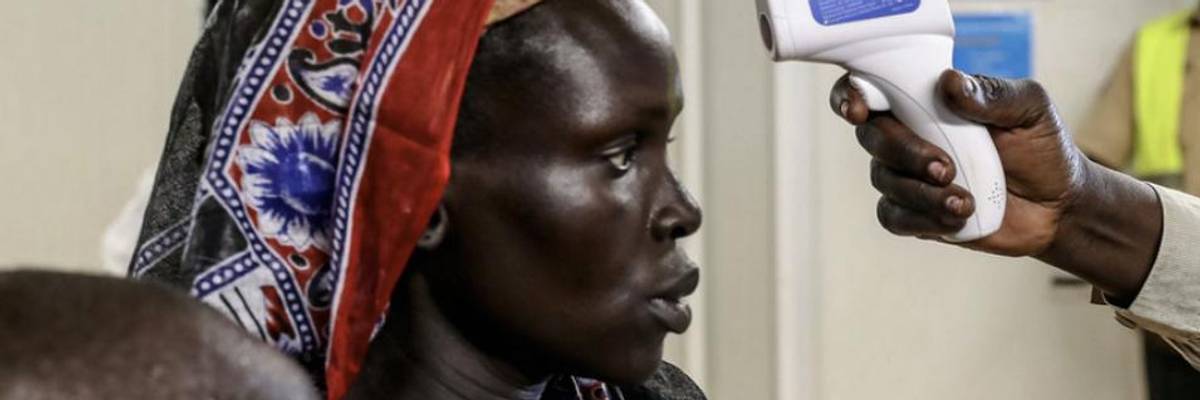
An internally displaced woman voluntarily returning to her home in Bentiu, South Sudan, is being checked for fever. (Photo: United Nations/Isaac Billy)
Leaders Must Act to Protect Refugees and Internally Displaced People in Africa
The window of opportunity for containment is shutting fast. We must work together quickly to stop the spread of Covid-19 among the continent's most vulnerable populations.
"We are waiting to die from Covid-19."
These chilling words, uttered by a Somalia refugee in Mogadishu, encapsulate the fears of refugees and Internally Displaced People (IDPs) in Africa.
A few hundred kilometers away in Qunyo Brrow on May 17, a U.S. drone strike hit the farming community in the middle of the night.
As the Covid-19 pandemic begins to ravage African countries, the lives of refugees and IDPs hang in the balance. Today in Africa, there are 84,634 confirmed cases of Covid-19, 32,494 recovered and more than 2,766 people have died. The actual number of those infected is likely much higher due to limited testing capacity. The World Health Organization (WHO) has warned us to prepare for the worst.
These are more than just numbers. They are families, friends, communities, and our fellow human beings. Our hearts go out to everyone struggling with this pandemic. But we need more than just sympathy. We need action.
Leaders of African countries, civil society organizations, and the international community must work together to ensure that refugees and internally displaced people have access to testing, healthcare, sanitation, and safe housing. Without these efforts, the pandemic poses a far greater risk to everyone across the continent.
For countries with weak health infrastructures and limited resources, hope for stopping the pandemic lies in containment. According to the United Nations Human Rights Council (UNHRC), Africa hosts 18 million displaced people, 12 million of whom are displaced within their own countries as a result of violence or forced migration.
"Leaders of African countries, civil society organizations, and the international community must work together to ensure that refugees and internally displaced people have access to testing, healthcare, sanitation, and safe housing. Without these efforts, the pandemic poses a far greater risk to everyone across the continent."
While most African governments are implementing and enforcing prevention strategies such as handwashing, wearing masks in public, travel restrictions, curfews, and stay-at-home orders, many people cannot comply. Stay-at-home orders could mean a death sentence for those facing persecution from extremists, or whose homes are in areas targeted by U.S. drone strikes. Drone strikes have only increased since the pandemic began, with more than 39 airstrikes launched since January. Even though civilians can hear the drones coming, the stay-at-home orders mean they have nowhere to run.
Refugees in Africa live in horrific conditions, packed into crowded camps and unsanitary environments with limited provisions. Internally displaced people generally live in informal settlements around big cities without access to water, food, and medical services. Many IDPs already experience poor health because of lack of healthcare, food, and clean water. In refugee camps and IDP settlements, water and hand sanitizer are rare commodities.
In Somalia, there are only 20 intensive care unit beds in the whole country of 15 million people, one Covid-19 testing facility, and few healthcare workers. More than two million IDPs live in temporary carton-made shelters or open-air dwelling spaces.
In Kenya, the Dadaab and Kakuma refugee camps host more than 400,000 people. In both camps, physical distancing is a big challenge--refugees live in close quarters and must queue to fetch water and food.
In Zimbabwe, over four million people are displaced due to political violence, natural disasters and resettlement initiatives. The onset of Covid-19 has heightened already existing challenges of economic security, social service delivery, and nutrition and food access.
After elections violence in 2015, thousands of Burundians fled to neighboring countries. Some refugees are now returning home, but there are still more than 335,000 Burundian refugees in Tanzania, Rwanda, and Uganda. Natural disasters within Burundi have led to the internal displacement of more than 112,000 people.
Once someone shows symptoms of Covid-19, self-isolation is a challenge for refugees and IDPs. How does one self-isolate in an open-air camp with hundreds of other people, or in a makeshift shelter with multiple people in it, surrounded by a thousand other temporary structures?
Worldwide, there are reports of governments showing negligence and hostility to refugees and displaced people, refusing them access to asylum or services. Some governments have suspended refugee and IDP intake processes, leaving many in limbo. A pandemic does not justify breaking international laws that protect the rights of refugees and internally displaced persons. Governments must honor their commitment to the Universal Declaration of Human Rights, which guarantees refugees the right to seek asylum from persecution, and the provision of safety in the host country.
Few African governments are paying sufficient attention to the plight of refugees and IDPs. This must change if we are to avert a catastrophe. If there is no plan responding to the needs of IDPs and refugees, other relief efforts will fail.
In addition to providing masks, sanitizers, water, food, and health services, IDPs and refugees need assistance to move out of unsafe conditions. With so many empty hotel rooms, governments could work with the private sector to shift people into hotel rooms and boarding schools. This would save lives and money that could go into rebuilding the economy after Covid-19.
As African governments intensify testing for Covid-19, refugees and IDPs must be a priority. Local production of rapid test kits in countries like Senegal and South Africa could make this a reality. IDPs and refugees infected with COVID-19 and their families should receive adequate and urgent health care in safe environments.
The window of opportunity for containment is shutting fast. We must work together quickly to stop the spread of Covid-19 among IDPs and refugees. This is not just necessary for the health of displaced people, but essential to avert an uncontrolled pandemic in Africa.
FINAL DAY! This is urgent.
Dear Common Dreams reader, It’s been nearly 30 years since I co-founded Common Dreams with my late wife, Lina Newhouser. We had the radical notion that journalism should serve the public good, not corporate profits. It was clear to us from the outset what it would take to build such a project. No paid advertisements. No corporate sponsors. No millionaire publisher telling us what to think or do. Many people said we wouldn't last a year, but we proved those doubters wrong. Together with a tremendous team of journalists and dedicated staff, we built an independent media outlet free from the constraints of profits and corporate control. Our mission from the outset was simple. To inform. To inspire. To ignite change for the common good. Building Common Dreams was not easy. Our survival was never guaranteed. When you take on the most powerful forces—Wall Street greed, fossil fuel industry destruction, Big Tech lobbyists, and uber-rich oligarchs who have spent billions upon billions rigging the economy and democracy in their favor—the only bulwark you have is supporters who believe in your work. But here’s the urgent message from me today. It’s never been this bad out there. And it’s never been this hard to keep us going. At the very moment Common Dreams is most needed and doing some of its best and most important work, the threats we face are intensifying. Right now, with just hours left in our Spring Campaign, we're still falling short of our make-or-break goal. When everyone does the little they can afford, we are strong. But if that support retreats or dries up, so do we. Can you make a gift right now to make sure Common Dreams not only survives but thrives? There is no backup plan or rainy day fund. There is only you. —Craig Brown, Co-founder |
"We are waiting to die from Covid-19."
These chilling words, uttered by a Somalia refugee in Mogadishu, encapsulate the fears of refugees and Internally Displaced People (IDPs) in Africa.
A few hundred kilometers away in Qunyo Brrow on May 17, a U.S. drone strike hit the farming community in the middle of the night.
As the Covid-19 pandemic begins to ravage African countries, the lives of refugees and IDPs hang in the balance. Today in Africa, there are 84,634 confirmed cases of Covid-19, 32,494 recovered and more than 2,766 people have died. The actual number of those infected is likely much higher due to limited testing capacity. The World Health Organization (WHO) has warned us to prepare for the worst.
These are more than just numbers. They are families, friends, communities, and our fellow human beings. Our hearts go out to everyone struggling with this pandemic. But we need more than just sympathy. We need action.
Leaders of African countries, civil society organizations, and the international community must work together to ensure that refugees and internally displaced people have access to testing, healthcare, sanitation, and safe housing. Without these efforts, the pandemic poses a far greater risk to everyone across the continent.
For countries with weak health infrastructures and limited resources, hope for stopping the pandemic lies in containment. According to the United Nations Human Rights Council (UNHRC), Africa hosts 18 million displaced people, 12 million of whom are displaced within their own countries as a result of violence or forced migration.
"Leaders of African countries, civil society organizations, and the international community must work together to ensure that refugees and internally displaced people have access to testing, healthcare, sanitation, and safe housing. Without these efforts, the pandemic poses a far greater risk to everyone across the continent."
While most African governments are implementing and enforcing prevention strategies such as handwashing, wearing masks in public, travel restrictions, curfews, and stay-at-home orders, many people cannot comply. Stay-at-home orders could mean a death sentence for those facing persecution from extremists, or whose homes are in areas targeted by U.S. drone strikes. Drone strikes have only increased since the pandemic began, with more than 39 airstrikes launched since January. Even though civilians can hear the drones coming, the stay-at-home orders mean they have nowhere to run.
Refugees in Africa live in horrific conditions, packed into crowded camps and unsanitary environments with limited provisions. Internally displaced people generally live in informal settlements around big cities without access to water, food, and medical services. Many IDPs already experience poor health because of lack of healthcare, food, and clean water. In refugee camps and IDP settlements, water and hand sanitizer are rare commodities.
In Somalia, there are only 20 intensive care unit beds in the whole country of 15 million people, one Covid-19 testing facility, and few healthcare workers. More than two million IDPs live in temporary carton-made shelters or open-air dwelling spaces.
In Kenya, the Dadaab and Kakuma refugee camps host more than 400,000 people. In both camps, physical distancing is a big challenge--refugees live in close quarters and must queue to fetch water and food.
In Zimbabwe, over four million people are displaced due to political violence, natural disasters and resettlement initiatives. The onset of Covid-19 has heightened already existing challenges of economic security, social service delivery, and nutrition and food access.
After elections violence in 2015, thousands of Burundians fled to neighboring countries. Some refugees are now returning home, but there are still more than 335,000 Burundian refugees in Tanzania, Rwanda, and Uganda. Natural disasters within Burundi have led to the internal displacement of more than 112,000 people.
Once someone shows symptoms of Covid-19, self-isolation is a challenge for refugees and IDPs. How does one self-isolate in an open-air camp with hundreds of other people, or in a makeshift shelter with multiple people in it, surrounded by a thousand other temporary structures?
Worldwide, there are reports of governments showing negligence and hostility to refugees and displaced people, refusing them access to asylum or services. Some governments have suspended refugee and IDP intake processes, leaving many in limbo. A pandemic does not justify breaking international laws that protect the rights of refugees and internally displaced persons. Governments must honor their commitment to the Universal Declaration of Human Rights, which guarantees refugees the right to seek asylum from persecution, and the provision of safety in the host country.
Few African governments are paying sufficient attention to the plight of refugees and IDPs. This must change if we are to avert a catastrophe. If there is no plan responding to the needs of IDPs and refugees, other relief efforts will fail.
In addition to providing masks, sanitizers, water, food, and health services, IDPs and refugees need assistance to move out of unsafe conditions. With so many empty hotel rooms, governments could work with the private sector to shift people into hotel rooms and boarding schools. This would save lives and money that could go into rebuilding the economy after Covid-19.
As African governments intensify testing for Covid-19, refugees and IDPs must be a priority. Local production of rapid test kits in countries like Senegal and South Africa could make this a reality. IDPs and refugees infected with COVID-19 and their families should receive adequate and urgent health care in safe environments.
The window of opportunity for containment is shutting fast. We must work together quickly to stop the spread of Covid-19 among IDPs and refugees. This is not just necessary for the health of displaced people, but essential to avert an uncontrolled pandemic in Africa.
"We are waiting to die from Covid-19."
These chilling words, uttered by a Somalia refugee in Mogadishu, encapsulate the fears of refugees and Internally Displaced People (IDPs) in Africa.
A few hundred kilometers away in Qunyo Brrow on May 17, a U.S. drone strike hit the farming community in the middle of the night.
As the Covid-19 pandemic begins to ravage African countries, the lives of refugees and IDPs hang in the balance. Today in Africa, there are 84,634 confirmed cases of Covid-19, 32,494 recovered and more than 2,766 people have died. The actual number of those infected is likely much higher due to limited testing capacity. The World Health Organization (WHO) has warned us to prepare for the worst.
These are more than just numbers. They are families, friends, communities, and our fellow human beings. Our hearts go out to everyone struggling with this pandemic. But we need more than just sympathy. We need action.
Leaders of African countries, civil society organizations, and the international community must work together to ensure that refugees and internally displaced people have access to testing, healthcare, sanitation, and safe housing. Without these efforts, the pandemic poses a far greater risk to everyone across the continent.
For countries with weak health infrastructures and limited resources, hope for stopping the pandemic lies in containment. According to the United Nations Human Rights Council (UNHRC), Africa hosts 18 million displaced people, 12 million of whom are displaced within their own countries as a result of violence or forced migration.
"Leaders of African countries, civil society organizations, and the international community must work together to ensure that refugees and internally displaced people have access to testing, healthcare, sanitation, and safe housing. Without these efforts, the pandemic poses a far greater risk to everyone across the continent."
While most African governments are implementing and enforcing prevention strategies such as handwashing, wearing masks in public, travel restrictions, curfews, and stay-at-home orders, many people cannot comply. Stay-at-home orders could mean a death sentence for those facing persecution from extremists, or whose homes are in areas targeted by U.S. drone strikes. Drone strikes have only increased since the pandemic began, with more than 39 airstrikes launched since January. Even though civilians can hear the drones coming, the stay-at-home orders mean they have nowhere to run.
Refugees in Africa live in horrific conditions, packed into crowded camps and unsanitary environments with limited provisions. Internally displaced people generally live in informal settlements around big cities without access to water, food, and medical services. Many IDPs already experience poor health because of lack of healthcare, food, and clean water. In refugee camps and IDP settlements, water and hand sanitizer are rare commodities.
In Somalia, there are only 20 intensive care unit beds in the whole country of 15 million people, one Covid-19 testing facility, and few healthcare workers. More than two million IDPs live in temporary carton-made shelters or open-air dwelling spaces.
In Kenya, the Dadaab and Kakuma refugee camps host more than 400,000 people. In both camps, physical distancing is a big challenge--refugees live in close quarters and must queue to fetch water and food.
In Zimbabwe, over four million people are displaced due to political violence, natural disasters and resettlement initiatives. The onset of Covid-19 has heightened already existing challenges of economic security, social service delivery, and nutrition and food access.
After elections violence in 2015, thousands of Burundians fled to neighboring countries. Some refugees are now returning home, but there are still more than 335,000 Burundian refugees in Tanzania, Rwanda, and Uganda. Natural disasters within Burundi have led to the internal displacement of more than 112,000 people.
Once someone shows symptoms of Covid-19, self-isolation is a challenge for refugees and IDPs. How does one self-isolate in an open-air camp with hundreds of other people, or in a makeshift shelter with multiple people in it, surrounded by a thousand other temporary structures?
Worldwide, there are reports of governments showing negligence and hostility to refugees and displaced people, refusing them access to asylum or services. Some governments have suspended refugee and IDP intake processes, leaving many in limbo. A pandemic does not justify breaking international laws that protect the rights of refugees and internally displaced persons. Governments must honor their commitment to the Universal Declaration of Human Rights, which guarantees refugees the right to seek asylum from persecution, and the provision of safety in the host country.
Few African governments are paying sufficient attention to the plight of refugees and IDPs. This must change if we are to avert a catastrophe. If there is no plan responding to the needs of IDPs and refugees, other relief efforts will fail.
In addition to providing masks, sanitizers, water, food, and health services, IDPs and refugees need assistance to move out of unsafe conditions. With so many empty hotel rooms, governments could work with the private sector to shift people into hotel rooms and boarding schools. This would save lives and money that could go into rebuilding the economy after Covid-19.
As African governments intensify testing for Covid-19, refugees and IDPs must be a priority. Local production of rapid test kits in countries like Senegal and South Africa could make this a reality. IDPs and refugees infected with COVID-19 and their families should receive adequate and urgent health care in safe environments.
The window of opportunity for containment is shutting fast. We must work together quickly to stop the spread of Covid-19 among IDPs and refugees. This is not just necessary for the health of displaced people, but essential to avert an uncontrolled pandemic in Africa.