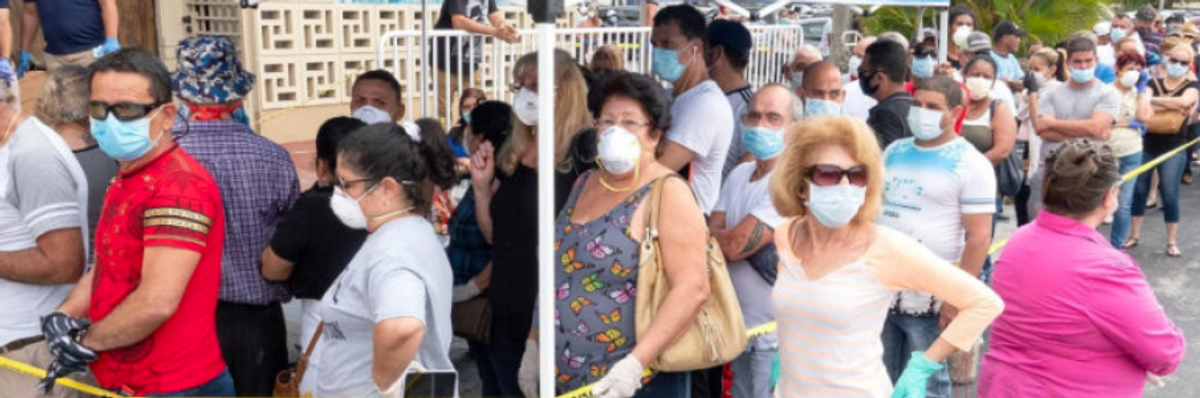
New York Times photo (4/12/20) of Floridians waiting in line to sign up for unemployment benefits.
Proposals to Ease Covid's Blow on the Hardest Hit All But Ignored by Corporate Media
By sidelining those voices, media sideline real solutions to the inequality they feign to care about.
As rent deferrals are ending in many states, leaving renters on the hook for the back payments, nearly a quarter of all households are at risk of eviction or foreclosure, according to one estimate (Washington Post, 5/31/20).
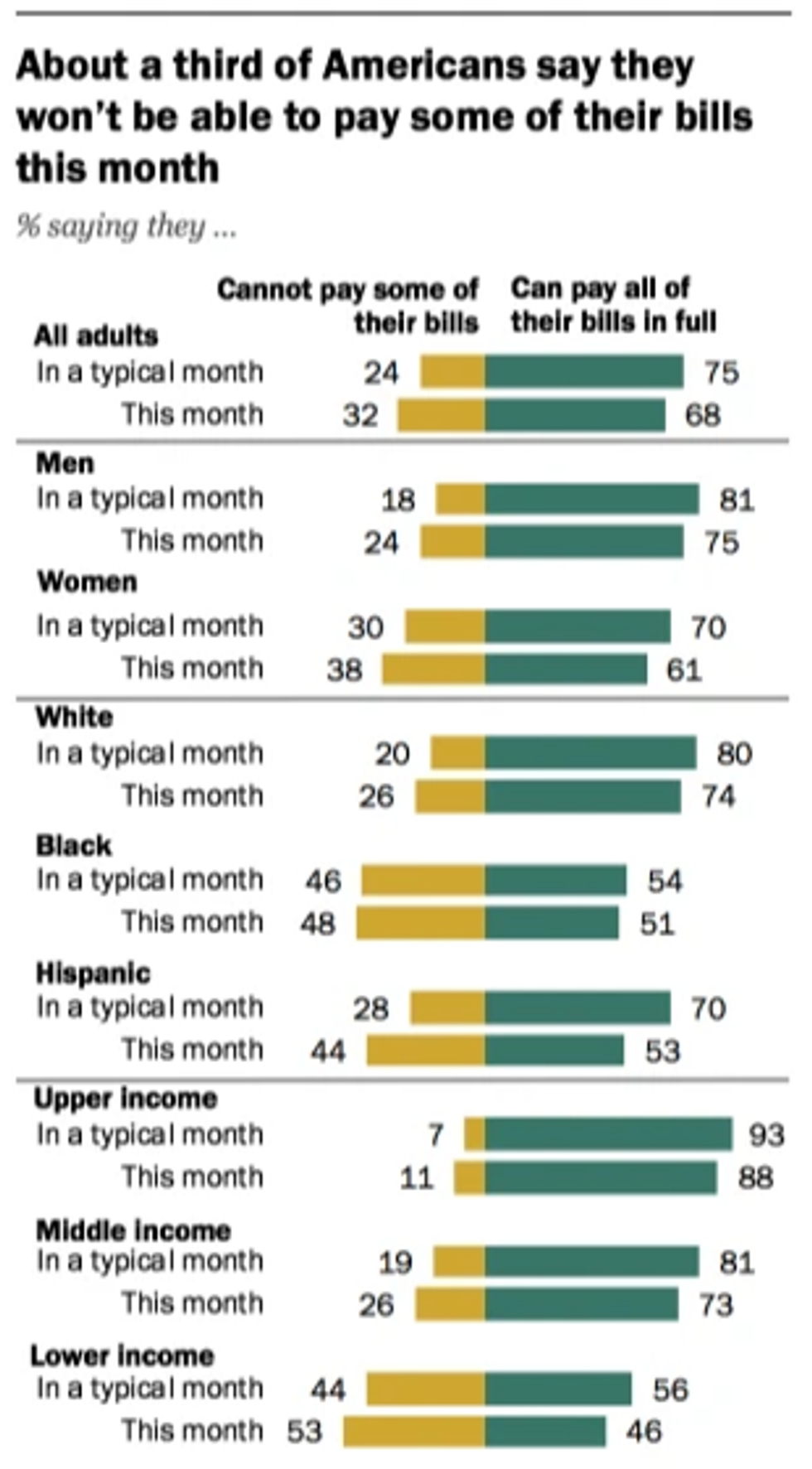
The poor and people of color are the hardest hit, not just by the novel coronavirus but also by the economic fallout: More than half of lower-income adults say they or someone in their household has lost work, while only 32% of upper-income adults say the same. Meanwhile, the vast majority of those low-income households don't have emergency funds to weather such hard times. And more black and Hispanic households report having lost work and lacking emergency funds than white households (Pew Research Center, 4/21/20).
It's easy enough to find reporting in major US news outlets describing the hardships many Americans are facing. But lamenting inequality is one thing, and acknowledging--or, God forbid, highlighting--efforts to rectify it are very much another for corporate media (see, e.g., FAIR.org, 4/10/20), who all but ignore serious, popular proposals that would prioritize those hardest hit, including communities of color and the poor.
There are plenty of ideas out there for measures that would truly help people, particularly those hardest hit by the crisis. The People's Bailout, for instance, endorsed by hundreds of progressive groups and almost 100 members of Congress, calls for Congress to adhere to five principles in crafting Covid-19 relief packages:
- Health is the top priority, for all people, with no exceptions.
- Economic relief must be provided directly to the people.
- Rescue workers and communities, not corporate executives.
- Make a down payment on a regenerative economy while preventing future crises.
- Protect our democratic process while protecting each other.
Among their more specific demands, the People's Bailout calls for regular direct cash payments; free and accessible testing, treatment and PPE; and a halt to evictions, foreclosures, and water and electricity shut offs.

Since the beginning of the pandemic, there have been only two mentions of the People's Bailout in leading national news outlets, both in the Washington Post's coverage of Earth Day (4/21/20, 4/22/20). In a Nexis search, FAIR found no mentions at all in the New York Times, LA Times, USA Today, NPR or the TV news networks.
Or take the April 13 letter to Congress signed by a long list of national, state and local organizations, including Oxfam America, the NAACP and the AFL-CIO, calling for $500 billion in unrestricted aid to state, local, territorial and tribal governments--which are required to balance their budgets in the face of unprecedented shortfalls--in addition to payroll guarantees, continued unemployment insurance payments, another round of cash payments (regardless of immigration status), stronger worker protections and full funding for frontline workers' health and safety. (See CounterSpin, 4/17/20.) Not a single leading network or newspaper reported on this letter.
These aren't wild ideas; even the bipartisan National Governors Association called for $500 billion in aid to states. But their call has gotten far less attention than Trump's top "economic relief" priority: a suspension of payroll taxes, which would provide little in the way of economic relief (particularly to the unemployed, who are no longer paying such taxes), but would seriously endanger the Social Security program it funds (Reuters, 3/11/20), and it has gotten little support on either side of the aisle. And yet, in the seven weeks since the NGA put out its call, the outlets ran only 35 stories that mentioned it, while Trump's payroll tax cut proposal netted 95 mentions.
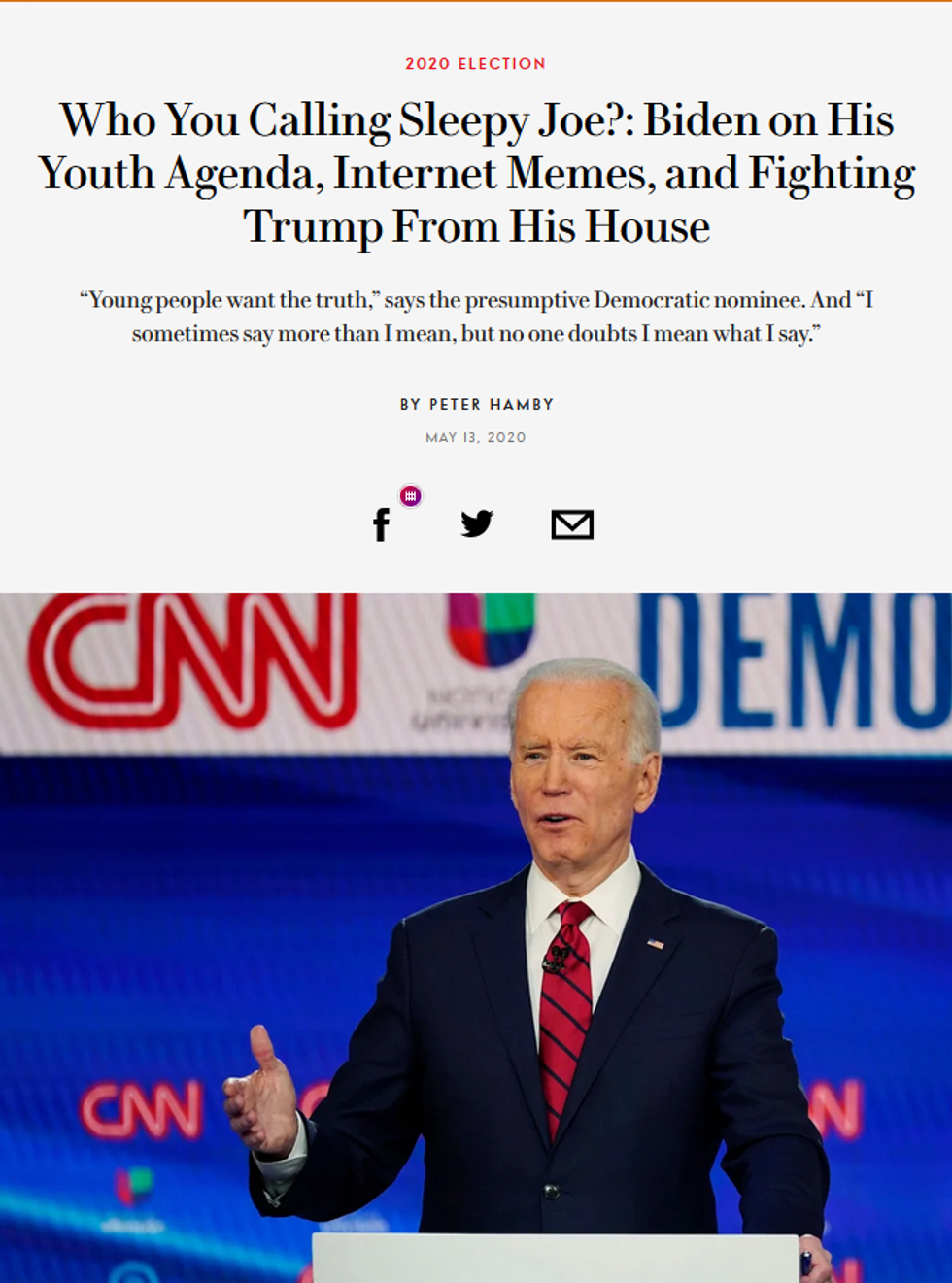
In an interview with James Hamby on Good Luck America, a documentary series on Snapchat (also published in Vanity Fair, 5/13/20, where Hamby is a contributing writer), presumptive Democratic presidential nominee Joe Biden made a startlingly progressive appeal for rent forgiveness:
There should be rent forgiveness and there should be mortgage forgiveness now in the middle of this crisis. Forgiveness. Not paid later, forgiveness. It's critically important to people who are in lower-income strata.
It was a remarkable position for the self-consciously centrist candidate to take, and yet there was virtually no coverage of it in the country's major news outlets. FAIR found one brief mention in the 22nd paragraph of a New York Times article by Carl Hulse (5/15/20) about potential blowback from Republicans' resistance to further economic recovery measures.

That article is instructive about which recovery measures are even allowed in the media debate. The piece, which quotes a handful of Democratic and Republican members of Congress, informed readers:
Members of both parties concede that the $3 trillion measure that Democrats were speeding through the House is several bridges too far, considering its giant cost and the underpinning of progressive policies on immigration and other issues that could never clear the Republican-controlled Senate.
It's worth pointing out, too, that while Hulse describes Republican resistance as "born of spending fatigue and policy divisions," less Timesian assessments could occasionally be found elsewhere, as at Bloomberg (5/19/20): "Republicans are concerned that providing more assistance to states and individuals would slow movement by governors to lift business restrictions."
Of course, to many both inside and outside of the party, that Democratic bill is not ambitious enough, as it included almost no key progressive demands--such as a federal paycheck guarantee program, ongoing direct monthly payments, an eviction and foreclosure moratorium, and an expansion of Medicare and Medicaid (Sanders.senate.gov, 5/14/20; Intercept, 5/15/20).
But Hulse's piece is typical of corporate media, relying heavily on government (and corporate) sources, and marginalizing voices that should be crucial to the national conversation. As a recent FAIR study (5/22/20) of the networks' Sunday morning political talkshows found, the guests given a platform to shape the discussion around both public health and economic strategies during the early weeks of the Covid-19 pandemic were overwhelmingly government officials; independent public health experts, and especially public interest groups, were sidelined. And by sidelining those voices, media sideline real solutions to the inequality they feign to care about.
FINAL DAY! This is urgent.
Dear Common Dreams reader, It’s been nearly 30 years since I co-founded Common Dreams with my late wife, Lina Newhouser. We had the radical notion that journalism should serve the public good, not corporate profits. It was clear to us from the outset what it would take to build such a project. No paid advertisements. No corporate sponsors. No millionaire publisher telling us what to think or do. Many people said we wouldn't last a year, but we proved those doubters wrong. Together with a tremendous team of journalists and dedicated staff, we built an independent media outlet free from the constraints of profits and corporate control. Our mission from the outset was simple. To inform. To inspire. To ignite change for the common good. Building Common Dreams was not easy. Our survival was never guaranteed. When you take on the most powerful forces—Wall Street greed, fossil fuel industry destruction, Big Tech lobbyists, and uber-rich oligarchs who have spent billions upon billions rigging the economy and democracy in their favor—the only bulwark you have is supporters who believe in your work. But here’s the urgent message from me today. It’s never been this bad out there. And it’s never been this hard to keep us going. At the very moment Common Dreams is most needed and doing some of its best and most important work, the threats we face are intensifying. Right now, with just hours left in our Spring Campaign, we're still falling short of our make-or-break goal. When everyone does the little they can afford, we are strong. But if that support retreats or dries up, so do we. Can you make a gift right now to make sure Common Dreams not only survives but thrives? There is no backup plan or rainy day fund. There is only you. —Craig Brown, Co-founder |
As rent deferrals are ending in many states, leaving renters on the hook for the back payments, nearly a quarter of all households are at risk of eviction or foreclosure, according to one estimate (Washington Post, 5/31/20).
The poor and people of color are the hardest hit, not just by the novel coronavirus but also by the economic fallout: More than half of lower-income adults say they or someone in their household has lost work, while only 32% of upper-income adults say the same. Meanwhile, the vast majority of those low-income households don't have emergency funds to weather such hard times. And more black and Hispanic households report having lost work and lacking emergency funds than white households (Pew Research Center, 4/21/20).
It's easy enough to find reporting in major US news outlets describing the hardships many Americans are facing. But lamenting inequality is one thing, and acknowledging--or, God forbid, highlighting--efforts to rectify it are very much another for corporate media (see, e.g., FAIR.org, 4/10/20), who all but ignore serious, popular proposals that would prioritize those hardest hit, including communities of color and the poor.
There are plenty of ideas out there for measures that would truly help people, particularly those hardest hit by the crisis. The People's Bailout, for instance, endorsed by hundreds of progressive groups and almost 100 members of Congress, calls for Congress to adhere to five principles in crafting Covid-19 relief packages:
- Health is the top priority, for all people, with no exceptions.
- Economic relief must be provided directly to the people.
- Rescue workers and communities, not corporate executives.
- Make a down payment on a regenerative economy while preventing future crises.
- Protect our democratic process while protecting each other.
Among their more specific demands, the People's Bailout calls for regular direct cash payments; free and accessible testing, treatment and PPE; and a halt to evictions, foreclosures, and water and electricity shut offs.

Since the beginning of the pandemic, there have been only two mentions of the People's Bailout in leading national news outlets, both in the Washington Post's coverage of Earth Day (4/21/20, 4/22/20). In a Nexis search, FAIR found no mentions at all in the New York Times, LA Times, USA Today, NPR or the TV news networks.
Or take the April 13 letter to Congress signed by a long list of national, state and local organizations, including Oxfam America, the NAACP and the AFL-CIO, calling for $500 billion in unrestricted aid to state, local, territorial and tribal governments--which are required to balance their budgets in the face of unprecedented shortfalls--in addition to payroll guarantees, continued unemployment insurance payments, another round of cash payments (regardless of immigration status), stronger worker protections and full funding for frontline workers' health and safety. (See CounterSpin, 4/17/20.) Not a single leading network or newspaper reported on this letter.
These aren't wild ideas; even the bipartisan National Governors Association called for $500 billion in aid to states. But their call has gotten far less attention than Trump's top "economic relief" priority: a suspension of payroll taxes, which would provide little in the way of economic relief (particularly to the unemployed, who are no longer paying such taxes), but would seriously endanger the Social Security program it funds (Reuters, 3/11/20), and it has gotten little support on either side of the aisle. And yet, in the seven weeks since the NGA put out its call, the outlets ran only 35 stories that mentioned it, while Trump's payroll tax cut proposal netted 95 mentions.
In an interview with James Hamby on Good Luck America, a documentary series on Snapchat (also published in Vanity Fair, 5/13/20, where Hamby is a contributing writer), presumptive Democratic presidential nominee Joe Biden made a startlingly progressive appeal for rent forgiveness:
There should be rent forgiveness and there should be mortgage forgiveness now in the middle of this crisis. Forgiveness. Not paid later, forgiveness. It's critically important to people who are in lower-income strata.
It was a remarkable position for the self-consciously centrist candidate to take, and yet there was virtually no coverage of it in the country's major news outlets. FAIR found one brief mention in the 22nd paragraph of a New York Times article by Carl Hulse (5/15/20) about potential blowback from Republicans' resistance to further economic recovery measures.

That article is instructive about which recovery measures are even allowed in the media debate. The piece, which quotes a handful of Democratic and Republican members of Congress, informed readers:
Members of both parties concede that the $3 trillion measure that Democrats were speeding through the House is several bridges too far, considering its giant cost and the underpinning of progressive policies on immigration and other issues that could never clear the Republican-controlled Senate.
It's worth pointing out, too, that while Hulse describes Republican resistance as "born of spending fatigue and policy divisions," less Timesian assessments could occasionally be found elsewhere, as at Bloomberg (5/19/20): "Republicans are concerned that providing more assistance to states and individuals would slow movement by governors to lift business restrictions."
Of course, to many both inside and outside of the party, that Democratic bill is not ambitious enough, as it included almost no key progressive demands--such as a federal paycheck guarantee program, ongoing direct monthly payments, an eviction and foreclosure moratorium, and an expansion of Medicare and Medicaid (Sanders.senate.gov, 5/14/20; Intercept, 5/15/20).
But Hulse's piece is typical of corporate media, relying heavily on government (and corporate) sources, and marginalizing voices that should be crucial to the national conversation. As a recent FAIR study (5/22/20) of the networks' Sunday morning political talkshows found, the guests given a platform to shape the discussion around both public health and economic strategies during the early weeks of the Covid-19 pandemic were overwhelmingly government officials; independent public health experts, and especially public interest groups, were sidelined. And by sidelining those voices, media sideline real solutions to the inequality they feign to care about.
As rent deferrals are ending in many states, leaving renters on the hook for the back payments, nearly a quarter of all households are at risk of eviction or foreclosure, according to one estimate (Washington Post, 5/31/20).
The poor and people of color are the hardest hit, not just by the novel coronavirus but also by the economic fallout: More than half of lower-income adults say they or someone in their household has lost work, while only 32% of upper-income adults say the same. Meanwhile, the vast majority of those low-income households don't have emergency funds to weather such hard times. And more black and Hispanic households report having lost work and lacking emergency funds than white households (Pew Research Center, 4/21/20).
It's easy enough to find reporting in major US news outlets describing the hardships many Americans are facing. But lamenting inequality is one thing, and acknowledging--or, God forbid, highlighting--efforts to rectify it are very much another for corporate media (see, e.g., FAIR.org, 4/10/20), who all but ignore serious, popular proposals that would prioritize those hardest hit, including communities of color and the poor.
There are plenty of ideas out there for measures that would truly help people, particularly those hardest hit by the crisis. The People's Bailout, for instance, endorsed by hundreds of progressive groups and almost 100 members of Congress, calls for Congress to adhere to five principles in crafting Covid-19 relief packages:
- Health is the top priority, for all people, with no exceptions.
- Economic relief must be provided directly to the people.
- Rescue workers and communities, not corporate executives.
- Make a down payment on a regenerative economy while preventing future crises.
- Protect our democratic process while protecting each other.
Among their more specific demands, the People's Bailout calls for regular direct cash payments; free and accessible testing, treatment and PPE; and a halt to evictions, foreclosures, and water and electricity shut offs.

Since the beginning of the pandemic, there have been only two mentions of the People's Bailout in leading national news outlets, both in the Washington Post's coverage of Earth Day (4/21/20, 4/22/20). In a Nexis search, FAIR found no mentions at all in the New York Times, LA Times, USA Today, NPR or the TV news networks.
Or take the April 13 letter to Congress signed by a long list of national, state and local organizations, including Oxfam America, the NAACP and the AFL-CIO, calling for $500 billion in unrestricted aid to state, local, territorial and tribal governments--which are required to balance their budgets in the face of unprecedented shortfalls--in addition to payroll guarantees, continued unemployment insurance payments, another round of cash payments (regardless of immigration status), stronger worker protections and full funding for frontline workers' health and safety. (See CounterSpin, 4/17/20.) Not a single leading network or newspaper reported on this letter.
These aren't wild ideas; even the bipartisan National Governors Association called for $500 billion in aid to states. But their call has gotten far less attention than Trump's top "economic relief" priority: a suspension of payroll taxes, which would provide little in the way of economic relief (particularly to the unemployed, who are no longer paying such taxes), but would seriously endanger the Social Security program it funds (Reuters, 3/11/20), and it has gotten little support on either side of the aisle. And yet, in the seven weeks since the NGA put out its call, the outlets ran only 35 stories that mentioned it, while Trump's payroll tax cut proposal netted 95 mentions.
In an interview with James Hamby on Good Luck America, a documentary series on Snapchat (also published in Vanity Fair, 5/13/20, where Hamby is a contributing writer), presumptive Democratic presidential nominee Joe Biden made a startlingly progressive appeal for rent forgiveness:
There should be rent forgiveness and there should be mortgage forgiveness now in the middle of this crisis. Forgiveness. Not paid later, forgiveness. It's critically important to people who are in lower-income strata.
It was a remarkable position for the self-consciously centrist candidate to take, and yet there was virtually no coverage of it in the country's major news outlets. FAIR found one brief mention in the 22nd paragraph of a New York Times article by Carl Hulse (5/15/20) about potential blowback from Republicans' resistance to further economic recovery measures.

That article is instructive about which recovery measures are even allowed in the media debate. The piece, which quotes a handful of Democratic and Republican members of Congress, informed readers:
Members of both parties concede that the $3 trillion measure that Democrats were speeding through the House is several bridges too far, considering its giant cost and the underpinning of progressive policies on immigration and other issues that could never clear the Republican-controlled Senate.
It's worth pointing out, too, that while Hulse describes Republican resistance as "born of spending fatigue and policy divisions," less Timesian assessments could occasionally be found elsewhere, as at Bloomberg (5/19/20): "Republicans are concerned that providing more assistance to states and individuals would slow movement by governors to lift business restrictions."
Of course, to many both inside and outside of the party, that Democratic bill is not ambitious enough, as it included almost no key progressive demands--such as a federal paycheck guarantee program, ongoing direct monthly payments, an eviction and foreclosure moratorium, and an expansion of Medicare and Medicaid (Sanders.senate.gov, 5/14/20; Intercept, 5/15/20).
But Hulse's piece is typical of corporate media, relying heavily on government (and corporate) sources, and marginalizing voices that should be crucial to the national conversation. As a recent FAIR study (5/22/20) of the networks' Sunday morning political talkshows found, the guests given a platform to shape the discussion around both public health and economic strategies during the early weeks of the Covid-19 pandemic were overwhelmingly government officials; independent public health experts, and especially public interest groups, were sidelined. And by sidelining those voices, media sideline real solutions to the inequality they feign to care about.