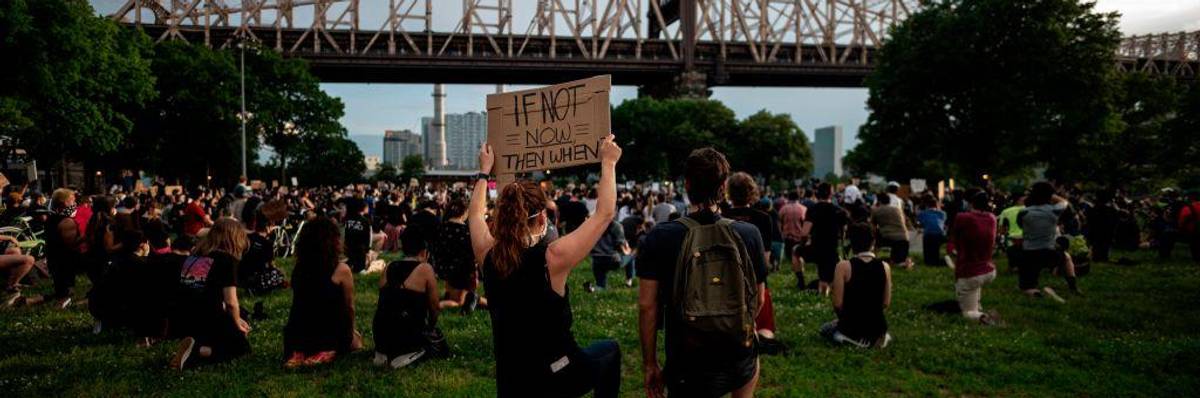
One day the whole nation will take to its knee. (Photo by JOHANNES EISELE/AFP via Getty Images)
The Knee for Change
In a country founded on racism, real change must be deeply structural.
Is George Floyd today's Emmett Till?
Is the nation moving beyond, oh God, its third manifestation of "legal" racism? The first manifestation was, of course, slavery, which was eliminated via the Civil War. The second manifestation was the Jim Crow/KKK era, with its lynchings, black vote suppression, unending segregation and unquestioned white supremacy; the civil rights movement undid at least the legal aspect of this horror, but hardly the racism itself. The third phase, which started percolating in the '70s and came to a full boil in the '80s and '90s, began with expanding the prison-industrial complex, militarizing the police and, of course, engaging in endless wars abroad. This, along with quasi-legal vote suppression, kept American racism institutionally intact and -- son of a gun! -- turned out to be enormously profitable. And people of color continued to suffer.
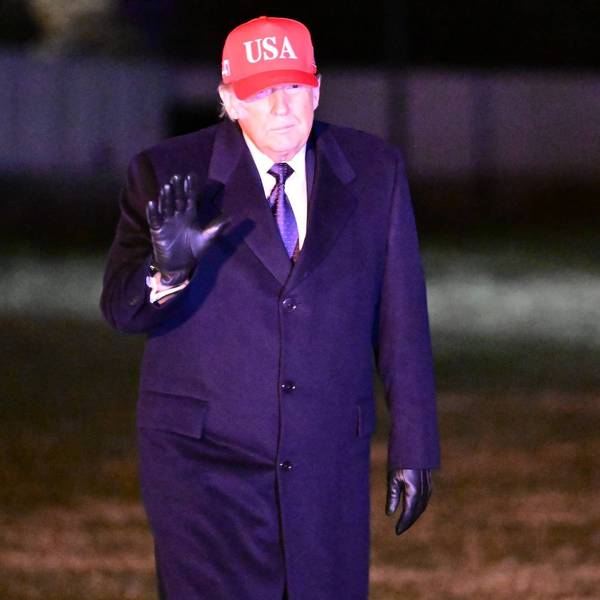
Is the brutal murder of George Floyd -- knee on the man's neck, smirk on the cop's face -- a tipping point for social change? Outrage bubbles across the country: protests in the middle of a pandemic. "I can't breathe!" Police mostly meet the outrage by "standing tough" and giving it the middle finger, with teargas, rubber bullets, arrests. The racist-in-chief wields a Bible, poses in front of a church, declares war (on "them") and, in various ways, calls for increased bloodshed and punishment to stop the protests.
"You have to dominate," he tells America's wimpy (Democrat) governors in a video teleconference. "If you don't dominate, you're wasting your time -- they're going to run over you, you're going to look like a bunch of jerks. . . . You've got to arrest people, you have to track people, you have to put them in jail for ten years and you'll never see this stuff again."
Yeah, racism lives! Stupidity lives! Let's make America great again! What we're witnessing, on one side of the protests, is a desperate grab for the old normal, which is on its way out.
But what's on the other side? Is real change emerging, or just its illusion? What, in God's name, is real change?
In a country founded on racism, real change must be deeply structural. Alex Vitale, writing in The Nation, makes a crucial point: Most attempts to "reform" the police are superficial and accomplish very little. But even when procedural and training changes are more than sheer PR, they fail to address our deepest social wrongs.
"These kinds of reforms," he writes, "turn out to have a lot more to do with providing political cover for local police and politicians than with reducing the abuses of policing. In part, that's because they assume that the professional enforcement of the law is automatically beneficial to everyone. They never question the legitimacy of using police to wage a war on drugs, arrest young children in school, criminalize homelessness, or label young people as gangbangers and superpredators to be incarcerated for life or killed in the streets. A totally lawful, procedurally proper, and perfectly unbiased low-level drug arrest is still going to ruin some young person's life for no good reason. There is no justice in that -- and giving narcotics units anti-bias training will do nothing to change this fact."
He writes: "It's time to rethink superficial and ineffective procedural police reforms and move to defund the police instead."
In other words, let go of the war on drugs, dismantle the prison-industrial complex and stop pouring money into over-militarized American policing; instead, begin diverting the money into social programs that will actually help people. And get the police out of the schools, i.e., take steps, as Vitale writes, "to undo the damage done by the 1994 Crime Bill, like defunding school policing in favor of providing more counselors and restorative justice programs. . . ."
Well, guess what? The cops have just been expelled from the Minneapolis public school system. According to the Minneapolis Star-Tribune: "Minneapolis Public Schools has severed its decades-long relationship with the city's police department in response to the death of George Floyd in police custody."
The June 2 vote was unanimous. It terminated the district's $1.1 million annual contract with the police, whose officers have roamed the corridors of the city's schools since 1967. The Star-Tribune quoted school board chairwoman Kim Ellison:
"I value people and education and life, Now I'm convinced, based on the actions of the Minneapolis Police Department, that we don't have the same values."
This is starting to feel like transformative change -- piecemeal, perhaps, but change is always piecemeal . . . until it's not. Indeed, change -- not from the top down, ordered by politicians, but from the soul up -- can be seen in some American police departments: in Flint, Mich., Camden, N.J., Santa Cruz, Calif., and other places. These are flickering examples of policing in synchronicity with communities of color and people protesting, yes, police brutality.
At the Flint Township Police Department, for instance, police were wearing riot gear when they met a group of protesters, but instead of handling the situation belligerently, they talked with the protesters -- and took off their helmets, laid down their batons.
"And when you show action of, 'Listen, I'm going to make myself vulnerable in order to come into your circle and show you that I want to be that solution,' that was the change maker right there," Genesee County Sheriff Chris Swanson said in an interview later, according to ABC News.
In Camden, police joined the march. "Once the police officers said they feel the same way and they're walking with us, that's what made, I think, the crowd and everyone else feel comfortable," march organizer Yolanda Deaver said. "The police that were there, they weren't standoffish. They weren't holding their batons, they didn't have their hands on their holster or their guns. They were standing down. They weren't agitating the crowd or anything; they let people speak, there was no pushing, no shoving or anything."
In Santa Cruz, police took a knee alongside the protesters, expressing solidarity with them in opposition to police brutality -- and the murder, by knee, of George Floyd.
One day the whole nation will take to its knee.
We are at a crossroads
This country and this world are at a monumental crossroads. US voters have an opportunity to beat back the forces of fascism and confront the billionaires who are rigging the economy, our media system, and our democracy, making it increasingly impossible for ordinary people to get by. We’re not just talking about the election. We’re talking about what must be done once these fascist elements are vanquished from power. We need a bolder set of solutions than what either major party has so far been willing to offer and a working-class movement ready to fight like hell for it. Trump didn't emerge from nowhere. The conditions that fueled MAGA authoritarianism were created by decades of radical neoliberal economic policies and a corrupt political system dominated by corporate interests. They slashed taxes on the super-rich, promising that the benefits would trickle down. They said giveaways to the corporate titans would make life more affordable for the rest of us. It was all bullshit. And when a bitter, betrayed populace searches for someone to blame, right-wing demagogues have little trouble finding scapegoats. People know when they're being lied to, but you won't hear any of this from the corporate media. Only independent journalism—powered and funded by people who believe in building a better world—can deliver truly trustworthy daily news. Our Fall Campaign is underway, and we need your help. To power our newsroom through the rest of the year, we need to raise $125,000 by midnight on October 31. So if you share our vision, please contribute whatever you can to sustain our work. |
Is George Floyd today's Emmett Till?
Is the nation moving beyond, oh God, its third manifestation of "legal" racism? The first manifestation was, of course, slavery, which was eliminated via the Civil War. The second manifestation was the Jim Crow/KKK era, with its lynchings, black vote suppression, unending segregation and unquestioned white supremacy; the civil rights movement undid at least the legal aspect of this horror, but hardly the racism itself. The third phase, which started percolating in the '70s and came to a full boil in the '80s and '90s, began with expanding the prison-industrial complex, militarizing the police and, of course, engaging in endless wars abroad. This, along with quasi-legal vote suppression, kept American racism institutionally intact and -- son of a gun! -- turned out to be enormously profitable. And people of color continued to suffer.
Is the brutal murder of George Floyd -- knee on the man's neck, smirk on the cop's face -- a tipping point for social change? Outrage bubbles across the country: protests in the middle of a pandemic. "I can't breathe!" Police mostly meet the outrage by "standing tough" and giving it the middle finger, with teargas, rubber bullets, arrests. The racist-in-chief wields a Bible, poses in front of a church, declares war (on "them") and, in various ways, calls for increased bloodshed and punishment to stop the protests.
"You have to dominate," he tells America's wimpy (Democrat) governors in a video teleconference. "If you don't dominate, you're wasting your time -- they're going to run over you, you're going to look like a bunch of jerks. . . . You've got to arrest people, you have to track people, you have to put them in jail for ten years and you'll never see this stuff again."
Yeah, racism lives! Stupidity lives! Let's make America great again! What we're witnessing, on one side of the protests, is a desperate grab for the old normal, which is on its way out.
But what's on the other side? Is real change emerging, or just its illusion? What, in God's name, is real change?
In a country founded on racism, real change must be deeply structural. Alex Vitale, writing in The Nation, makes a crucial point: Most attempts to "reform" the police are superficial and accomplish very little. But even when procedural and training changes are more than sheer PR, they fail to address our deepest social wrongs.
"These kinds of reforms," he writes, "turn out to have a lot more to do with providing political cover for local police and politicians than with reducing the abuses of policing. In part, that's because they assume that the professional enforcement of the law is automatically beneficial to everyone. They never question the legitimacy of using police to wage a war on drugs, arrest young children in school, criminalize homelessness, or label young people as gangbangers and superpredators to be incarcerated for life or killed in the streets. A totally lawful, procedurally proper, and perfectly unbiased low-level drug arrest is still going to ruin some young person's life for no good reason. There is no justice in that -- and giving narcotics units anti-bias training will do nothing to change this fact."
He writes: "It's time to rethink superficial and ineffective procedural police reforms and move to defund the police instead."
In other words, let go of the war on drugs, dismantle the prison-industrial complex and stop pouring money into over-militarized American policing; instead, begin diverting the money into social programs that will actually help people. And get the police out of the schools, i.e., take steps, as Vitale writes, "to undo the damage done by the 1994 Crime Bill, like defunding school policing in favor of providing more counselors and restorative justice programs. . . ."
Well, guess what? The cops have just been expelled from the Minneapolis public school system. According to the Minneapolis Star-Tribune: "Minneapolis Public Schools has severed its decades-long relationship with the city's police department in response to the death of George Floyd in police custody."
The June 2 vote was unanimous. It terminated the district's $1.1 million annual contract with the police, whose officers have roamed the corridors of the city's schools since 1967. The Star-Tribune quoted school board chairwoman Kim Ellison:
"I value people and education and life, Now I'm convinced, based on the actions of the Minneapolis Police Department, that we don't have the same values."
This is starting to feel like transformative change -- piecemeal, perhaps, but change is always piecemeal . . . until it's not. Indeed, change -- not from the top down, ordered by politicians, but from the soul up -- can be seen in some American police departments: in Flint, Mich., Camden, N.J., Santa Cruz, Calif., and other places. These are flickering examples of policing in synchronicity with communities of color and people protesting, yes, police brutality.
At the Flint Township Police Department, for instance, police were wearing riot gear when they met a group of protesters, but instead of handling the situation belligerently, they talked with the protesters -- and took off their helmets, laid down their batons.
"And when you show action of, 'Listen, I'm going to make myself vulnerable in order to come into your circle and show you that I want to be that solution,' that was the change maker right there," Genesee County Sheriff Chris Swanson said in an interview later, according to ABC News.
In Camden, police joined the march. "Once the police officers said they feel the same way and they're walking with us, that's what made, I think, the crowd and everyone else feel comfortable," march organizer Yolanda Deaver said. "The police that were there, they weren't standoffish. They weren't holding their batons, they didn't have their hands on their holster or their guns. They were standing down. They weren't agitating the crowd or anything; they let people speak, there was no pushing, no shoving or anything."
In Santa Cruz, police took a knee alongside the protesters, expressing solidarity with them in opposition to police brutality -- and the murder, by knee, of George Floyd.
One day the whole nation will take to its knee.