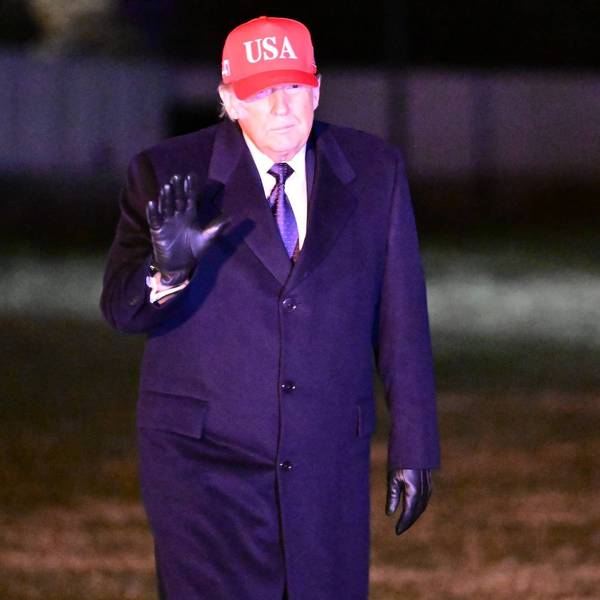
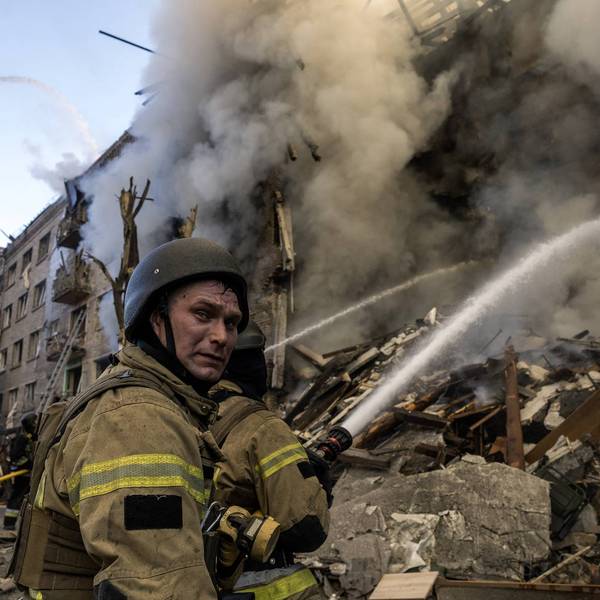

Demonstrators carry signs during an anti-war protest after President Donald Trump launched airstrikes in Syria, April 15, 2018 in New York City. (Photo: Kena Betancur/Getty Images)
Dismantle the War Economy
To create real security, we must slash the Pentagon budget and invest in meeting everyone’s basic human needs.
2020 began with a near-war with Iran - the deadly upshot of a bomb-first-ask-questions-later approach to world affairs.
Then came a pandemic - a public health disaster made all the more lethal by our leadership's utter indifference to the lives of the people, especially the poor and people of color.
Then the murders of George Floyd, Breonna Taylor, and Tony McDade. Three more names to the list of Black lives that didn't matter to the state. An eruption of righteous rage. Even more police brutality in response.
The lesson of these historic months is clear: funneling trillions of dollars into institutions designed to violently protect the status quo - be they police or military - does not make ourselves, our loved ones, or our communities safer. Police budgets account for 30-60% of town and city budgets. As cities and states find themselves in budget crises, education and health care find themselves on the chopping block while police budgets are protected and even increased.
As demands to demilitarize the police and redistribute funds to programs of social uplift gains traction across the country, we call to similarly reimagine our approach to national security. To create real security, we must slash the Pentagon budget, dismantle the war economy, and invest instead in meeting everyone's basic human needs. We're building a movement to do just that.
The US warmaking budget is well over $700 billion a year. That's more than the next 10 countries combined - 53 cents of every dollar in the federal discretionary budget. For comparison, when Donald Trump tried to kick 700,000 poor people out of the lifesaving food stamps program last year, it was justified by an expected saving of $1 billion per year.
Every dollar spent on feeding this war machine is a dollar not spent on housing. On healthcare. On education. On jobs. On preventing pandemics. On confronting the climate crisis. In a country beset by searing poverty, gaping inequality, and widespread environmental injustice, the overblown Pentagon budget is not just a case of mismatched priorities: it's a war on the poor.
In a country beset by searing poverty, gaping inequality, and widespread environmental injustice, the overblown Pentagon budget is not just a case of mismatched priorities: it's a war on the poor.What have we gotten in return? The average American is no less likely to die from terrorism now than before September 11th - the average person in the world, significantly more likely. The Iraq war cost at least 300,000 lives (we will never know the true count), and has by most accounts left it worse off than before the invasion. In 19 years of US occupation of Afghanistan - yes, there are now US soldiers fighting in Afghanistan who were born after 9/11 - tens of thousands have died, countless more have suffered, and the Taliban is no weaker than when we began. And Yemen, which the United States has been directly bombing for 18 years and more recently outsourced even more bombing to Saudi Arabia and the UAE, has become a nightmarish scene of violence, famine, and disease.
The violence-first approach to foreign and domestic policy does not address the root causes of conflict or unrest. It doesn't make the people of the United States safer. It certainly doesn't make the rest of the world safer. At some point we must ask the question: who does this all serve?
Nearly half of the money that flows into the Pentagon's overstuffed coffers goes straight to for-profit war corporations - corporations like Lockheed-Martin whose multi-million dollar lobbying spending is only matched by the excessive salaries of their top executives. Still more corporations planned to get rich off the post-invasion reorganization of Iraq's economy. Meanwhile, the politicians that serve their interests rally support through jingoist slogans and the scapegoating of foreigners. In short, as the modern system of policing is used to suppress Black, brown, and poor communities in order to protect private property and preserve the existing hierarchy of power, so too does the war economy.
Thanks to the brave commitment of protestors in the streets, and the legacies of activists who have been on the frontlines for decades, the once-marginal demand to demilitarize our communities and redirect funding from the police to public programs like healthcare and education has gone mainstream. Across the country, people are recognizing that empowering institutions designed to put violence first does not make us safer. It's time to do the same for the Pentagon.
This week, Congresswoman Barbara Lee unveiled new legislation calling to cut $350 billion from the Pentagon budget, and to invest those funds to meet vital human needs. This echoes the Poor People's Moral Budget, which the Poor People's Campaign, Institute for Policy Studies, and the Kairos Center launched a year ago. Cutting the military budget in half would be a monumental step in the right direction. But it won't succeed without a movement that can force our lawmakers to say yes when they are still so clearly desirous of saying no. That's where we come in.
This Saturday, the Poor People's Campaign, with the support of partners like Win Without War, is hosting the nation's largest digital gathering of poor and dispossessed people, along with all those of conscience. Many thousands from across the country will join together to demand that the United States slash its warmaking budget and redirect its resources toward fighting poverty, uprooting systemic racism, reversing environmental injustice and preserving life through investments in healthcare, housing, education and more.
2020 began with an almost-war. Then a pandemic. Then a series of murders. But then came the uprising. As demands grow to redirect money away from the police and toward the building blocks of a more just, equitable society, we must do the same for the war economy.
Our security will not come from the muzzle of a gun, but from the voice of a movement.
We are at a crossroads
This country and this world are at a monumental crossroads. In a few short weeks, US voters will have an opportunity to beat back the forces of fascism and confront the billionaires who are rigging the economy, our media system, and our democracy, making it increasingly impossible for ordinary people to get by. We’re not just talking about the election. We’re talking about what must be done once these fascist elements are vanquished from power. We need a bolder set of solutions than what either major party has so far been willing to offer and a working-class movement ready to fight like hell for it. Trump didn't emerge from nowhere. The conditions that fueled MAGA authoritarianism were created by decades of radical neoliberal economic policies and a corrupt political system dominated by corporate interests. They slashed taxes on the super-rich, promising that the benefits would trickle down. They said giveaways to the corporate titans would make life more affordable for the rest of us. It was all bullshit. And when a bitter, betrayed populace searches for someone to blame, right-wing demagogues have little trouble finding scapegoats. People know when they're being lied to, but you won't hear any of this from the corporate media. Only independent journalism—powered and funded by people who believe in building a better world—can deliver truly trustworthy daily news. Our Fall Campaign is underway, and we need your help. To power our newsroom through the rest of the year, we need to raise $125,000 by midnight on October 31. So if you share our vision, please contribute whatever you can to sustain our work. |
2020 began with a near-war with Iran - the deadly upshot of a bomb-first-ask-questions-later approach to world affairs.
Then came a pandemic - a public health disaster made all the more lethal by our leadership's utter indifference to the lives of the people, especially the poor and people of color.
Then the murders of George Floyd, Breonna Taylor, and Tony McDade. Three more names to the list of Black lives that didn't matter to the state. An eruption of righteous rage. Even more police brutality in response.
The lesson of these historic months is clear: funneling trillions of dollars into institutions designed to violently protect the status quo - be they police or military - does not make ourselves, our loved ones, or our communities safer. Police budgets account for 30-60% of town and city budgets. As cities and states find themselves in budget crises, education and health care find themselves on the chopping block while police budgets are protected and even increased.
As demands to demilitarize the police and redistribute funds to programs of social uplift gains traction across the country, we call to similarly reimagine our approach to national security. To create real security, we must slash the Pentagon budget, dismantle the war economy, and invest instead in meeting everyone's basic human needs. We're building a movement to do just that.
The US warmaking budget is well over $700 billion a year. That's more than the next 10 countries combined - 53 cents of every dollar in the federal discretionary budget. For comparison, when Donald Trump tried to kick 700,000 poor people out of the lifesaving food stamps program last year, it was justified by an expected saving of $1 billion per year.
Every dollar spent on feeding this war machine is a dollar not spent on housing. On healthcare. On education. On jobs. On preventing pandemics. On confronting the climate crisis. In a country beset by searing poverty, gaping inequality, and widespread environmental injustice, the overblown Pentagon budget is not just a case of mismatched priorities: it's a war on the poor.
In a country beset by searing poverty, gaping inequality, and widespread environmental injustice, the overblown Pentagon budget is not just a case of mismatched priorities: it's a war on the poor.What have we gotten in return? The average American is no less likely to die from terrorism now than before September 11th - the average person in the world, significantly more likely. The Iraq war cost at least 300,000 lives (we will never know the true count), and has by most accounts left it worse off than before the invasion. In 19 years of US occupation of Afghanistan - yes, there are now US soldiers fighting in Afghanistan who were born after 9/11 - tens of thousands have died, countless more have suffered, and the Taliban is no weaker than when we began. And Yemen, which the United States has been directly bombing for 18 years and more recently outsourced even more bombing to Saudi Arabia and the UAE, has become a nightmarish scene of violence, famine, and disease.
The violence-first approach to foreign and domestic policy does not address the root causes of conflict or unrest. It doesn't make the people of the United States safer. It certainly doesn't make the rest of the world safer. At some point we must ask the question: who does this all serve?
Nearly half of the money that flows into the Pentagon's overstuffed coffers goes straight to for-profit war corporations - corporations like Lockheed-Martin whose multi-million dollar lobbying spending is only matched by the excessive salaries of their top executives. Still more corporations planned to get rich off the post-invasion reorganization of Iraq's economy. Meanwhile, the politicians that serve their interests rally support through jingoist slogans and the scapegoating of foreigners. In short, as the modern system of policing is used to suppress Black, brown, and poor communities in order to protect private property and preserve the existing hierarchy of power, so too does the war economy.
Thanks to the brave commitment of protestors in the streets, and the legacies of activists who have been on the frontlines for decades, the once-marginal demand to demilitarize our communities and redirect funding from the police to public programs like healthcare and education has gone mainstream. Across the country, people are recognizing that empowering institutions designed to put violence first does not make us safer. It's time to do the same for the Pentagon.
This week, Congresswoman Barbara Lee unveiled new legislation calling to cut $350 billion from the Pentagon budget, and to invest those funds to meet vital human needs. This echoes the Poor People's Moral Budget, which the Poor People's Campaign, Institute for Policy Studies, and the Kairos Center launched a year ago. Cutting the military budget in half would be a monumental step in the right direction. But it won't succeed without a movement that can force our lawmakers to say yes when they are still so clearly desirous of saying no. That's where we come in.
This Saturday, the Poor People's Campaign, with the support of partners like Win Without War, is hosting the nation's largest digital gathering of poor and dispossessed people, along with all those of conscience. Many thousands from across the country will join together to demand that the United States slash its warmaking budget and redirect its resources toward fighting poverty, uprooting systemic racism, reversing environmental injustice and preserving life through investments in healthcare, housing, education and more.
2020 began with an almost-war. Then a pandemic. Then a series of murders. But then came the uprising. As demands grow to redirect money away from the police and toward the building blocks of a more just, equitable society, we must do the same for the war economy.
Our security will not come from the muzzle of a gun, but from the voice of a movement.