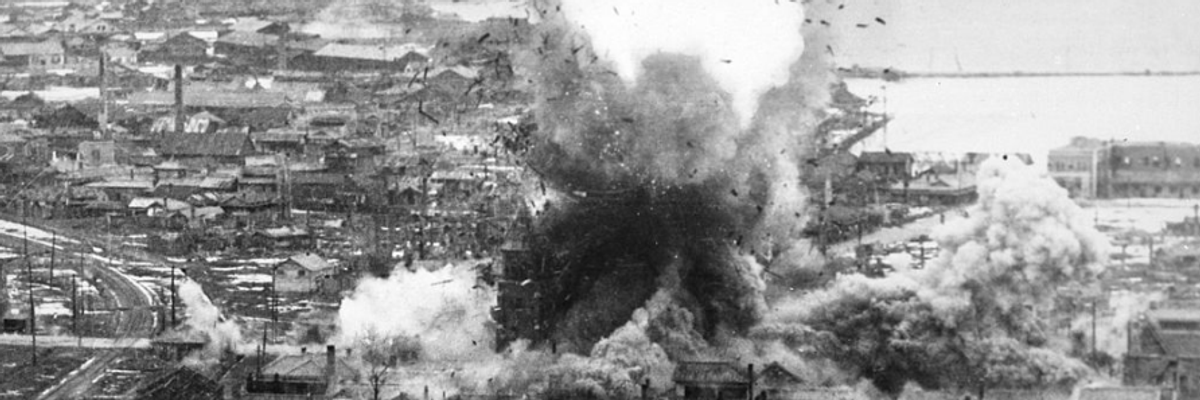
Bombs dropped by a US Air Force B-26 Invader destroy civilian targets in Wonsan, Korea in 1951. (Photo: USAF Photo/Creative Commons)
The Korean War and US 'Total Destruction' Began 70 Years Ago
For Koreans of a certain age, total destruction by the United States isn’t just some abstract threat, it is a hellish reality that ranks among the most egregious crimes of a century that witnessed some of the most appalling barbarity in human history.
For a brief moment in the summer of 1945 there was joy in Korea. Koreans, who had suffered tremendously during half a century of brutal Japanese occupation and World War II, celebrated what they believed was their liberation by victorious US and Soviet forces. Full of hope for a future free of foreign rule, they proudly declared their independence; however, Supreme Allied Commander Douglas MacArthur announced that the US and the USSR would be occupying--and dividing--the entire Korean peninsula. Adding insult to injury, vanquished but no less vicious Japanese forces would be employed to violently repress dissent.
Like so many other imperial endeavors, the division of Korea along the 38th parallel was an exercise in arbitrariness and utter disregard for the wishes of the people it affected. The United States, which claimed to champion freedom, denied it to the people of Korea, who very quickly realized that they were merely trading one occupying empire for another. A survey of Koreans in the summer of 1946 found that 77 percent preferred socialism or communism while only 14 percent favored capitalism. However, the US backed the right-wing dictatorship of Syngman Rhee, a conservative Christian and staunch anti-communist who ruled the South with an iron fist. By early 1950 there were more than 100,000 political prisoners in the South. Summary executions of leftists, both real and imagined, claimed tens of thousands of lives as the South's police state reign of terror rivaled the worst outrages of the communist North, which was unifying under the former anti-Japanese guerrilla leader Kim Il-sung.
General Curtis "Bombs Away" LeMay--who commanded firebombing raids on Japanese cities that killed more civilians than the nuclear bombings of Hiroshima and Nagasaki--served as strategic air commander during the Korean War. He would later acknowledge that "over a period of three years or so, we killed off 20 percent of the population" of North Korea. That's nearly 1.9 million men, women and children.
As efforts to negotiate a unified Korean state failed, a nascent anti-government insurgency grew in the South and was brutally repressed. Brief but bloody border skirmishes escalated; both Rhee and Kim wanted to force unification through invasion. On June 25, 1950, Northern forces launched an all-out invasion of the South. Seoul, the Southern capital, fell three days later. Although the US initially insisted that no US ground troops would be needed in the fight, MacArthur was soon convinced that American boots on the ground were the key to repulsing Northern aggression. President Harry S. Truman agreed, calling the intervention a "police action."
The US military, strutting with atomic swagger and still puffed up with the pride of victory, expected a short war. Green, flabby GIs, more fit for the pomp and parades of Japanese occupation duty than for the horrors of close combat that awaited them in Korea, imagined they would be back to the bars and bordellos of Tokyo in a matter of weeks, maybe a couple of months at the longest. However, Northern forces routed both the South's army and the Americans, who hastily retreated southward toward Busan along with hundreds of thousands of civilian refugees.
One area in which US forces enjoyed near total supremacy was in aerial bombardment. Overcoming initial reluctance from MacArthur, Gen. George Stratemeyer ordered US bombers to "destroy every means of communications and every installation, factory, city, and village" in North Korea. More bombs were dropped on Korea than during the entire World War II Pacific campaign. The massive US carpet bombing of North Korea included napalm, incendiary and fragmentation bombs that killed and maimed by the thousands and left cities, towns, villages and countryside in scorched and shattered ruins. In the Northern capital of Pyongyang, only around 50,000 people out of a prewar population of 500,000 remained in 1953. When all the cities and towns were destroyed, US warplanes bombed dams, reservoirs and rice fields, flooding the countryside and destroying the nation's food supply. Only emergency aid from China, the Soviet Union and other socialist nations averted imminent famine.
US commanders, fearing Northern troops would infiltrate Southern lines disguised as civilians, ordered fighter pilots to bomb and strafe refugees as they fled south. In the most infamous atrocity of the war, Air Force pilots killed hundreds of men, women and children at No Gun Ri over three days in late July 1950. Retreating US troops also blew up bridges teeming with hundreds of refugees and burned villages, towns and cities to the ground in a scorched earth policy meant to deny the advancing enemy quarter.
At least 100,000 South Koreans were murdered by their own armed forces, who targeted anyone suspected of having leftist sympathies. American commanders approved, and US troops were present at horrific mass slaughters throughout the war. Most Americans were fed a more sanitized version of the war, although some of its horrors were celebrated--witness John Ford's propaganda piece This Is Korea! in which footage of a flamethrower attack is accompanied by movie cowboy John Wayne's chilling voice-over: "Fry 'em out! Burn 'em out! Cook 'em!"
General Curtis "Bombs Away" LeMay--who commanded firebombing raids on Japanese cities that killed more civilians than the nuclear bombings of Hiroshima and Nagasaki--served as strategic air commander during the Korean War. He would later acknowledge that "over a period of three years or so, we killed off 20 percent of the population" of North Korea. That's nearly 1.9 million men, women and children. In comparison, the Nazis had murdered 17 percent of Poland's pre-World War II population just a few years earlier. Speaking of Nazis, the destruction of Korea occurred just a few short years after Germans were convicted at Nuremberg, and subsequently executed, for "wanton destruction of cities, towns and villages."
By the time that North and South Korean, American and Chinese generals -- China had intervened when Allied troops approached its borders--signed a ceasefire agreement on July 27, 1953, North Korea was utterly in ruins. "Everything is destroyed," said US bomber commander Gen. Emmett O'Donnell. "There is nothing standing worthy of the name." Sixty-four years later, President Donald Trump, who was in the process of fulfilling his campaign promise to "bomb the shit out of" Islamist militants in the Middle East, threatened to "totally destroy" North Korea over its nuclear missile program. Such threats, coming as they do from the nation that's killed more foreign civilians than any other over the past 75 years, are not to be taken lightly. For Koreans of a certain age, total destruction by the United States isn't just some abstract threat, it is a hellish reality that ranks among the most egregious crimes of a century that witnessed some of the most appalling barbarity in human history.
Watch:
We are at a crossroads
This country and this world are at a monumental crossroads. US voters have an opportunity to beat back the forces of fascism and confront the billionaires who are rigging the economy, our media system, and our democracy, making it increasingly impossible for ordinary people to get by. We’re not just talking about the election. We’re talking about what must be done once these fascist elements are vanquished from power. We need a bolder set of solutions than what either major party has so far been willing to offer and a working-class movement ready to fight like hell for it. Trump didn't emerge from nowhere. The conditions that fueled MAGA authoritarianism were created by decades of radical neoliberal economic policies and a corrupt political system dominated by corporate interests. They slashed taxes on the super-rich, promising that the benefits would trickle down. They said giveaways to the corporate titans would make life more affordable for the rest of us. It was all bullshit. And when a bitter, betrayed populace searches for someone to blame, right-wing demagogues have little trouble finding scapegoats. People know when they're being lied to, but you won't hear any of this from the corporate media. Only independent journalism—powered and funded by people who believe in building a better world—can deliver truly trustworthy daily news. Our Fall Campaign is underway, and we need your help. To power our newsroom through the rest of the year, we need to raise $125,000 by midnight on October 31. So if you share our vision, please contribute whatever you can to sustain our work. |
For a brief moment in the summer of 1945 there was joy in Korea. Koreans, who had suffered tremendously during half a century of brutal Japanese occupation and World War II, celebrated what they believed was their liberation by victorious US and Soviet forces. Full of hope for a future free of foreign rule, they proudly declared their independence; however, Supreme Allied Commander Douglas MacArthur announced that the US and the USSR would be occupying--and dividing--the entire Korean peninsula. Adding insult to injury, vanquished but no less vicious Japanese forces would be employed to violently repress dissent.
Like so many other imperial endeavors, the division of Korea along the 38th parallel was an exercise in arbitrariness and utter disregard for the wishes of the people it affected. The United States, which claimed to champion freedom, denied it to the people of Korea, who very quickly realized that they were merely trading one occupying empire for another. A survey of Koreans in the summer of 1946 found that 77 percent preferred socialism or communism while only 14 percent favored capitalism. However, the US backed the right-wing dictatorship of Syngman Rhee, a conservative Christian and staunch anti-communist who ruled the South with an iron fist. By early 1950 there were more than 100,000 political prisoners in the South. Summary executions of leftists, both real and imagined, claimed tens of thousands of lives as the South's police state reign of terror rivaled the worst outrages of the communist North, which was unifying under the former anti-Japanese guerrilla leader Kim Il-sung.
General Curtis "Bombs Away" LeMay--who commanded firebombing raids on Japanese cities that killed more civilians than the nuclear bombings of Hiroshima and Nagasaki--served as strategic air commander during the Korean War. He would later acknowledge that "over a period of three years or so, we killed off 20 percent of the population" of North Korea. That's nearly 1.9 million men, women and children.
As efforts to negotiate a unified Korean state failed, a nascent anti-government insurgency grew in the South and was brutally repressed. Brief but bloody border skirmishes escalated; both Rhee and Kim wanted to force unification through invasion. On June 25, 1950, Northern forces launched an all-out invasion of the South. Seoul, the Southern capital, fell three days later. Although the US initially insisted that no US ground troops would be needed in the fight, MacArthur was soon convinced that American boots on the ground were the key to repulsing Northern aggression. President Harry S. Truman agreed, calling the intervention a "police action."
The US military, strutting with atomic swagger and still puffed up with the pride of victory, expected a short war. Green, flabby GIs, more fit for the pomp and parades of Japanese occupation duty than for the horrors of close combat that awaited them in Korea, imagined they would be back to the bars and bordellos of Tokyo in a matter of weeks, maybe a couple of months at the longest. However, Northern forces routed both the South's army and the Americans, who hastily retreated southward toward Busan along with hundreds of thousands of civilian refugees.
One area in which US forces enjoyed near total supremacy was in aerial bombardment. Overcoming initial reluctance from MacArthur, Gen. George Stratemeyer ordered US bombers to "destroy every means of communications and every installation, factory, city, and village" in North Korea. More bombs were dropped on Korea than during the entire World War II Pacific campaign. The massive US carpet bombing of North Korea included napalm, incendiary and fragmentation bombs that killed and maimed by the thousands and left cities, towns, villages and countryside in scorched and shattered ruins. In the Northern capital of Pyongyang, only around 50,000 people out of a prewar population of 500,000 remained in 1953. When all the cities and towns were destroyed, US warplanes bombed dams, reservoirs and rice fields, flooding the countryside and destroying the nation's food supply. Only emergency aid from China, the Soviet Union and other socialist nations averted imminent famine.
US commanders, fearing Northern troops would infiltrate Southern lines disguised as civilians, ordered fighter pilots to bomb and strafe refugees as they fled south. In the most infamous atrocity of the war, Air Force pilots killed hundreds of men, women and children at No Gun Ri over three days in late July 1950. Retreating US troops also blew up bridges teeming with hundreds of refugees and burned villages, towns and cities to the ground in a scorched earth policy meant to deny the advancing enemy quarter.
At least 100,000 South Koreans were murdered by their own armed forces, who targeted anyone suspected of having leftist sympathies. American commanders approved, and US troops were present at horrific mass slaughters throughout the war. Most Americans were fed a more sanitized version of the war, although some of its horrors were celebrated--witness John Ford's propaganda piece This Is Korea! in which footage of a flamethrower attack is accompanied by movie cowboy John Wayne's chilling voice-over: "Fry 'em out! Burn 'em out! Cook 'em!"
General Curtis "Bombs Away" LeMay--who commanded firebombing raids on Japanese cities that killed more civilians than the nuclear bombings of Hiroshima and Nagasaki--served as strategic air commander during the Korean War. He would later acknowledge that "over a period of three years or so, we killed off 20 percent of the population" of North Korea. That's nearly 1.9 million men, women and children. In comparison, the Nazis had murdered 17 percent of Poland's pre-World War II population just a few years earlier. Speaking of Nazis, the destruction of Korea occurred just a few short years after Germans were convicted at Nuremberg, and subsequently executed, for "wanton destruction of cities, towns and villages."
By the time that North and South Korean, American and Chinese generals -- China had intervened when Allied troops approached its borders--signed a ceasefire agreement on July 27, 1953, North Korea was utterly in ruins. "Everything is destroyed," said US bomber commander Gen. Emmett O'Donnell. "There is nothing standing worthy of the name." Sixty-four years later, President Donald Trump, who was in the process of fulfilling his campaign promise to "bomb the shit out of" Islamist militants in the Middle East, threatened to "totally destroy" North Korea over its nuclear missile program. Such threats, coming as they do from the nation that's killed more foreign civilians than any other over the past 75 years, are not to be taken lightly. For Koreans of a certain age, total destruction by the United States isn't just some abstract threat, it is a hellish reality that ranks among the most egregious crimes of a century that witnessed some of the most appalling barbarity in human history.
Watch: