SUBSCRIBE TO OUR FREE NEWSLETTER
Daily news & progressive opinion—funded by the people, not the corporations—delivered straight to your inbox.
5
#000000
#FFFFFF
To donate by check, phone, or other method, see our More Ways to Give page.
Daily news & progressive opinion—funded by the people, not the corporations—delivered straight to your inbox.
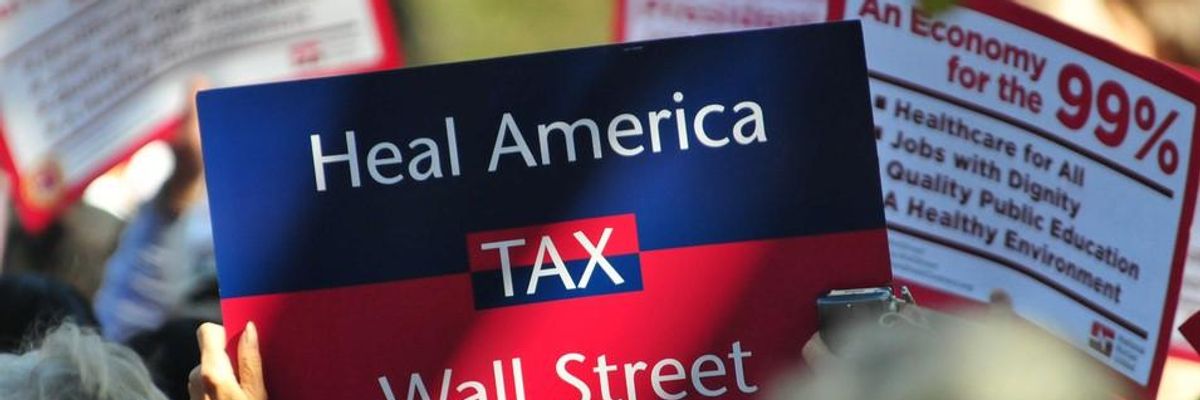
National Nurses United for an International Day of Action, Lafayette Square, Washington, D.C. (Photo: Flickr Glyn Lowe Photo Works, @glynlowe).
The pandemic has claimed nearly 15 million U.S. jobs. Meanwhile, high flying financial traders are making a killing off the market volatility caused by the crisis. A new House bill would tax Wall Street windfalls to guarantee good jobs for people in high unemployment areas.
The Workforce Promotion and Access Act would ensure employment in jobs that pay at least $15 per hour with benefits and address local needs, such as childcare, eldercare, and infrastructure. Democratic Representatives Bonnie Watson Coleman and Ilhan Omar are the bill's lead sponsors.
"A financial transaction tax would significantly reduce high frequency trading, which has no real economic value, drains profits from traditional investors, and benefits only the wealthy."
In 2018, Watson Coleman joined with Senator Cory Booker to introduce the first federal jobs guarantee bill. The new proposal differs from the original model in two important ways.
First, while the 2018 bill aimed to create pilot programs in no more than 15 communities and regions, the new bill expands the scope to respond to the scale of the current economic crisis. It would provide job creation grants to states and localities where the unemployment rate is higher than 10 percent or 100 percent of the national unemployment rate.
Every adult in these hard-hit areas would have the opportunity to have a job, something Erica Smiley, Executive Director for Jobs with Justice, sees as a way to reduce the excessive power corporations hold over their employees.
"Working people who stand up to corporate bosses and get fired as a result face loss of income, loss of housing, loss of medical care, and food insecurity," Smiley said in a press release. "The Workforce Promotion and Access Act blunts the threat of firing and allows working people to demand a role in our economic system."
Smiley also noted that Black people and other communities of color that have been most affected by the twin pandemics would benefit most from the bill. A recent report by the Institute for Policy Studies and the National Community Reinvestment Coalition listed a federal jobs guarantee as one of eight solutions to the racial wealth divide. As of July 2, the Black unemployment rate was 15.4 percent, compared to 12.4 percent for whites.
A second difference in the new bill over the 2018 model is that it includes a mechanism for covering the cost of the jobs program. While lawmakers shouldn't wait to take crisis response action until they can pay for every dime of spending, this particular "pay for" is worth pursuing because it would have multiple benefits.
The proposal would apply a tax of 0.1 percent on each trade of stocks, derivatives, and other financial instruments. The Congressional Budget Office estimates that such a tax could generate $777 billion over 10 years.
Because the tax applies to every Wall Street trade, high frequency traders who flip stocks every second or even millisecond would pay the bulk of the tax. For pension holders with ordinary turnover rates in their portfolios, the cost would be negligible.
By elevating market volatility, the crisis has increased profits for fast traders who use advanced technologies to spot market movements and capitalize on them before traditional investors. As the Wall Street Journal explains it, "High-frequency traders, which typically deploy sophisticated algorithms and powerful computers to move in and out of markets at lightning speeds, tend to do well when markets are volatile." High levels of market volatility are expected to continue throughout 2020.
A financial transaction tax would significantly reduce high frequency trading, which has no real economic value, drains profits from traditional investors, and benefits only the wealthy.
Susan Harley, deputy director of Public Citizen's Congress Watch division, applauded the inclusion of the tax, which has garnered support over the past year from Democratic Presidential candidate Joe Biden and former Treasury Secretary Robert Rubin.
"By implementing a Wall Street tax, the Workforce Promotion and Access Act both provides a focus on equity and redistributing tax responsibility while making real progress on the road to relief for families in America by providing a job to those who need it," Harley said.
Dear Common Dreams reader, It’s been nearly 30 years since I co-founded Common Dreams with my late wife, Lina Newhouser. We had the radical notion that journalism should serve the public good, not corporate profits. It was clear to us from the outset what it would take to build such a project. No paid advertisements. No corporate sponsors. No millionaire publisher telling us what to think or do. Many people said we wouldn't last a year, but we proved those doubters wrong. Together with a tremendous team of journalists and dedicated staff, we built an independent media outlet free from the constraints of profits and corporate control. Our mission has always been simple: To inform. To inspire. To ignite change for the common good. Building Common Dreams was not easy. Our survival was never guaranteed. When you take on the most powerful forces—Wall Street greed, fossil fuel industry destruction, Big Tech lobbyists, and uber-rich oligarchs who have spent billions upon billions rigging the economy and democracy in their favor—the only bulwark you have is supporters who believe in your work. But here’s the urgent message from me today. It's never been this bad out there. And it's never been this hard to keep us going. At the very moment Common Dreams is most needed, the threats we face are intensifying. We need your support now more than ever. We don't accept corporate advertising and never will. We don't have a paywall because we don't think people should be blocked from critical news based on their ability to pay. Everything we do is funded by the donations of readers like you. When everyone does the little they can afford, we are strong. But if that support retreats or dries up, so do we. Will you donate now to make sure Common Dreams not only survives but thrives? —Craig Brown, Co-founder |
The pandemic has claimed nearly 15 million U.S. jobs. Meanwhile, high flying financial traders are making a killing off the market volatility caused by the crisis. A new House bill would tax Wall Street windfalls to guarantee good jobs for people in high unemployment areas.
The Workforce Promotion and Access Act would ensure employment in jobs that pay at least $15 per hour with benefits and address local needs, such as childcare, eldercare, and infrastructure. Democratic Representatives Bonnie Watson Coleman and Ilhan Omar are the bill's lead sponsors.
"A financial transaction tax would significantly reduce high frequency trading, which has no real economic value, drains profits from traditional investors, and benefits only the wealthy."
In 2018, Watson Coleman joined with Senator Cory Booker to introduce the first federal jobs guarantee bill. The new proposal differs from the original model in two important ways.
First, while the 2018 bill aimed to create pilot programs in no more than 15 communities and regions, the new bill expands the scope to respond to the scale of the current economic crisis. It would provide job creation grants to states and localities where the unemployment rate is higher than 10 percent or 100 percent of the national unemployment rate.
Every adult in these hard-hit areas would have the opportunity to have a job, something Erica Smiley, Executive Director for Jobs with Justice, sees as a way to reduce the excessive power corporations hold over their employees.
"Working people who stand up to corporate bosses and get fired as a result face loss of income, loss of housing, loss of medical care, and food insecurity," Smiley said in a press release. "The Workforce Promotion and Access Act blunts the threat of firing and allows working people to demand a role in our economic system."
Smiley also noted that Black people and other communities of color that have been most affected by the twin pandemics would benefit most from the bill. A recent report by the Institute for Policy Studies and the National Community Reinvestment Coalition listed a federal jobs guarantee as one of eight solutions to the racial wealth divide. As of July 2, the Black unemployment rate was 15.4 percent, compared to 12.4 percent for whites.
A second difference in the new bill over the 2018 model is that it includes a mechanism for covering the cost of the jobs program. While lawmakers shouldn't wait to take crisis response action until they can pay for every dime of spending, this particular "pay for" is worth pursuing because it would have multiple benefits.
The proposal would apply a tax of 0.1 percent on each trade of stocks, derivatives, and other financial instruments. The Congressional Budget Office estimates that such a tax could generate $777 billion over 10 years.
Because the tax applies to every Wall Street trade, high frequency traders who flip stocks every second or even millisecond would pay the bulk of the tax. For pension holders with ordinary turnover rates in their portfolios, the cost would be negligible.
By elevating market volatility, the crisis has increased profits for fast traders who use advanced technologies to spot market movements and capitalize on them before traditional investors. As the Wall Street Journal explains it, "High-frequency traders, which typically deploy sophisticated algorithms and powerful computers to move in and out of markets at lightning speeds, tend to do well when markets are volatile." High levels of market volatility are expected to continue throughout 2020.
A financial transaction tax would significantly reduce high frequency trading, which has no real economic value, drains profits from traditional investors, and benefits only the wealthy.
Susan Harley, deputy director of Public Citizen's Congress Watch division, applauded the inclusion of the tax, which has garnered support over the past year from Democratic Presidential candidate Joe Biden and former Treasury Secretary Robert Rubin.
"By implementing a Wall Street tax, the Workforce Promotion and Access Act both provides a focus on equity and redistributing tax responsibility while making real progress on the road to relief for families in America by providing a job to those who need it," Harley said.
The pandemic has claimed nearly 15 million U.S. jobs. Meanwhile, high flying financial traders are making a killing off the market volatility caused by the crisis. A new House bill would tax Wall Street windfalls to guarantee good jobs for people in high unemployment areas.
The Workforce Promotion and Access Act would ensure employment in jobs that pay at least $15 per hour with benefits and address local needs, such as childcare, eldercare, and infrastructure. Democratic Representatives Bonnie Watson Coleman and Ilhan Omar are the bill's lead sponsors.
"A financial transaction tax would significantly reduce high frequency trading, which has no real economic value, drains profits from traditional investors, and benefits only the wealthy."
In 2018, Watson Coleman joined with Senator Cory Booker to introduce the first federal jobs guarantee bill. The new proposal differs from the original model in two important ways.
First, while the 2018 bill aimed to create pilot programs in no more than 15 communities and regions, the new bill expands the scope to respond to the scale of the current economic crisis. It would provide job creation grants to states and localities where the unemployment rate is higher than 10 percent or 100 percent of the national unemployment rate.
Every adult in these hard-hit areas would have the opportunity to have a job, something Erica Smiley, Executive Director for Jobs with Justice, sees as a way to reduce the excessive power corporations hold over their employees.
"Working people who stand up to corporate bosses and get fired as a result face loss of income, loss of housing, loss of medical care, and food insecurity," Smiley said in a press release. "The Workforce Promotion and Access Act blunts the threat of firing and allows working people to demand a role in our economic system."
Smiley also noted that Black people and other communities of color that have been most affected by the twin pandemics would benefit most from the bill. A recent report by the Institute for Policy Studies and the National Community Reinvestment Coalition listed a federal jobs guarantee as one of eight solutions to the racial wealth divide. As of July 2, the Black unemployment rate was 15.4 percent, compared to 12.4 percent for whites.
A second difference in the new bill over the 2018 model is that it includes a mechanism for covering the cost of the jobs program. While lawmakers shouldn't wait to take crisis response action until they can pay for every dime of spending, this particular "pay for" is worth pursuing because it would have multiple benefits.
The proposal would apply a tax of 0.1 percent on each trade of stocks, derivatives, and other financial instruments. The Congressional Budget Office estimates that such a tax could generate $777 billion over 10 years.
Because the tax applies to every Wall Street trade, high frequency traders who flip stocks every second or even millisecond would pay the bulk of the tax. For pension holders with ordinary turnover rates in their portfolios, the cost would be negligible.
By elevating market volatility, the crisis has increased profits for fast traders who use advanced technologies to spot market movements and capitalize on them before traditional investors. As the Wall Street Journal explains it, "High-frequency traders, which typically deploy sophisticated algorithms and powerful computers to move in and out of markets at lightning speeds, tend to do well when markets are volatile." High levels of market volatility are expected to continue throughout 2020.
A financial transaction tax would significantly reduce high frequency trading, which has no real economic value, drains profits from traditional investors, and benefits only the wealthy.
Susan Harley, deputy director of Public Citizen's Congress Watch division, applauded the inclusion of the tax, which has garnered support over the past year from Democratic Presidential candidate Joe Biden and former Treasury Secretary Robert Rubin.
"By implementing a Wall Street tax, the Workforce Promotion and Access Act both provides a focus on equity and redistributing tax responsibility while making real progress on the road to relief for families in America by providing a job to those who need it," Harley said.