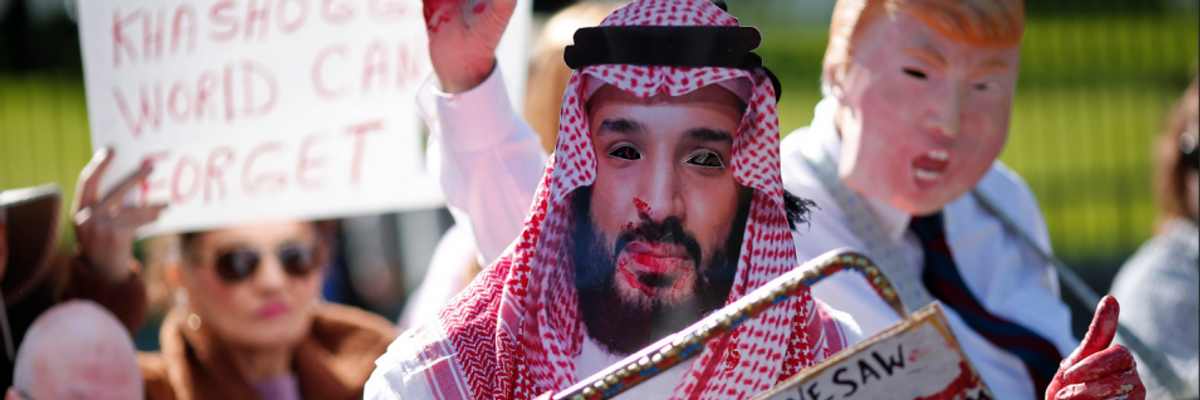
A protester dressed as Saudi Crown Prince Mohammad bin Salman and another dressed as U.S. President Donald Trump stand outside the White House in the wake of the disappearance of the Saudi journalist Jamal Khashoggi on October 19, 2018. (Photo: Win McNamee/Getty Images)
Saudi Crown Prince's Hit Squads Reflect His Foreign Policy--And Ours
When the unlawful killing of political enemies on foreign soil could refer to President Trump's unlawful assassination of an Iranian general just as easily as it could refer to Mohammad bin Salman ordering hits on Khashoggi and Dr. Aljabri, it's time to think about what our foreign policy has become.
The Saudi Crown Prince Mohammed bin Salman, often referred to as MbS, is facing the court of international public opinion once again. This time, he stands accused of sending a hit squad to Canada to assassinate former Saudi intelligence official Dr. Saad Aljabri--not to be confused with the hit squad he sent to Turkey to murder Washington Post columnist Jamal Khashoggi. As the distinction suggests, uninhibited violence towards anyone MbS perceives as a threat to his rule is what we've come to expect from the de facto leader of one of America's closest allies in the Middle East.
Sadly, this story goes deeper and darker than a Saudi hit squad playing "that's not my bone saw" with Canadian customs. MbS' brand of scorched-earth political retribution and brazen violence on foreign soil is also a feature of his foreign policy. In case anyone needed reminding, it's a feature of American foreign policy too.
Since becoming the Kingdom's crown prince in 2017, the Saudi Crown Prince has been systematically silencing, arresting, torturing, and killing people he believes might pose a threat to his power. In his first year in power, he infamously arrested dozens of family members along with hundreds of others and held them at the Ritz-Carlton in Riyadh. Dr. Aljabri, regarded by some in Washington as an important ally in the fight against al Qaeda, was the right hand man of Mohammed bin Nayef, MbS' uncle, who was charged with treason earlier this year. Dr. Aljabri's crime was apparently knowing too much about the royal family that could undermine MbS' rule. Jamal Khashoggi's crime was speaking out against the Crown Prince, and against Saudi Arabia's devastating war in Yemen.
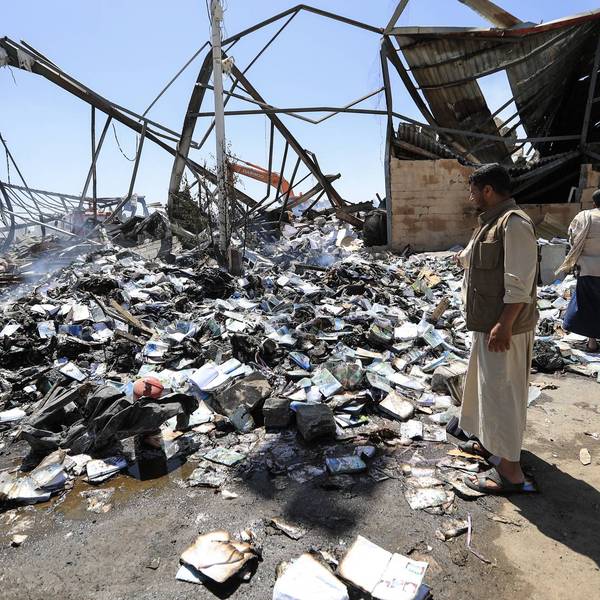
If Saudi Arabia's conduct in the war in Yemen were a person, it's name would be Mohammed bin Salman. Since March 2015, Saudi Arabia has been waging a brutal war against Yemen's Houthi rebels in an effort to reinstall its ally, Yemeni President Abdrabbuh Mansur Hadi. A Saudi-led coalition has killed thousands of Yemeni civilians in an indiscriminate bombing campaign notorious for targeting hospitals, weddings, funerals, and even a school bus full of children. It's also repeatedly targeted Yemen's food systems and impeded the delivery of humanitarian aid, pushing millions to the brink of starvation.
Unfortunately, holding Saudi Arabia accountable for its conduct in the war in Yemen has proved almost as elusive as holding the Crown Prince accountable for his international assassination squads. For instance, when the UN put Saudi Arabia on its blacklist of countries that violate children's human rights for its role in the killing of children in Yemen, news broke that Saudi Arabia threatened to withhold humanitarian funding from the UN unless it was removed from the list. Then UN Secretary General Ban Ki-moon regrettably acquiesced in what he called "one of the most painful and difficult decisions I have had to make." While the UN put Saudi Arabia back on its blacklist the following year, the Saudi-led coalition's unabated bombing of Yemen suggests deeper accountability is still a ways off.
The same could be said for U.S. accountability for the war in Yemen. Since the start of the Saudi-led intervention, the U.S. has been a key backer of the war effort, offering arms sales and military support to the coalition despite its well-documented attacks against civilians, and despite international calls for peace in a country facing the worst humanitarian crisis on the planet. While Congress eventually passed a war powers resolution calling for the withdrawal of unauthorized U.S. support for the war in Yemen, the president's veto has kept our nation involved in this ever-deepening catastrophe.
Direct U.S. support for Saudi Arabia speaks volumes about U.S. foreign policy, but the reflection goes deeper still. The Crown Prince's authoritarianism reflects our own when our president deploys secret police in the streets of Portland to intimidate, assault, and detain protesters. The Crown Prince's hit squads reflect a long-standing U.S. assassination program, euphemistically referred to as drone warfare or "targeted killing." When the unlawful killing of political enemies on foreign soil could refer to President Trump's unlawful assassination of an Iranian general just as easily as it could refer to the Saudi Crown Prince ordering hits on Khashoggi and Dr. Aljabri, it's time to think about what our foreign policy has become.
Saudi-style authoritarianism in our streets is what we have to look forward to if we continue to let our democracy slip. As for U.S. foreign policy, our task isn't preventing authoritarianism--it's ending it.
We are at a crossroads
This country and this world are at a monumental crossroads. In a few short weeks, US voters will have an opportunity to beat back the forces of fascism and confront the billionaires who are rigging the economy, our media system, and our democracy, making it increasingly impossible for ordinary people to get by. We’re not just talking about the election. We’re talking about what must be done once these fascist elements are vanquished from power. We need a bolder set of solutions than what either major party has so far been willing to offer and a working-class movement ready to fight like hell for it. Trump didn't emerge from nowhere. The conditions that fueled MAGA authoritarianism were created by decades of radical neoliberal economic policies and a corrupt political system dominated by corporate interests. They slashed taxes on the super-rich, promising that the benefits would trickle down. They said giveaways to the corporate titans would make life more affordable for the rest of us. It was all bullshit. And when a bitter, betrayed populace searches for someone to blame, right-wing demagogues have little trouble finding scapegoats. People know when they're being lied to, but you won't hear any of this from the corporate media. Only independent journalism—powered and funded by people who believe in building a better world—can deliver truly trustworthy daily news. Our Fall Campaign is underway, and we need your help. To power our newsroom through the rest of the year, we need to raise $125,000 by midnight on October 31. So if you share our vision, please contribute whatever you can to sustain our work. |
The Saudi Crown Prince Mohammed bin Salman, often referred to as MbS, is facing the court of international public opinion once again. This time, he stands accused of sending a hit squad to Canada to assassinate former Saudi intelligence official Dr. Saad Aljabri--not to be confused with the hit squad he sent to Turkey to murder Washington Post columnist Jamal Khashoggi. As the distinction suggests, uninhibited violence towards anyone MbS perceives as a threat to his rule is what we've come to expect from the de facto leader of one of America's closest allies in the Middle East.
Sadly, this story goes deeper and darker than a Saudi hit squad playing "that's not my bone saw" with Canadian customs. MbS' brand of scorched-earth political retribution and brazen violence on foreign soil is also a feature of his foreign policy. In case anyone needed reminding, it's a feature of American foreign policy too.
Since becoming the Kingdom's crown prince in 2017, the Saudi Crown Prince has been systematically silencing, arresting, torturing, and killing people he believes might pose a threat to his power. In his first year in power, he infamously arrested dozens of family members along with hundreds of others and held them at the Ritz-Carlton in Riyadh. Dr. Aljabri, regarded by some in Washington as an important ally in the fight against al Qaeda, was the right hand man of Mohammed bin Nayef, MbS' uncle, who was charged with treason earlier this year. Dr. Aljabri's crime was apparently knowing too much about the royal family that could undermine MbS' rule. Jamal Khashoggi's crime was speaking out against the Crown Prince, and against Saudi Arabia's devastating war in Yemen.
If Saudi Arabia's conduct in the war in Yemen were a person, it's name would be Mohammed bin Salman. Since March 2015, Saudi Arabia has been waging a brutal war against Yemen's Houthi rebels in an effort to reinstall its ally, Yemeni President Abdrabbuh Mansur Hadi. A Saudi-led coalition has killed thousands of Yemeni civilians in an indiscriminate bombing campaign notorious for targeting hospitals, weddings, funerals, and even a school bus full of children. It's also repeatedly targeted Yemen's food systems and impeded the delivery of humanitarian aid, pushing millions to the brink of starvation.
Unfortunately, holding Saudi Arabia accountable for its conduct in the war in Yemen has proved almost as elusive as holding the Crown Prince accountable for his international assassination squads. For instance, when the UN put Saudi Arabia on its blacklist of countries that violate children's human rights for its role in the killing of children in Yemen, news broke that Saudi Arabia threatened to withhold humanitarian funding from the UN unless it was removed from the list. Then UN Secretary General Ban Ki-moon regrettably acquiesced in what he called "one of the most painful and difficult decisions I have had to make." While the UN put Saudi Arabia back on its blacklist the following year, the Saudi-led coalition's unabated bombing of Yemen suggests deeper accountability is still a ways off.
The same could be said for U.S. accountability for the war in Yemen. Since the start of the Saudi-led intervention, the U.S. has been a key backer of the war effort, offering arms sales and military support to the coalition despite its well-documented attacks against civilians, and despite international calls for peace in a country facing the worst humanitarian crisis on the planet. While Congress eventually passed a war powers resolution calling for the withdrawal of unauthorized U.S. support for the war in Yemen, the president's veto has kept our nation involved in this ever-deepening catastrophe.
Direct U.S. support for Saudi Arabia speaks volumes about U.S. foreign policy, but the reflection goes deeper still. The Crown Prince's authoritarianism reflects our own when our president deploys secret police in the streets of Portland to intimidate, assault, and detain protesters. The Crown Prince's hit squads reflect a long-standing U.S. assassination program, euphemistically referred to as drone warfare or "targeted killing." When the unlawful killing of political enemies on foreign soil could refer to President Trump's unlawful assassination of an Iranian general just as easily as it could refer to the Saudi Crown Prince ordering hits on Khashoggi and Dr. Aljabri, it's time to think about what our foreign policy has become.
Saudi-style authoritarianism in our streets is what we have to look forward to if we continue to let our democracy slip. As for U.S. foreign policy, our task isn't preventing authoritarianism--it's ending it.