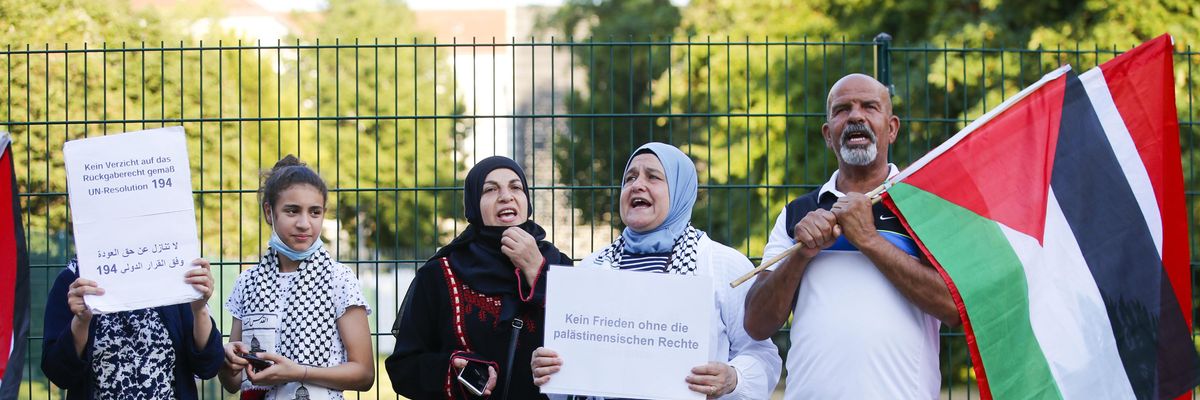
A group of Palestinians gathers in front of the UAE's Embassy in Berlin to protest against the UAE-Israel normalization deal, on August 17, 2020, in Berlin, Germany. (Photo by Abdulhamid Hosbas/Anadolu Agency via Getty Images)
For Israel and the UAE, Peace for Profit Comes with Authoritarian Maneuvering and State-Surveillance
They are officially leaving the Palestinians at the station.
Trump is already pruning the roses for his photo-op. Pre-election optics a la Oslo. Much like Oslo, it will be a convivial affair. Political charlatans will wax paternalistic on behalf of Palestinians. And Israel will tout it as a paean to economic peace and national sacrifice by suspending the de jure annexation that is already de facto. Peace, incidentally, is the best deflection game there is. It is also driven by market incentives and the shared architecture of control Israel and the Gulf States regularly deploy on their citizens and subjects.
Indeed, any political animus between Israel and the United Arab Emirates is mostly bluster. The Israelis have had a diplomatic presence in the UAE since 2015 with the establishment of the International Renewable Energy Consortium's Israeli office in Abu Dhabi. The Emiratis have also been running aerial exercises with the Israelis since at least 2016, and the Israeli Ministry of Defense regularly doles out permits for arms and military-grade surveillance sales to the Gulf States. After all, Israel exports 80 percent of its arms production abroad. And the UAE has been eager to develop a knowledge economy through infrastructure, tech-savvy, and special economic zones.
Despite the ubiquitous economic strains of the Covid-19 pandemic, the Israeli economy is remarkably insulated. High tech research and development, supported by foreign direct investment and venture capital, allows for sophisticated product integration nearly immune to consumer boycotts. The reality is that Israel operates with impunity because anti-normalization is costly. That was the calculus Anwar Sadat made in 1979 when he decided that economic peace was cheaper than justice and reckoning in Israel/Palestine.
In a similar vein, DarkMatter, the UAE cybersecurity firm that assisted Dubai police in identifying the Mossad agents responsible in the 2010 extrajudicial killing of Hamas official, Mahmoud al-Mabhouh, has been busy recruiting young Israelis directly from Unit 8200 and DarkMatter's top competitor, the Israeli NSO Group, for contracts upwards of $1 million.
Tech moguls have been flying privately chartered flights between Tel Aviv and Abu Dhabi since at least 2014. In fact, the Israeli-American tech mogul of AGT International and Logic Technologies, Mati Kochavi, has been working with the UAE since 2012 when his company landed an $800 million contract to launch Falcon Eye, a city-wide trajectory-mapping surveillance project in Abu Dhabi. Private deals like this one in Abu Dhabi involving foreign subcontracting are often treated in isolation from a broader schema of regional geopolitics, and they shouldn't be.
In Bahrain, Kuwait, Qatar, and the UAE, foreign nationals comprise the majority of the population--representing 80 percent in Qatar and the UAE. And still, GCC Secretary-General, Abdul Rahman Al Attiya, has stated that non-Arab foreign workers pose an imminent national security threat to the Gulf.
The special economic zones that propel flows of migration and fragment labor precipitate other workers out of the labor pool entirely. Building on the conventional wisdom of neoliberalism that contends unproductive human capital be discarded from the labor pool, Naomi Klein suggests that "Israel has taken this disposal process a step further: it has built walls around the dangerous poor."
These perceived threats to the nation require new technologies of governance as modes and expressions of biopolitical control and forge new transnational networks along with them. As the French philosopher, Gilles Deleuze noted in his 1992 essay Postscript on the Societies of Control, "The operation of markets is now the instrument of social control and forms the impudent breed of our masters... It is true that capitalism has retained as a constant the extreme poverty of three-quarters of humanity, too poor for debt, too numerous for confinement: control will not only have to deal with erosions of frontiers but with the explosions within shanty towns or ghettos." A Global War on Terror has helped obscure growing authoritarianism and widening inequality. Projecting security-cooperation as normative diplomacy elides authoritarian maneuvering and state-surveillance.
Following the breakdown of the Kerry negotiations in 2014, Robert Siegel from NPR's All Things Considered spoke with Tzipi Livni, the former Israeli Minister of Justice and chief negotiator. When questioned on the prospect of further regional cooperation, Livni offered up a banality on moral leadership: "This is what I believe in. The world is divided between the good guys and the bad guys. And we, Israel - of course, the United States - the legitimate Palestinian government, Egypt, Jordan, and the Gulf States. We are part of the camp of so-called moderates or diplomats against these terrorists." Livni is not alone in her analysis.
In a 2018 interview with Jeffrey Goldberg of the Atlantic, Mohamed bin Salman, the crown prince of Saudi Arabia, a close ally of Mohammed bin Zayed, and a personal friend of Jared Kushner, was quick to reinforce this chasm between good guys and the "shadow caliphates" of the "triangle of evil:" Iran, the Muslim Brotherhood, and Sunni terror groups with Islamist parties like the Brotherhood. National security is always political and economic. We insist on looking at Israel-Gulf relations exclusively as an instrument of Iranian containment and regional trade while ignoring the role of the surveillance-industrial-complex in capitalist class formation.
Peace for some is best served with separation barriers, F-16s, and apache helicopters to economically warehouse those deemed political liabilities. It is also served with "low-intensity" conflict military software in the form of biometrics, drones, and CCTVs on everyone else. Israeli-Emirati peace confirms what was already implicit: that Israel and the UAE are economically and militarily aligned, and that the Emiratis' route to Haram al-Sharif is via the Donald J Trump light rail station. Only this time, they are officially leaving the Palestinians at the station.
We are at a crossroads
This country and this world are at a monumental crossroads. In a few short weeks, US voters will have an opportunity to beat back the forces of fascism and confront the billionaires who are rigging the economy, our media system, and our democracy, making it increasingly impossible for ordinary people to get by. We’re not just talking about the election. We’re talking about what must be done once these fascist elements are vanquished from power. We need a bolder set of solutions than what either major party has so far been willing to offer and a working-class movement ready to fight like hell for it. Trump didn't emerge from nowhere. The conditions that fueled MAGA authoritarianism were created by decades of radical neoliberal economic policies and a corrupt political system dominated by corporate interests. They slashed taxes on the super-rich, promising that the benefits would trickle down. They said giveaways to the corporate titans would make life more affordable for the rest of us. It was all bullshit. And when a bitter, betrayed populace searches for someone to blame, right-wing demagogues have little trouble finding scapegoats. People know when they're being lied to, but you won't hear any of this from the corporate media. Only independent journalism—powered and funded by people who believe in building a better world—can deliver truly trustworthy daily news. Our Fall Campaign is underway, and we need your help. To power our newsroom through the rest of the year, we need to raise $125,000 by midnight on October 31. So if you share our vision, please contribute whatever you can to sustain our work. |
Trump is already pruning the roses for his photo-op. Pre-election optics a la Oslo. Much like Oslo, it will be a convivial affair. Political charlatans will wax paternalistic on behalf of Palestinians. And Israel will tout it as a paean to economic peace and national sacrifice by suspending the de jure annexation that is already de facto. Peace, incidentally, is the best deflection game there is. It is also driven by market incentives and the shared architecture of control Israel and the Gulf States regularly deploy on their citizens and subjects.
Indeed, any political animus between Israel and the United Arab Emirates is mostly bluster. The Israelis have had a diplomatic presence in the UAE since 2015 with the establishment of the International Renewable Energy Consortium's Israeli office in Abu Dhabi. The Emiratis have also been running aerial exercises with the Israelis since at least 2016, and the Israeli Ministry of Defense regularly doles out permits for arms and military-grade surveillance sales to the Gulf States. After all, Israel exports 80 percent of its arms production abroad. And the UAE has been eager to develop a knowledge economy through infrastructure, tech-savvy, and special economic zones.
Despite the ubiquitous economic strains of the Covid-19 pandemic, the Israeli economy is remarkably insulated. High tech research and development, supported by foreign direct investment and venture capital, allows for sophisticated product integration nearly immune to consumer boycotts. The reality is that Israel operates with impunity because anti-normalization is costly. That was the calculus Anwar Sadat made in 1979 when he decided that economic peace was cheaper than justice and reckoning in Israel/Palestine.
In a similar vein, DarkMatter, the UAE cybersecurity firm that assisted Dubai police in identifying the Mossad agents responsible in the 2010 extrajudicial killing of Hamas official, Mahmoud al-Mabhouh, has been busy recruiting young Israelis directly from Unit 8200 and DarkMatter's top competitor, the Israeli NSO Group, for contracts upwards of $1 million.
Tech moguls have been flying privately chartered flights between Tel Aviv and Abu Dhabi since at least 2014. In fact, the Israeli-American tech mogul of AGT International and Logic Technologies, Mati Kochavi, has been working with the UAE since 2012 when his company landed an $800 million contract to launch Falcon Eye, a city-wide trajectory-mapping surveillance project in Abu Dhabi. Private deals like this one in Abu Dhabi involving foreign subcontracting are often treated in isolation from a broader schema of regional geopolitics, and they shouldn't be.
In Bahrain, Kuwait, Qatar, and the UAE, foreign nationals comprise the majority of the population--representing 80 percent in Qatar and the UAE. And still, GCC Secretary-General, Abdul Rahman Al Attiya, has stated that non-Arab foreign workers pose an imminent national security threat to the Gulf.
The special economic zones that propel flows of migration and fragment labor precipitate other workers out of the labor pool entirely. Building on the conventional wisdom of neoliberalism that contends unproductive human capital be discarded from the labor pool, Naomi Klein suggests that "Israel has taken this disposal process a step further: it has built walls around the dangerous poor."
These perceived threats to the nation require new technologies of governance as modes and expressions of biopolitical control and forge new transnational networks along with them. As the French philosopher, Gilles Deleuze noted in his 1992 essay Postscript on the Societies of Control, "The operation of markets is now the instrument of social control and forms the impudent breed of our masters... It is true that capitalism has retained as a constant the extreme poverty of three-quarters of humanity, too poor for debt, too numerous for confinement: control will not only have to deal with erosions of frontiers but with the explosions within shanty towns or ghettos." A Global War on Terror has helped obscure growing authoritarianism and widening inequality. Projecting security-cooperation as normative diplomacy elides authoritarian maneuvering and state-surveillance.
Following the breakdown of the Kerry negotiations in 2014, Robert Siegel from NPR's All Things Considered spoke with Tzipi Livni, the former Israeli Minister of Justice and chief negotiator. When questioned on the prospect of further regional cooperation, Livni offered up a banality on moral leadership: "This is what I believe in. The world is divided between the good guys and the bad guys. And we, Israel - of course, the United States - the legitimate Palestinian government, Egypt, Jordan, and the Gulf States. We are part of the camp of so-called moderates or diplomats against these terrorists." Livni is not alone in her analysis.
In a 2018 interview with Jeffrey Goldberg of the Atlantic, Mohamed bin Salman, the crown prince of Saudi Arabia, a close ally of Mohammed bin Zayed, and a personal friend of Jared Kushner, was quick to reinforce this chasm between good guys and the "shadow caliphates" of the "triangle of evil:" Iran, the Muslim Brotherhood, and Sunni terror groups with Islamist parties like the Brotherhood. National security is always political and economic. We insist on looking at Israel-Gulf relations exclusively as an instrument of Iranian containment and regional trade while ignoring the role of the surveillance-industrial-complex in capitalist class formation.
Peace for some is best served with separation barriers, F-16s, and apache helicopters to economically warehouse those deemed political liabilities. It is also served with "low-intensity" conflict military software in the form of biometrics, drones, and CCTVs on everyone else. Israeli-Emirati peace confirms what was already implicit: that Israel and the UAE are economically and militarily aligned, and that the Emiratis' route to Haram al-Sharif is via the Donald J Trump light rail station. Only this time, they are officially leaving the Palestinians at the station.