
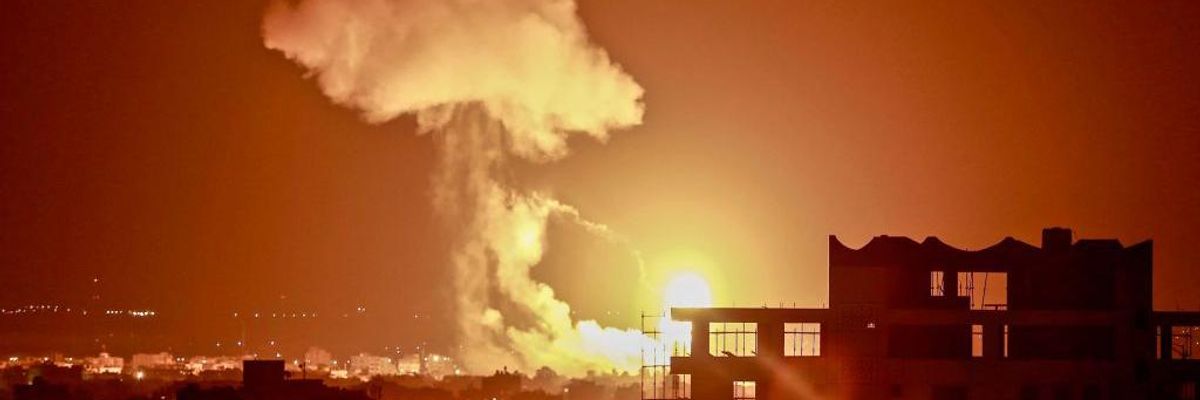
An explosion goes off during an airstrike carried out by Israeli warplanes. (Photo: Mohammed Talatene/picture alliance via Getty Images)
Netanyahu vs Gantz: Gaza Escalation as Reflection of Israel's Political Rivalry
For as long as Israeli leaders continue to see a war on Gaza as a political opportunity and a platform for their own electoral games, the siege will carry on, relentlessly.
Only recently, the Palestinian group, Hamas, and Israel seemed close to reaching a prisoner exchange agreement, where Hamas would release several Israeli soldiers held in Gaza while Israel would set free an unspecified number of Palestinian detainees held in Israeli prisons.
Instead of the much-anticipated announcement of some kind of a deal, on August 10, Israeli bombs began falling on the besieged Strip and incendiary balloons, originating in Gaza, made their way to the Israeli side of the fence.
So, what happened?
The answer lies largely--though not entirely--in Israel, specifically in the political conflict between Israeli Prime Minister, Benjamin Netanyahu and his right-wing political camp, on the one hand, and their government's coalition partners, led by Defense Minister, Benny Gantz, on the other.
The discord between Netanyahu and Gantz is concentrated on a fierce budget conflict currently underway in the Knesset, which has little to do with government spending or fiscal responsibilities.
Gantz, who is supposed to serve his term as Prime Minister, starting November 2021, believes that Netanyahu plans on passing a one-year budget to disrupt the coalition agreement and to call for new elections before the leadership swap takes place. Therefore, Gantz insists on extending the budget coverage to two years, to avoid any possible betrayal by Netanyahu's Likud party.
Netanyahu's plot, which was revealed by the daily newspaper Haaretz on July 29, is not entirely motivated by the Israeli leader's love for power, but by his mistrust of Gantz's own motives. If Gantz becomes the country's Prime Minister, he is likely to appoint new judges who are sympathetic towards his Blue and White and, thus, eager to indict Netanyahu in his ongoing corruption trial.
For both Netanyahu and Gantz, this is, perhaps, the most crucial fight of their political careers: the former fighting for his freedom, the latter fighting for survival.
One issue, however, is acceptable to both leaders: the understanding that military strength will always garner greater support from the Israeli public, especially if another election becomes inevitable. A successive, fourth election is likely to take place if the budget battle is not resolved.
As a military showdown in South Lebanon becomes unattainable due to the massive explosion that rocked Beirut on August 4, the two Israeli leaders have turned their attention to Gaza. Moving quickly, as if on the campaign trail, Gantz and Netanyahu are busy making their case to Israelis living in the southern towns bordering the Gaza Strip.
Gantz paid the leaders of these communities a visit on August 19. He was joined by a carefully selected delegation of top Israeli government and military officials, including Agriculture Minister, Alon Schuster, and Gaza Division Commander, Brig.-Gen. Nimrod Aloni, who joined via video conference.
Aside from the customary threats of targeting anyone in Gaza who dares threaten Israeli security, Gantz has engaged in election campaign type of self-promotion. "We have changed the equation in Gaza. Since I entered office, there has been a response to every breach in our security," Gantz said, emphasizing his own achievements, as opposed to those of the coalition government--thus denying Netanyahu any credit.
Netanyahu, on the other hand, has threatened harsh retaliation against Gaza if Hamas does not prevent protesters from releasing incendiary balloons. "We have adopted a policy under which a fire is treated as a rocket," he told the mayors of southern towns on August 18.
Netanyahu is keeping the Gaza war option open, in case it becomes his only recourse. Gantz, as Defense Minister and Netanyahu's rival is, however, enjoying greater political space to maneuver. From August 10, he has ordered his military to bomb Gaza every night. With every bomb dropped on Gaza, Gantz's credibility among Israeli voters, especially in the south, increases slightly.
If the current conflagration leads to an all-out war, it will be the entire coalition government--including Netanyahu and his Likud party--that will bear responsibility for its potential disastrous consequences. This places Gantz in a powerful position.
The current military showdown in Gaza is not entirely the outcome of Israel's own political fight. Gaza society is currently at a breaking point.
The truce between Gaza groups and Israel, which was reached through Egyptian mediation in November 2019, amounted to nothing. Despite much assurance that besieged Gazans would receive badly needed respite, the situation has, instead, reached an unprecedented, unbearable phase: Gaza's only power generator has run out of fuel and is no longer in operation; the Strip's tiny fishing zone of barely three nautical miles was declared a closed military zone by Israel on August 16; the Karem Abu Salem Crossing, through which meager supplies enter Gaza through Israel, is officially shut down.
The 13-year-old Israeli siege on Gaza is currently at its worst possible manifestation, with little room for the Gaza population to even express their outrage at their miserable plight.
In December 2019, the Hamas authorities decided to limit the frequency of protests, known as Gaza's March of Return, which had taken place almost daily, starting March 2018.
Over 300 Palestinians were killed by Israeli snipers during the protests. Despite the high death toll and the relative failure to ignite international uproar against the siege, the non-violent protests permitted ordinary Palestinians to vent, to organize, and to take initiative.
The current growing frustration in Gaza has compelled Hamas to open up a space for protesters to return to the fence in the hope that it pushes the subject of the siege back to the news agenda.
The incendiary balloons, which have ignited the ire of the Israeli military recently, is one of several Palestinian messages that Gazans refuse to accept that the protracted siege is now their permanent reality.
While Egyptian mediation may eventually offer Palestinians a temporary fix and avoid an all-out war, Israeli violence in Gaza, under the current political arrangement, will not cease.
Certainly, for as long as Israeli leaders continue to see a war on Gaza as a political opportunity and a platform for their own electoral games, the siege will carry on, relentlessly.
We are at a crossroads
This country and this world are at a monumental crossroads. In a few short weeks, US voters will have an opportunity to beat back the forces of fascism and confront the billionaires who are rigging the economy, our media system, and our democracy, making it increasingly impossible for ordinary people to get by. We’re not just talking about the election. We’re talking about what must be done once these fascist elements are vanquished from power. We need a bolder set of solutions than what either major party has so far been willing to offer and a working-class movement ready to fight like hell for it. Trump didn't emerge from nowhere. The conditions that fueled MAGA authoritarianism were created by decades of radical neoliberal economic policies and a corrupt political system dominated by corporate interests. They slashed taxes on the super-rich, promising that the benefits would trickle down. They said giveaways to the corporate titans would make life more affordable for the rest of us. It was all bullshit. And when a bitter, betrayed populace searches for someone to blame, right-wing demagogues have little trouble finding scapegoats. People know when they're being lied to, but you won't hear any of this from the corporate media. Only independent journalism—powered and funded by people who believe in building a better world—can deliver truly trustworthy daily news. Our Fall Campaign is underway, and we need your help. To power our newsroom through the rest of the year, we need to raise $125,000 by midnight on October 31. So if you share our vision, please contribute whatever you can to sustain our work. |
Only recently, the Palestinian group, Hamas, and Israel seemed close to reaching a prisoner exchange agreement, where Hamas would release several Israeli soldiers held in Gaza while Israel would set free an unspecified number of Palestinian detainees held in Israeli prisons.
Instead of the much-anticipated announcement of some kind of a deal, on August 10, Israeli bombs began falling on the besieged Strip and incendiary balloons, originating in Gaza, made their way to the Israeli side of the fence.
So, what happened?
The answer lies largely--though not entirely--in Israel, specifically in the political conflict between Israeli Prime Minister, Benjamin Netanyahu and his right-wing political camp, on the one hand, and their government's coalition partners, led by Defense Minister, Benny Gantz, on the other.
The discord between Netanyahu and Gantz is concentrated on a fierce budget conflict currently underway in the Knesset, which has little to do with government spending or fiscal responsibilities.
Gantz, who is supposed to serve his term as Prime Minister, starting November 2021, believes that Netanyahu plans on passing a one-year budget to disrupt the coalition agreement and to call for new elections before the leadership swap takes place. Therefore, Gantz insists on extending the budget coverage to two years, to avoid any possible betrayal by Netanyahu's Likud party.
Netanyahu's plot, which was revealed by the daily newspaper Haaretz on July 29, is not entirely motivated by the Israeli leader's love for power, but by his mistrust of Gantz's own motives. If Gantz becomes the country's Prime Minister, he is likely to appoint new judges who are sympathetic towards his Blue and White and, thus, eager to indict Netanyahu in his ongoing corruption trial.
For both Netanyahu and Gantz, this is, perhaps, the most crucial fight of their political careers: the former fighting for his freedom, the latter fighting for survival.
One issue, however, is acceptable to both leaders: the understanding that military strength will always garner greater support from the Israeli public, especially if another election becomes inevitable. A successive, fourth election is likely to take place if the budget battle is not resolved.
As a military showdown in South Lebanon becomes unattainable due to the massive explosion that rocked Beirut on August 4, the two Israeli leaders have turned their attention to Gaza. Moving quickly, as if on the campaign trail, Gantz and Netanyahu are busy making their case to Israelis living in the southern towns bordering the Gaza Strip.
Gantz paid the leaders of these communities a visit on August 19. He was joined by a carefully selected delegation of top Israeli government and military officials, including Agriculture Minister, Alon Schuster, and Gaza Division Commander, Brig.-Gen. Nimrod Aloni, who joined via video conference.
Aside from the customary threats of targeting anyone in Gaza who dares threaten Israeli security, Gantz has engaged in election campaign type of self-promotion. "We have changed the equation in Gaza. Since I entered office, there has been a response to every breach in our security," Gantz said, emphasizing his own achievements, as opposed to those of the coalition government--thus denying Netanyahu any credit.
Netanyahu, on the other hand, has threatened harsh retaliation against Gaza if Hamas does not prevent protesters from releasing incendiary balloons. "We have adopted a policy under which a fire is treated as a rocket," he told the mayors of southern towns on August 18.
Netanyahu is keeping the Gaza war option open, in case it becomes his only recourse. Gantz, as Defense Minister and Netanyahu's rival is, however, enjoying greater political space to maneuver. From August 10, he has ordered his military to bomb Gaza every night. With every bomb dropped on Gaza, Gantz's credibility among Israeli voters, especially in the south, increases slightly.
If the current conflagration leads to an all-out war, it will be the entire coalition government--including Netanyahu and his Likud party--that will bear responsibility for its potential disastrous consequences. This places Gantz in a powerful position.
The current military showdown in Gaza is not entirely the outcome of Israel's own political fight. Gaza society is currently at a breaking point.
The truce between Gaza groups and Israel, which was reached through Egyptian mediation in November 2019, amounted to nothing. Despite much assurance that besieged Gazans would receive badly needed respite, the situation has, instead, reached an unprecedented, unbearable phase: Gaza's only power generator has run out of fuel and is no longer in operation; the Strip's tiny fishing zone of barely three nautical miles was declared a closed military zone by Israel on August 16; the Karem Abu Salem Crossing, through which meager supplies enter Gaza through Israel, is officially shut down.
The 13-year-old Israeli siege on Gaza is currently at its worst possible manifestation, with little room for the Gaza population to even express their outrage at their miserable plight.
In December 2019, the Hamas authorities decided to limit the frequency of protests, known as Gaza's March of Return, which had taken place almost daily, starting March 2018.
Over 300 Palestinians were killed by Israeli snipers during the protests. Despite the high death toll and the relative failure to ignite international uproar against the siege, the non-violent protests permitted ordinary Palestinians to vent, to organize, and to take initiative.
The current growing frustration in Gaza has compelled Hamas to open up a space for protesters to return to the fence in the hope that it pushes the subject of the siege back to the news agenda.
The incendiary balloons, which have ignited the ire of the Israeli military recently, is one of several Palestinian messages that Gazans refuse to accept that the protracted siege is now their permanent reality.
While Egyptian mediation may eventually offer Palestinians a temporary fix and avoid an all-out war, Israeli violence in Gaza, under the current political arrangement, will not cease.
Certainly, for as long as Israeli leaders continue to see a war on Gaza as a political opportunity and a platform for their own electoral games, the siege will carry on, relentlessly.