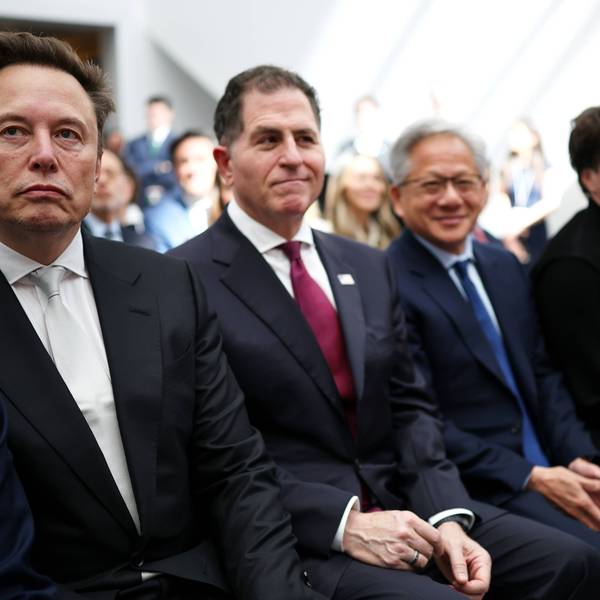


Following a year of hearings and research, the staff of the Subcommittee on Antitrust found that Facebook, Google, Amazon, and Apple all have either significant market power or outright monopoly power in a variety of markets. (Photo: Peter Macdiarmid/Getty Images)
House Antitrust Report Is a Bold Prescription for Curing Big Tech's Ills
The power of Big Tech weakens innovation, erodes privacy, and undermines "political and economic liberties."
The long-awaited report[pdf] by the House Judiciary Committee staff[1] on Big Tech's monopoly power hits all the right notes--and just a few wrong ones. Following a year of hearings and research, the staff of the Subcommittee on Antitrust found that Facebook, Google, Amazon, and Apple all have either significant market power or outright monopoly power in a variety of markets. Many of the report's recommendations echo calls EFF has also made, proof of just how obviously effective, needed, and common-sense they are.
The power of Big Tech weakens innovation, erodes privacy, and undermines "political and economic liberties," says the report. We're pleased to see the report go beyond U.S. antitrust law's narrow focus on consumer prices. The report also recommends many of the interventions that EFF has championed: new requirements for interoperability, a tougher standard for approving mergers and acquisitions, and stepping up the DOJ and Federal Trade Commission enforcement of the antitrust laws.
Interoperability as a Remedy
EFF has long been pointing out the value of interoperability as a monopoly-killer and innovation promoter that harnesses the skills of diverse and widely distributed entrepreneurs, without the central planning of governments or giant tech firms. That's why we're pleased that one of the committee's recommendations is to require the Big Tech firms to allow their services to interoperate with competitors, breaking the power of network effects. Policies to promote compatible products are "an important complement, not substitute, to vigorous antitrust enforcement," says the report.
Privacy Focus
The report explains how "the persistent collection and misuse of consumer data" by Big Tech firms is a sign of their monopoly power and gets worse the closer to monopoly a company gets. For example, major privacy scandals and data breaches haven't caused many people to stop using Facebook, which is evidence of the social network's monopoly power. People continue to use Facebook not because they trust it, but because it's where their friends and family are. The lack of competition has allowed the Big Tech firms to create a "race to the bottom" on privacy. Importantly, the report connects this to antitrust analysis: while most Facebook and Google services are free to the consumer, poor privacy protection means a lower-quality product that customers wouldn't accept if they had alternatives. That's a harm that antitrust laws can address.
Get Tougher on Mergers
The report also recommends raising the bar on approval of mergers and acquisitions by the dominant tech platforms through a burden-shift: before acquiring nascent tech firms, the Big Tech companies would need to prove that the acquisition would not increase monopoly power or substantially decrease competition. This shift is another measure that EFF has long supported, because it makes sense: merging firms always have the most information about impacts on consumers and competition, information that enforcers often have difficulty obtaining, especially with limited budgets for litigation.
For News Media, It's Goliath vs. Goliath
The report stumbles when it makes recommendations about preserving news media in the face of declining advertising revenues. The report recommends offering news media companies an exemption from the antitrust laws, allowing them to join as a bloc to negotiate some form of payments from Big Tech news aggregators. The problem with this is that U.S. news media is itself a highly concentrated industry. Exempting another set of giant firms from antitrust scrutiny will tend to shift money from one set of monopolists to another, without providing more media diversity for consumers. The report recognizes that such exemptions are "disfavored" and may run contrary to the goals of antitrust law.
Overall, the Judiciary Committee report is a strong, evidence-based prescription for fixing antitrust law to help address the problems of Big Tech. We hope the conversation continues, with good changes to the law and increased enforcement yet to come.
We are at a crossroads
This country and this world are at a monumental crossroads. US voters have an opportunity to beat back the forces of fascism and confront the billionaires who are rigging the economy, our media system, and our democracy, making it increasingly impossible for ordinary people to get by. We’re not just talking about the election. We’re talking about what must be done once these fascist elements are vanquished from power. We need a bolder set of solutions than what either major party has so far been willing to offer and a working-class movement ready to fight like hell for it. Trump didn't emerge from nowhere. The conditions that fueled MAGA authoritarianism were created by decades of radical neoliberal economic policies and a corrupt political system dominated by corporate interests. They slashed taxes on the super-rich, promising that the benefits would trickle down. They said giveaways to the corporate titans would make life more affordable for the rest of us. It was all bullshit. And when a bitter, betrayed populace searches for someone to blame, right-wing demagogues have little trouble finding scapegoats. People know when they're being lied to, but you won't hear any of this from the corporate media. Only independent journalism—powered and funded by people who believe in building a better world—can deliver truly trustworthy daily news. Our Fall Campaign is underway, and we need your help. To power our newsroom through the rest of the year, we need to raise $125,000 by midnight on October 31. So if you share our vision, please contribute whatever you can to sustain our work. |
The long-awaited report[pdf] by the House Judiciary Committee staff[1] on Big Tech's monopoly power hits all the right notes--and just a few wrong ones. Following a year of hearings and research, the staff of the Subcommittee on Antitrust found that Facebook, Google, Amazon, and Apple all have either significant market power or outright monopoly power in a variety of markets. Many of the report's recommendations echo calls EFF has also made, proof of just how obviously effective, needed, and common-sense they are.
The power of Big Tech weakens innovation, erodes privacy, and undermines "political and economic liberties," says the report. We're pleased to see the report go beyond U.S. antitrust law's narrow focus on consumer prices. The report also recommends many of the interventions that EFF has championed: new requirements for interoperability, a tougher standard for approving mergers and acquisitions, and stepping up the DOJ and Federal Trade Commission enforcement of the antitrust laws.
Interoperability as a Remedy
EFF has long been pointing out the value of interoperability as a monopoly-killer and innovation promoter that harnesses the skills of diverse and widely distributed entrepreneurs, without the central planning of governments or giant tech firms. That's why we're pleased that one of the committee's recommendations is to require the Big Tech firms to allow their services to interoperate with competitors, breaking the power of network effects. Policies to promote compatible products are "an important complement, not substitute, to vigorous antitrust enforcement," says the report.
Privacy Focus
The report explains how "the persistent collection and misuse of consumer data" by Big Tech firms is a sign of their monopoly power and gets worse the closer to monopoly a company gets. For example, major privacy scandals and data breaches haven't caused many people to stop using Facebook, which is evidence of the social network's monopoly power. People continue to use Facebook not because they trust it, but because it's where their friends and family are. The lack of competition has allowed the Big Tech firms to create a "race to the bottom" on privacy. Importantly, the report connects this to antitrust analysis: while most Facebook and Google services are free to the consumer, poor privacy protection means a lower-quality product that customers wouldn't accept if they had alternatives. That's a harm that antitrust laws can address.
Get Tougher on Mergers
The report also recommends raising the bar on approval of mergers and acquisitions by the dominant tech platforms through a burden-shift: before acquiring nascent tech firms, the Big Tech companies would need to prove that the acquisition would not increase monopoly power or substantially decrease competition. This shift is another measure that EFF has long supported, because it makes sense: merging firms always have the most information about impacts on consumers and competition, information that enforcers often have difficulty obtaining, especially with limited budgets for litigation.
For News Media, It's Goliath vs. Goliath
The report stumbles when it makes recommendations about preserving news media in the face of declining advertising revenues. The report recommends offering news media companies an exemption from the antitrust laws, allowing them to join as a bloc to negotiate some form of payments from Big Tech news aggregators. The problem with this is that U.S. news media is itself a highly concentrated industry. Exempting another set of giant firms from antitrust scrutiny will tend to shift money from one set of monopolists to another, without providing more media diversity for consumers. The report recognizes that such exemptions are "disfavored" and may run contrary to the goals of antitrust law.
Overall, the Judiciary Committee report is a strong, evidence-based prescription for fixing antitrust law to help address the problems of Big Tech. We hope the conversation continues, with good changes to the law and increased enforcement yet to come.