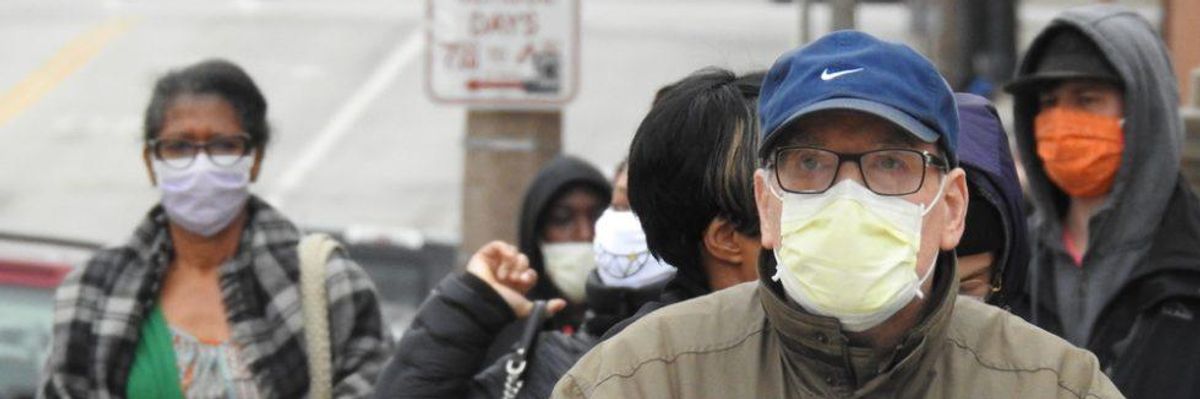
Voting lines in Milwaukee, April 2020 (Photo: Shutterstock)
Unleashing the Power of Poor Voters
Low-income voters could decide this election. These neighborhood activists are working to make it happen.
Voter mobilization is not easy in Metcalfe Park, a majority-Black neighborhood in Milwaukee scarred by poverty, racism, disenfranchisement, and neglect.
"I don't believe in voting," one young Black woman told Melody McCurtis, who's been going door-to-door to get out the vote. "The higher-ups, they're going to pick the president. Our votes don't count."
McCurtis and her mother, Danell Cross, are community organizers with Metcalfe Park Community Bridges. Their tireless efforts to mobilize neighbors to overcome skepticism and other barriers to voting are captured in a new short film, Metcalfe Park: Black Vote Rising, produced in part by the Economic Hardship Reporting Project.
As they canvass door-to-door to reach people who are missed by digital social media campaigns, Cross and McCurtis deliver food and COVID-19 safety kits along with voting instructions. Their goal is to motivate their neighbors to vote while preparing them for potential voter suppression and disinformation campaigns -- all while many of these neighbors are grappling with job loss, furloughs, and COVID-19 sickness.
During the disastrous Wisconsin primary in April, an estimated 16 percent of Black voters in Milwaukee were disenfranchised. One major problem: In the midst of the pandemic, the number of polling sites in the greater Milwaukee area was slashed from more than 180 to just five, forcing people to risk exposure and wait hours to cast their votes.
The mother-daughter duo is determined to achieve a better outcome in the general election. And their efforts could have tremendous impact.
A report by the Poor People's Campaign shows that increasing voter participation among the poor could make a huge difference in election results. In the 2016 presidential election, 34 million poor or low-income people who were eligible did not vote.
If low-income voters had participated at similar rates as higher income voters (and voted against the winning candidate) in 2016, new low-income voters could've flipped the presidential results in 15 states. Single-digit increases in voter turnout among poor voters could have easily changed the results in states like Michigan, Florida, and Pennsylvania -- not to mention Wisconsin.
In 2106, Wisconsin was decided by just 20,000 votes. Meanwhile 460,000 low-income, eligible Wisconsinites did not vote in that election. An increase of 4.9 percent of the non-voting low-income electorate would've equaled the margin of victory for Wisconsin in 2016.
Increased voter participation by the poor, as part of broader organizing strategies, can have an even greater impact at the local level.
"We know that when we vote, they'll start paying attention," McCurtis explains. "We have officials that are not advocating for the right jobs to come in. We have officials that say, 'Oh, let's open up a Family Dollar that pays $8 per hour.' When I vote, I'm voting to keep the officials accountable -- not just for me, but for the entire community."
We are at a crossroads
This country and this world are at a monumental crossroads. US voters have an opportunity to beat back the forces of fascism and confront the billionaires who are rigging the economy, our media system, and our democracy, making it increasingly impossible for ordinary people to get by. We’re not just talking about the election. We’re talking about what must be done once these fascist elements are vanquished from power. We need a bolder set of solutions than what either major party has so far been willing to offer and a working-class movement ready to fight like hell for it. Trump didn't emerge from nowhere. The conditions that fueled MAGA authoritarianism were created by decades of radical neoliberal economic policies and a corrupt political system dominated by corporate interests. They slashed taxes on the super-rich, promising that the benefits would trickle down. They said giveaways to the corporate titans would make life more affordable for the rest of us. It was all bullshit. And when a bitter, betrayed populace searches for someone to blame, right-wing demagogues have little trouble finding scapegoats. People know when they're being lied to, but you won't hear any of this from the corporate media. Only independent journalism—powered and funded by people who believe in building a better world—can deliver truly trustworthy daily news. Our Fall Campaign is underway, and we need your help. To power our newsroom through the rest of the year, we need to raise $125,000 by midnight on October 31. So if you share our vision, please contribute whatever you can to sustain our work. |
Voter mobilization is not easy in Metcalfe Park, a majority-Black neighborhood in Milwaukee scarred by poverty, racism, disenfranchisement, and neglect.
"I don't believe in voting," one young Black woman told Melody McCurtis, who's been going door-to-door to get out the vote. "The higher-ups, they're going to pick the president. Our votes don't count."
McCurtis and her mother, Danell Cross, are community organizers with Metcalfe Park Community Bridges. Their tireless efforts to mobilize neighbors to overcome skepticism and other barriers to voting are captured in a new short film, Metcalfe Park: Black Vote Rising, produced in part by the Economic Hardship Reporting Project.
As they canvass door-to-door to reach people who are missed by digital social media campaigns, Cross and McCurtis deliver food and COVID-19 safety kits along with voting instructions. Their goal is to motivate their neighbors to vote while preparing them for potential voter suppression and disinformation campaigns -- all while many of these neighbors are grappling with job loss, furloughs, and COVID-19 sickness.
During the disastrous Wisconsin primary in April, an estimated 16 percent of Black voters in Milwaukee were disenfranchised. One major problem: In the midst of the pandemic, the number of polling sites in the greater Milwaukee area was slashed from more than 180 to just five, forcing people to risk exposure and wait hours to cast their votes.
The mother-daughter duo is determined to achieve a better outcome in the general election. And their efforts could have tremendous impact.
A report by the Poor People's Campaign shows that increasing voter participation among the poor could make a huge difference in election results. In the 2016 presidential election, 34 million poor or low-income people who were eligible did not vote.
If low-income voters had participated at similar rates as higher income voters (and voted against the winning candidate) in 2016, new low-income voters could've flipped the presidential results in 15 states. Single-digit increases in voter turnout among poor voters could have easily changed the results in states like Michigan, Florida, and Pennsylvania -- not to mention Wisconsin.
In 2106, Wisconsin was decided by just 20,000 votes. Meanwhile 460,000 low-income, eligible Wisconsinites did not vote in that election. An increase of 4.9 percent of the non-voting low-income electorate would've equaled the margin of victory for Wisconsin in 2016.
Increased voter participation by the poor, as part of broader organizing strategies, can have an even greater impact at the local level.
"We know that when we vote, they'll start paying attention," McCurtis explains. "We have officials that are not advocating for the right jobs to come in. We have officials that say, 'Oh, let's open up a Family Dollar that pays $8 per hour.' When I vote, I'm voting to keep the officials accountable -- not just for me, but for the entire community."