SUBSCRIBE TO OUR FREE NEWSLETTER
Daily news & progressive opinion—funded by the people, not the corporations—delivered straight to your inbox.
5
#000000
#FFFFFF
To donate by check, phone, or other method, see our More Ways to Give page.
Daily news & progressive opinion—funded by the people, not the corporations—delivered straight to your inbox.
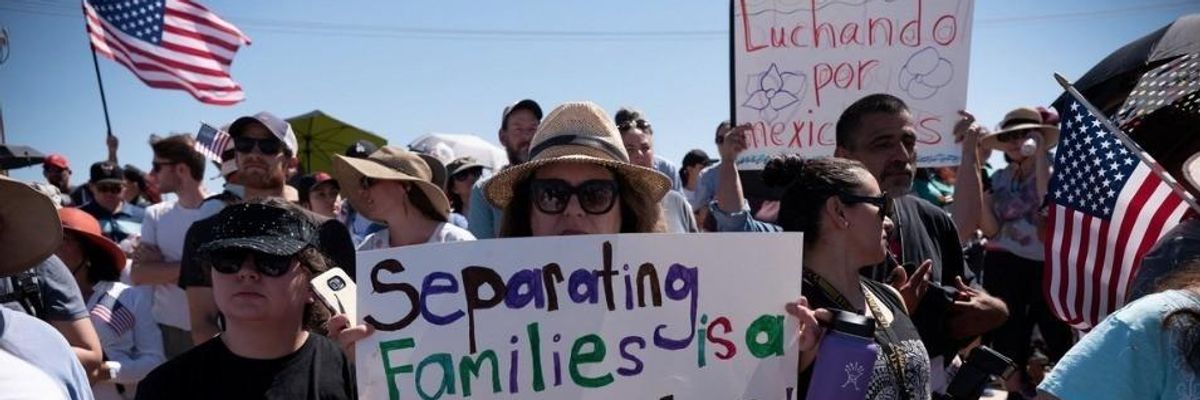
The separation of Central American families carried out by the Trump Administration is just the latest version of cruel family separation practices rooted in America's soil. (Photo: @ajplus/Twitter)
On Thursday, the U.S. House of Representatives Committee on the Judiciary released a report with a title that pulls no punches: "The Trump Administration's Family Separation Policy: Trauma, Destruction, and Chaos." It opens with the righteous statement that "these preventable tragedies must not be forgotten." The Committee's indignation is justified, but what is missing is historical context. The separation of Central American families carried out by the Trump Administration is just the latest version of cruel family separation practices rooted in America's soil.
The report is a product of a 21-month investigation that, in the Committee's own words, "revealed a process marked by reckless incompetence and intentional cruelty." The Administration formally executed the "zero tolerance" family separation policy between April and June 2018. However, the report details that the executive branch began sowing the policy's seeds weeks after inauguration, in mid-February 2017, and the actual separation of families began before the President's announcement. In fact, it reveals that the U.S. Department of Health and Human Services (HHS) reported that by April 2018-the same month the President publicly revealed zero tolerance-the government already had separated "at least 856 children" from their parents, of which "twenty-six percent were under the age of five."
The report also details how government officials when they first started separating families acknowledged that there was no way to link children with their parents, but did nothing to rectify this. Last week, we learned that the government has yet to find the parents of 545 migrant children. The HHS Office of Inspector General estimated that in total, the U.S. government separated nearly 2,800 children. The Young Center for Immigrant Children's Rights issued a report this summer on the Administration's ongoing practices that separate migrant children from their parents.
The law clinic I direct represents two of these thousands of separated families. In both cases, U.S. immigration officials separated the parents from their children, who at the time were under the age of eight, soon after the families crossed the border. Officials ripped both children from their parents' arms, put them on planes, and held them in shelters thousands of miles away. The government deported their parents within a week of their arrivals. Both parents then spent agonizing weeks in their home countries trying to get information on the children's whereabouts. After about six months, the U.S. government finally returned the children to their parents.
Even as someone who for almost two decades has witnessed egregious harms inflicted on non-citizens by the U.S. government, I found myself particularly affected by the cruelty my clients had suffered. I initially was unable to answer my students' question of how the U.S. government can engage in such cruelty, until together we realized that family separation is embedded in American history. It was a practice tied to our inhumane founding, to force a fantasized notion of America by solving the so-called "Indian problem." Part of this solution was separating Indigenous children from their families, first by placing them in boarding schools and later by promoting and facilitating their adoption by non-Indigenous families. A 1978 U.S. House of Representatives report cited that the government separated approximately twenty-five to thirty-five percent of Indigenous children from their families.
There was also the separation of enslaved families and kidnapped freed African Americans, about which Ta'Nehisi Coates says, "Here we find the roots of American wealth and democracy - in the for-profit destruction of the most important asset available to any people, the family. The destruction was not incidental to America's rise; it facilitated that rise." Local governments and private organizations removed Polish and Irish immigrant children from the mid-19ththrough early 20thcentury, the majority of whom were Catholic, through a movement called "orphan trains." Most of 150,000 to 200,000 children were not orphans, and were placed with Protestant and Anglo-American families. Although family separation arguably is not explicitly the objective of U.S. mass incarceration and mass deportation policies, it certainly has been their outcome.
Imagine if the House Committee report placed the Trump Administration's family separation practices in the context of the separation of vulnerable, mostly Black and Brown, families as deeply rooted in American history. Some might say that doing so would dilute its critical force. I offer that providing historical context would force us to think more broadly about systemic oppression, creating spaces for change that could be more meaningful to communities in the U.S. most vulnerable to state sponsored violence and harm.
Dear Common Dreams reader, It’s been nearly 30 years since I co-founded Common Dreams with my late wife, Lina Newhouser. We had the radical notion that journalism should serve the public good, not corporate profits. It was clear to us from the outset what it would take to build such a project. No paid advertisements. No corporate sponsors. No millionaire publisher telling us what to think or do. Many people said we wouldn't last a year, but we proved those doubters wrong. Together with a tremendous team of journalists and dedicated staff, we built an independent media outlet free from the constraints of profits and corporate control. Our mission has always been simple: To inform. To inspire. To ignite change for the common good. Building Common Dreams was not easy. Our survival was never guaranteed. When you take on the most powerful forces—Wall Street greed, fossil fuel industry destruction, Big Tech lobbyists, and uber-rich oligarchs who have spent billions upon billions rigging the economy and democracy in their favor—the only bulwark you have is supporters who believe in your work. But here’s the urgent message from me today. It's never been this bad out there. And it's never been this hard to keep us going. At the very moment Common Dreams is most needed, the threats we face are intensifying. We need your support now more than ever. We don't accept corporate advertising and never will. We don't have a paywall because we don't think people should be blocked from critical news based on their ability to pay. Everything we do is funded by the donations of readers like you. When everyone does the little they can afford, we are strong. But if that support retreats or dries up, so do we. Will you donate now to make sure Common Dreams not only survives but thrives? —Craig Brown, Co-founder |
On Thursday, the U.S. House of Representatives Committee on the Judiciary released a report with a title that pulls no punches: "The Trump Administration's Family Separation Policy: Trauma, Destruction, and Chaos." It opens with the righteous statement that "these preventable tragedies must not be forgotten." The Committee's indignation is justified, but what is missing is historical context. The separation of Central American families carried out by the Trump Administration is just the latest version of cruel family separation practices rooted in America's soil.
The report is a product of a 21-month investigation that, in the Committee's own words, "revealed a process marked by reckless incompetence and intentional cruelty." The Administration formally executed the "zero tolerance" family separation policy between April and June 2018. However, the report details that the executive branch began sowing the policy's seeds weeks after inauguration, in mid-February 2017, and the actual separation of families began before the President's announcement. In fact, it reveals that the U.S. Department of Health and Human Services (HHS) reported that by April 2018-the same month the President publicly revealed zero tolerance-the government already had separated "at least 856 children" from their parents, of which "twenty-six percent were under the age of five."
The report also details how government officials when they first started separating families acknowledged that there was no way to link children with their parents, but did nothing to rectify this. Last week, we learned that the government has yet to find the parents of 545 migrant children. The HHS Office of Inspector General estimated that in total, the U.S. government separated nearly 2,800 children. The Young Center for Immigrant Children's Rights issued a report this summer on the Administration's ongoing practices that separate migrant children from their parents.
The law clinic I direct represents two of these thousands of separated families. In both cases, U.S. immigration officials separated the parents from their children, who at the time were under the age of eight, soon after the families crossed the border. Officials ripped both children from their parents' arms, put them on planes, and held them in shelters thousands of miles away. The government deported their parents within a week of their arrivals. Both parents then spent agonizing weeks in their home countries trying to get information on the children's whereabouts. After about six months, the U.S. government finally returned the children to their parents.
Even as someone who for almost two decades has witnessed egregious harms inflicted on non-citizens by the U.S. government, I found myself particularly affected by the cruelty my clients had suffered. I initially was unable to answer my students' question of how the U.S. government can engage in such cruelty, until together we realized that family separation is embedded in American history. It was a practice tied to our inhumane founding, to force a fantasized notion of America by solving the so-called "Indian problem." Part of this solution was separating Indigenous children from their families, first by placing them in boarding schools and later by promoting and facilitating their adoption by non-Indigenous families. A 1978 U.S. House of Representatives report cited that the government separated approximately twenty-five to thirty-five percent of Indigenous children from their families.
There was also the separation of enslaved families and kidnapped freed African Americans, about which Ta'Nehisi Coates says, "Here we find the roots of American wealth and democracy - in the for-profit destruction of the most important asset available to any people, the family. The destruction was not incidental to America's rise; it facilitated that rise." Local governments and private organizations removed Polish and Irish immigrant children from the mid-19ththrough early 20thcentury, the majority of whom were Catholic, through a movement called "orphan trains." Most of 150,000 to 200,000 children were not orphans, and were placed with Protestant and Anglo-American families. Although family separation arguably is not explicitly the objective of U.S. mass incarceration and mass deportation policies, it certainly has been their outcome.
Imagine if the House Committee report placed the Trump Administration's family separation practices in the context of the separation of vulnerable, mostly Black and Brown, families as deeply rooted in American history. Some might say that doing so would dilute its critical force. I offer that providing historical context would force us to think more broadly about systemic oppression, creating spaces for change that could be more meaningful to communities in the U.S. most vulnerable to state sponsored violence and harm.
On Thursday, the U.S. House of Representatives Committee on the Judiciary released a report with a title that pulls no punches: "The Trump Administration's Family Separation Policy: Trauma, Destruction, and Chaos." It opens with the righteous statement that "these preventable tragedies must not be forgotten." The Committee's indignation is justified, but what is missing is historical context. The separation of Central American families carried out by the Trump Administration is just the latest version of cruel family separation practices rooted in America's soil.
The report is a product of a 21-month investigation that, in the Committee's own words, "revealed a process marked by reckless incompetence and intentional cruelty." The Administration formally executed the "zero tolerance" family separation policy between April and June 2018. However, the report details that the executive branch began sowing the policy's seeds weeks after inauguration, in mid-February 2017, and the actual separation of families began before the President's announcement. In fact, it reveals that the U.S. Department of Health and Human Services (HHS) reported that by April 2018-the same month the President publicly revealed zero tolerance-the government already had separated "at least 856 children" from their parents, of which "twenty-six percent were under the age of five."
The report also details how government officials when they first started separating families acknowledged that there was no way to link children with their parents, but did nothing to rectify this. Last week, we learned that the government has yet to find the parents of 545 migrant children. The HHS Office of Inspector General estimated that in total, the U.S. government separated nearly 2,800 children. The Young Center for Immigrant Children's Rights issued a report this summer on the Administration's ongoing practices that separate migrant children from their parents.
The law clinic I direct represents two of these thousands of separated families. In both cases, U.S. immigration officials separated the parents from their children, who at the time were under the age of eight, soon after the families crossed the border. Officials ripped both children from their parents' arms, put them on planes, and held them in shelters thousands of miles away. The government deported their parents within a week of their arrivals. Both parents then spent agonizing weeks in their home countries trying to get information on the children's whereabouts. After about six months, the U.S. government finally returned the children to their parents.
Even as someone who for almost two decades has witnessed egregious harms inflicted on non-citizens by the U.S. government, I found myself particularly affected by the cruelty my clients had suffered. I initially was unable to answer my students' question of how the U.S. government can engage in such cruelty, until together we realized that family separation is embedded in American history. It was a practice tied to our inhumane founding, to force a fantasized notion of America by solving the so-called "Indian problem." Part of this solution was separating Indigenous children from their families, first by placing them in boarding schools and later by promoting and facilitating their adoption by non-Indigenous families. A 1978 U.S. House of Representatives report cited that the government separated approximately twenty-five to thirty-five percent of Indigenous children from their families.
There was also the separation of enslaved families and kidnapped freed African Americans, about which Ta'Nehisi Coates says, "Here we find the roots of American wealth and democracy - in the for-profit destruction of the most important asset available to any people, the family. The destruction was not incidental to America's rise; it facilitated that rise." Local governments and private organizations removed Polish and Irish immigrant children from the mid-19ththrough early 20thcentury, the majority of whom were Catholic, through a movement called "orphan trains." Most of 150,000 to 200,000 children were not orphans, and were placed with Protestant and Anglo-American families. Although family separation arguably is not explicitly the objective of U.S. mass incarceration and mass deportation policies, it certainly has been their outcome.
Imagine if the House Committee report placed the Trump Administration's family separation practices in the context of the separation of vulnerable, mostly Black and Brown, families as deeply rooted in American history. Some might say that doing so would dilute its critical force. I offer that providing historical context would force us to think more broadly about systemic oppression, creating spaces for change that could be more meaningful to communities in the U.S. most vulnerable to state sponsored violence and harm.