SUBSCRIBE TO OUR FREE NEWSLETTER
Daily news & progressive opinion—funded by the people, not the corporations—delivered straight to your inbox.
5
#000000
#FFFFFF
To donate by check, phone, or other method, see our More Ways to Give page.
Daily news & progressive opinion—funded by the people, not the corporations—delivered straight to your inbox.
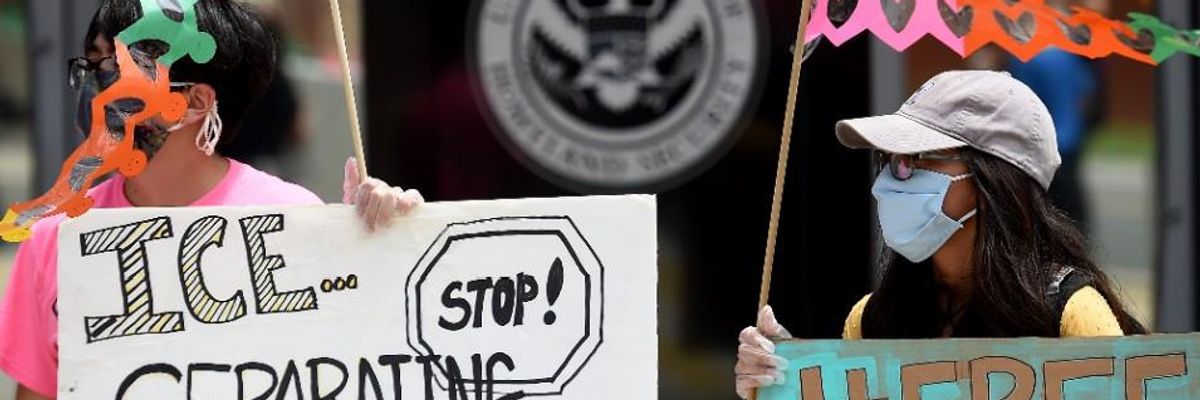
Demonstrators protest outside the Immigration and Customs Enforcement (ICE) headquarters to demand the release of immigran families in detention centers at risk during the coronavirus pandemic in Washington, D.C. on July 17, 2020. (Photo: Olivier Douliery/AFP via Getty Images)
President Biden's 100-day deportation moratorium, announced late last month, was a monumental achievement for immigrant justice activists and immigrant communities. Less visible but potentially groundbreaking: The Department of Homeland Security's promise to conduct a top-to-bottom review of programs and policies governing the arrests and deportations of immigrants in the United States.
While a Texas court temporarily enjoined the deportation moratorium (the ACLU has intervened in the case), the top-to-bottom review will go forward. Its success is the key to the puzzle of how to actually limit deportations and keep families together over the course of Biden's presidency. What's at stake? Whether millions of immigrants and their family members -- many of whom have lived in the U.S. for years -- will be forced to live in fear of being deported, and torn away from their families and communities.
"It doesn't have to be this way. These ICE programs are in many ways a vestige of the post-9/11 era of government overreach and destruction of civil rights."
DHS set out the deportation moratorium in a short memo, which stated that immigration enforcement in the interior of the United States should "prioritize responding to threats to national security, public safety, and border security." It set out corresponding "interim civil enforcement priorities" that will apply during the 100-day period, pending the full review. And this week, Immigration and Customs Enforcement will issue new interim guidelines designed to make ICE agents accountable to the interim priorities. Taken together, this is a major break from the Trump administration's approach, which effectively made all undocumented people targets for deportation and gave ICE agents free rein.
We have serious reservations about the interim enforcement priorities, which use sweeping and overbroad terms that have harmed communities of color for decades and mischaracterize all recent border crossers as threats to border security. Still, this news is significant: limiting immigration enforcement to these priorities would likely protect tens of thousands of people from deportation.
But without additional serious reforms, there is no reason to believe that ICE will abide by the Biden interim priorities and their eventual successor priorities. Even now, ICE agents are saying publicly that they intend to undermine the new administration, ICE's spokesperson is touting the agency's "unlimited discretion to evaluate any conduct" to justify arresting individuals on "public safety" grounds, and ICE is deporting individuals who should be protected by the Biden interim priorities.
As long as ICE has the resources to track, arrest, and deport large numbers of people, it will attempt to do so, bending the law to its prerogative. That is the lesson of the Obama years, when ICE flouted the enforcement priorities and related reforms, deporting thousands of individuals who did not meet its criteria. ICE also continued to regularly issue detainers requesting that state and local law enforcement agencies jail individuals past their release date, so that ICE could deport them, although the DHS secretary had directed detainers to be used only in "special circumstances."
At the time, immigrant justice groups argued that ICE's deportation and detention quotas had not changed in response to the Obama enforcement priorities, and there was simply "no evidence" that ICE agents would "actually modify their practices." In recent years, Freedom of Information Act requests have confirmed that ICE deportations continue to be quota-driven -- not public safety driven, as it claims.
Biden's review of immigrant enforcement policies must reckon with how to change both ICE culture and capacity. This is hard, but one of the clearest fixes is ending ICE programs that use state and local law enforcement as "force multipliers." These include the 287(g) program, ICE detainers, and Secure Communities.
Under these programs, local police have helped ICE ensnare thousands of people in an indiscriminate deportation dragnet -- the opposite of the limited approach the Biden administration has promised. Here's how: Being in the business of immigration enforcement incentivizes local police to make pretextual arrests on state or local criminal grounds -- with the actual goal of identifying immigrants to detain for ICE's deportation. It emboldens law enforcement officers across the country to use immigration enforcement as a means of threatening and harassing people in immigrant communities. Racial profiling, harassment, and constitutional violations have resulted, as congressional hearings have detailed.
Local police jail people on ICE detainers, which ICE agents issue unilaterally with no outside review. ICE uses detainers in local jails as a "stop gap measure" to give the agency time to pick up people encountered by local police, despite often lacking probable cause to believe they are deportable. This is one reason why so many U.S. citizens and immigrants have been wrongfully detained by local police on behalf of ICE.
It doesn't have to be this way. These ICE programs are in many ways a vestige of the post-9/11 era of government overreach and destruction of civil rights. ICE turned to state and local law enforcement, claiming "terrorism" concerns as justification in a strategy championed by Kris Kobach. Here, as in so many instances, "terrorism" was simply cover for the government to expand its powers and engage in biased profiling -- not make us safer.
Dear Common Dreams reader, It’s been nearly 30 years since I co-founded Common Dreams with my late wife, Lina Newhouser. We had the radical notion that journalism should serve the public good, not corporate profits. It was clear to us from the outset what it would take to build such a project. No paid advertisements. No corporate sponsors. No millionaire publisher telling us what to think or do. Many people said we wouldn't last a year, but we proved those doubters wrong. Together with a tremendous team of journalists and dedicated staff, we built an independent media outlet free from the constraints of profits and corporate control. Our mission has always been simple: To inform. To inspire. To ignite change for the common good. Building Common Dreams was not easy. Our survival was never guaranteed. When you take on the most powerful forces—Wall Street greed, fossil fuel industry destruction, Big Tech lobbyists, and uber-rich oligarchs who have spent billions upon billions rigging the economy and democracy in their favor—the only bulwark you have is supporters who believe in your work. But here’s the urgent message from me today. It's never been this bad out there. And it's never been this hard to keep us going. At the very moment Common Dreams is most needed, the threats we face are intensifying. We need your support now more than ever. We don't accept corporate advertising and never will. We don't have a paywall because we don't think people should be blocked from critical news based on their ability to pay. Everything we do is funded by the donations of readers like you. When everyone does the little they can afford, we are strong. But if that support retreats or dries up, so do we. Will you donate now to make sure Common Dreams not only survives but thrives? —Craig Brown, Co-founder |
President Biden's 100-day deportation moratorium, announced late last month, was a monumental achievement for immigrant justice activists and immigrant communities. Less visible but potentially groundbreaking: The Department of Homeland Security's promise to conduct a top-to-bottom review of programs and policies governing the arrests and deportations of immigrants in the United States.
While a Texas court temporarily enjoined the deportation moratorium (the ACLU has intervened in the case), the top-to-bottom review will go forward. Its success is the key to the puzzle of how to actually limit deportations and keep families together over the course of Biden's presidency. What's at stake? Whether millions of immigrants and their family members -- many of whom have lived in the U.S. for years -- will be forced to live in fear of being deported, and torn away from their families and communities.
"It doesn't have to be this way. These ICE programs are in many ways a vestige of the post-9/11 era of government overreach and destruction of civil rights."
DHS set out the deportation moratorium in a short memo, which stated that immigration enforcement in the interior of the United States should "prioritize responding to threats to national security, public safety, and border security." It set out corresponding "interim civil enforcement priorities" that will apply during the 100-day period, pending the full review. And this week, Immigration and Customs Enforcement will issue new interim guidelines designed to make ICE agents accountable to the interim priorities. Taken together, this is a major break from the Trump administration's approach, which effectively made all undocumented people targets for deportation and gave ICE agents free rein.
We have serious reservations about the interim enforcement priorities, which use sweeping and overbroad terms that have harmed communities of color for decades and mischaracterize all recent border crossers as threats to border security. Still, this news is significant: limiting immigration enforcement to these priorities would likely protect tens of thousands of people from deportation.
But without additional serious reforms, there is no reason to believe that ICE will abide by the Biden interim priorities and their eventual successor priorities. Even now, ICE agents are saying publicly that they intend to undermine the new administration, ICE's spokesperson is touting the agency's "unlimited discretion to evaluate any conduct" to justify arresting individuals on "public safety" grounds, and ICE is deporting individuals who should be protected by the Biden interim priorities.
As long as ICE has the resources to track, arrest, and deport large numbers of people, it will attempt to do so, bending the law to its prerogative. That is the lesson of the Obama years, when ICE flouted the enforcement priorities and related reforms, deporting thousands of individuals who did not meet its criteria. ICE also continued to regularly issue detainers requesting that state and local law enforcement agencies jail individuals past their release date, so that ICE could deport them, although the DHS secretary had directed detainers to be used only in "special circumstances."
At the time, immigrant justice groups argued that ICE's deportation and detention quotas had not changed in response to the Obama enforcement priorities, and there was simply "no evidence" that ICE agents would "actually modify their practices." In recent years, Freedom of Information Act requests have confirmed that ICE deportations continue to be quota-driven -- not public safety driven, as it claims.
Biden's review of immigrant enforcement policies must reckon with how to change both ICE culture and capacity. This is hard, but one of the clearest fixes is ending ICE programs that use state and local law enforcement as "force multipliers." These include the 287(g) program, ICE detainers, and Secure Communities.
Under these programs, local police have helped ICE ensnare thousands of people in an indiscriminate deportation dragnet -- the opposite of the limited approach the Biden administration has promised. Here's how: Being in the business of immigration enforcement incentivizes local police to make pretextual arrests on state or local criminal grounds -- with the actual goal of identifying immigrants to detain for ICE's deportation. It emboldens law enforcement officers across the country to use immigration enforcement as a means of threatening and harassing people in immigrant communities. Racial profiling, harassment, and constitutional violations have resulted, as congressional hearings have detailed.
Local police jail people on ICE detainers, which ICE agents issue unilaterally with no outside review. ICE uses detainers in local jails as a "stop gap measure" to give the agency time to pick up people encountered by local police, despite often lacking probable cause to believe they are deportable. This is one reason why so many U.S. citizens and immigrants have been wrongfully detained by local police on behalf of ICE.
It doesn't have to be this way. These ICE programs are in many ways a vestige of the post-9/11 era of government overreach and destruction of civil rights. ICE turned to state and local law enforcement, claiming "terrorism" concerns as justification in a strategy championed by Kris Kobach. Here, as in so many instances, "terrorism" was simply cover for the government to expand its powers and engage in biased profiling -- not make us safer.
President Biden's 100-day deportation moratorium, announced late last month, was a monumental achievement for immigrant justice activists and immigrant communities. Less visible but potentially groundbreaking: The Department of Homeland Security's promise to conduct a top-to-bottom review of programs and policies governing the arrests and deportations of immigrants in the United States.
While a Texas court temporarily enjoined the deportation moratorium (the ACLU has intervened in the case), the top-to-bottom review will go forward. Its success is the key to the puzzle of how to actually limit deportations and keep families together over the course of Biden's presidency. What's at stake? Whether millions of immigrants and their family members -- many of whom have lived in the U.S. for years -- will be forced to live in fear of being deported, and torn away from their families and communities.
"It doesn't have to be this way. These ICE programs are in many ways a vestige of the post-9/11 era of government overreach and destruction of civil rights."
DHS set out the deportation moratorium in a short memo, which stated that immigration enforcement in the interior of the United States should "prioritize responding to threats to national security, public safety, and border security." It set out corresponding "interim civil enforcement priorities" that will apply during the 100-day period, pending the full review. And this week, Immigration and Customs Enforcement will issue new interim guidelines designed to make ICE agents accountable to the interim priorities. Taken together, this is a major break from the Trump administration's approach, which effectively made all undocumented people targets for deportation and gave ICE agents free rein.
We have serious reservations about the interim enforcement priorities, which use sweeping and overbroad terms that have harmed communities of color for decades and mischaracterize all recent border crossers as threats to border security. Still, this news is significant: limiting immigration enforcement to these priorities would likely protect tens of thousands of people from deportation.
But without additional serious reforms, there is no reason to believe that ICE will abide by the Biden interim priorities and their eventual successor priorities. Even now, ICE agents are saying publicly that they intend to undermine the new administration, ICE's spokesperson is touting the agency's "unlimited discretion to evaluate any conduct" to justify arresting individuals on "public safety" grounds, and ICE is deporting individuals who should be protected by the Biden interim priorities.
As long as ICE has the resources to track, arrest, and deport large numbers of people, it will attempt to do so, bending the law to its prerogative. That is the lesson of the Obama years, when ICE flouted the enforcement priorities and related reforms, deporting thousands of individuals who did not meet its criteria. ICE also continued to regularly issue detainers requesting that state and local law enforcement agencies jail individuals past their release date, so that ICE could deport them, although the DHS secretary had directed detainers to be used only in "special circumstances."
At the time, immigrant justice groups argued that ICE's deportation and detention quotas had not changed in response to the Obama enforcement priorities, and there was simply "no evidence" that ICE agents would "actually modify their practices." In recent years, Freedom of Information Act requests have confirmed that ICE deportations continue to be quota-driven -- not public safety driven, as it claims.
Biden's review of immigrant enforcement policies must reckon with how to change both ICE culture and capacity. This is hard, but one of the clearest fixes is ending ICE programs that use state and local law enforcement as "force multipliers." These include the 287(g) program, ICE detainers, and Secure Communities.
Under these programs, local police have helped ICE ensnare thousands of people in an indiscriminate deportation dragnet -- the opposite of the limited approach the Biden administration has promised. Here's how: Being in the business of immigration enforcement incentivizes local police to make pretextual arrests on state or local criminal grounds -- with the actual goal of identifying immigrants to detain for ICE's deportation. It emboldens law enforcement officers across the country to use immigration enforcement as a means of threatening and harassing people in immigrant communities. Racial profiling, harassment, and constitutional violations have resulted, as congressional hearings have detailed.
Local police jail people on ICE detainers, which ICE agents issue unilaterally with no outside review. ICE uses detainers in local jails as a "stop gap measure" to give the agency time to pick up people encountered by local police, despite often lacking probable cause to believe they are deportable. This is one reason why so many U.S. citizens and immigrants have been wrongfully detained by local police on behalf of ICE.
It doesn't have to be this way. These ICE programs are in many ways a vestige of the post-9/11 era of government overreach and destruction of civil rights. ICE turned to state and local law enforcement, claiming "terrorism" concerns as justification in a strategy championed by Kris Kobach. Here, as in so many instances, "terrorism" was simply cover for the government to expand its powers and engage in biased profiling -- not make us safer.