SUBSCRIBE TO OUR FREE NEWSLETTER
Daily news & progressive opinion—funded by the people, not the corporations—delivered straight to your inbox.
5
#000000
#FFFFFF
To donate by check, phone, or other method, see our More Ways to Give page.
Daily news & progressive opinion—funded by the people, not the corporations—delivered straight to your inbox.
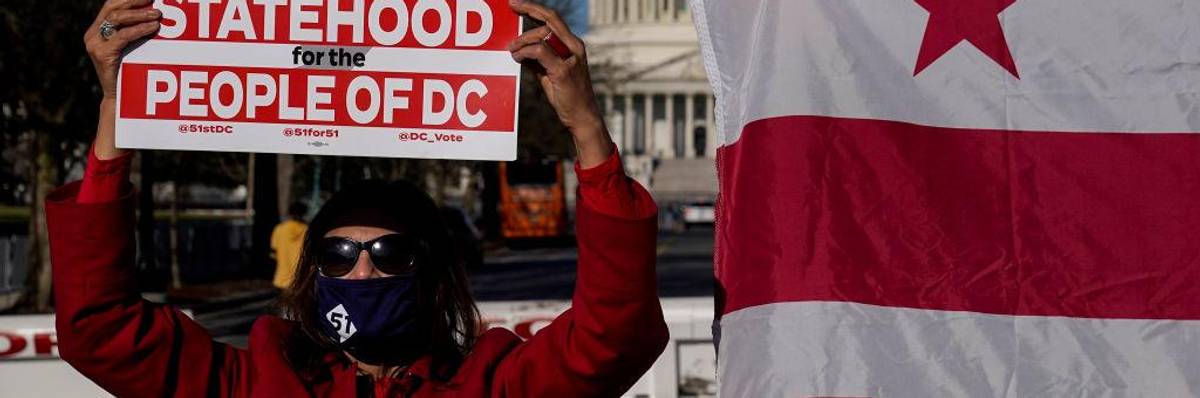
Residents of the District of Columbia rally for statehood near the U.S. Capitol on March 22, 2021 in Washington, DC. On Monday, the House Oversight Committee is holding a hearing on legislation that the House passed last Summer that would establish the District of Columbia as the 51st state. (Photo: Drew Angerer/Getty Images)
Today, the House Committee on Oversight and Reform is holding a hearing on a bill to establish statehood for Washington, D.C. Since the last congressional hearing on statehood in September 2019, the COVID-19 pandemic, protests in D.C. after the killing of George Floyd, and the insurrection attempt at the U.S. Capitol building have all highlighted how the lack of full statehood rights continues to cause serious harm to the health and safety of D.C. residents. These events underscore the urgency with which our country must grant full and equal rights to the 712,000 residents of D.C.
Historically, Congress has treated Washington, D.C. in the same manner as the states when it comes to federal financial assistance, such as federal grants, Medicare reimbursement, and funding for highways, education, and food assistance. However, when Congress passed a $2 trillion COVID-19 stimulus bill in March of 2020, members of Congress opted to treat the District of Columbia as a territory, shortchanging D.C. residents a full $755 million in relief at a time when D.C. had more COVID-19 cases than 19 other states. During this critical public health crisis, D.C. was left at the mercy of Congress, a body in which its residents hold no voting representation, and Congress chose to withhold more than half of the aid it provided to every other state.
Events over the past year reinforce how D.C.'s lack of statehood continues to wreak havoc on the health, safety, and daily lives of its 712,000 residents.
The $755 million was retroactively made whole in the American Rescue Plan Act of 2021, passed by Congress in March, more than a full year after passage of the first stimulus bill. The 712,000 residents of D.C. need test kits, hospital supplies, and emergency relief for businesses as much as every other American trying to survive the COVID-19 pandemic, but without statehood, the residents of D.C. lack full representation in the representational democracy making key life or death decisions during a global health crisis.
Other recent examples show the harm caused by D.C.'s lack of full authority over its own National Guard and law enforcement due to lack of statehood. In the wake of the killing of George Floyd, D.C. residents and others from around the region exercised their right to free speech and protested against police brutality. These demonstrators were met with brutal force by military personnel when the president used his uniquely exclusive control over the D.C. National Guard to deploy those troops to the area, in addition to scores of law enforcement officers.
On June 1, 2020, President Trump ordered those federal officers to forcefully clear peaceful protestors out of Lafayette Park and the surrounding streets in Washington, D.C., using batons, rubber bullets, and pepper spray -- literally tear gassing civil rights protestors in front of the White House so he could take a photo in front of a church. Additionally, the president has the ability to take over D.C.'s own local police force for 48 hours, and that time period may be extended with mere notification to members of Congress who oversee District affairs -- something President Trump threatened to do repeatedly in 2020.
Another striking example came on Jan. 6, 2021, when a violent mob entered the U.S. Capitol during the tallying of Electoral College votes for the 2020 presidential election to overturn the results on behalf of Donald Trump. Unlike every state in the country, D.C. does not have the authority to deploy its own National Guard troops; instead, D.C. must rely on the Department of Defense, as the D.C. National Guard always remains under federal control. During the attack, approval for National Guard troops to stop the violent mob came after a lengthy delay by the Trump administration, long after the attack was underway and in a manner that put D.C. residents and everyone in the building in danger. Five people died in the course of the mob's assault on the Capitol.
While restraint should be exercised in deploying National Guard troops, and uncertainties remain around the exact reasons for the delay, what is clear is that the delay in the use of the National Guard on Jan. 6 stands in stark contrast to the extensive and aggressive deployment of the D.C. National Guard on the streets of D.C. by the federal government during Black Lives Matter demonstrations during the summer of 2020.
In 1788, James Madison wrote that the inhabitants of the yet-to-be-chosen federal district should have a "voice in the election of the government which is to exercise authority over them." More than 200 years later, residents of the District of Columbia still lack full representation in Congress. Events over the past year reinforce how D.C.'s lack of statehood continues to wreak havoc on the health, safety, and daily lives of its 712,000 residents. The continuing denial of representation for District residents is an overt act of voter suppression with roots in the Reconstruction era. It is beyond time to rectify this by giving D.C. the true autonomy and self-governance that comes with statehood.
You can read our full testimony here.
Dear Common Dreams reader, It’s been nearly 30 years since I co-founded Common Dreams with my late wife, Lina Newhouser. We had the radical notion that journalism should serve the public good, not corporate profits. It was clear to us from the outset what it would take to build such a project. No paid advertisements. No corporate sponsors. No millionaire publisher telling us what to think or do. Many people said we wouldn't last a year, but we proved those doubters wrong. Together with a tremendous team of journalists and dedicated staff, we built an independent media outlet free from the constraints of profits and corporate control. Our mission has always been simple: To inform. To inspire. To ignite change for the common good. Building Common Dreams was not easy. Our survival was never guaranteed. When you take on the most powerful forces—Wall Street greed, fossil fuel industry destruction, Big Tech lobbyists, and uber-rich oligarchs who have spent billions upon billions rigging the economy and democracy in their favor—the only bulwark you have is supporters who believe in your work. But here’s the urgent message from me today. It's never been this bad out there. And it's never been this hard to keep us going. At the very moment Common Dreams is most needed, the threats we face are intensifying. We need your support now more than ever. We don't accept corporate advertising and never will. We don't have a paywall because we don't think people should be blocked from critical news based on their ability to pay. Everything we do is funded by the donations of readers like you. When everyone does the little they can afford, we are strong. But if that support retreats or dries up, so do we. Will you donate now to make sure Common Dreams not only survives but thrives? —Craig Brown, Co-founder |
Today, the House Committee on Oversight and Reform is holding a hearing on a bill to establish statehood for Washington, D.C. Since the last congressional hearing on statehood in September 2019, the COVID-19 pandemic, protests in D.C. after the killing of George Floyd, and the insurrection attempt at the U.S. Capitol building have all highlighted how the lack of full statehood rights continues to cause serious harm to the health and safety of D.C. residents. These events underscore the urgency with which our country must grant full and equal rights to the 712,000 residents of D.C.
Historically, Congress has treated Washington, D.C. in the same manner as the states when it comes to federal financial assistance, such as federal grants, Medicare reimbursement, and funding for highways, education, and food assistance. However, when Congress passed a $2 trillion COVID-19 stimulus bill in March of 2020, members of Congress opted to treat the District of Columbia as a territory, shortchanging D.C. residents a full $755 million in relief at a time when D.C. had more COVID-19 cases than 19 other states. During this critical public health crisis, D.C. was left at the mercy of Congress, a body in which its residents hold no voting representation, and Congress chose to withhold more than half of the aid it provided to every other state.
Events over the past year reinforce how D.C.'s lack of statehood continues to wreak havoc on the health, safety, and daily lives of its 712,000 residents.
The $755 million was retroactively made whole in the American Rescue Plan Act of 2021, passed by Congress in March, more than a full year after passage of the first stimulus bill. The 712,000 residents of D.C. need test kits, hospital supplies, and emergency relief for businesses as much as every other American trying to survive the COVID-19 pandemic, but without statehood, the residents of D.C. lack full representation in the representational democracy making key life or death decisions during a global health crisis.
Other recent examples show the harm caused by D.C.'s lack of full authority over its own National Guard and law enforcement due to lack of statehood. In the wake of the killing of George Floyd, D.C. residents and others from around the region exercised their right to free speech and protested against police brutality. These demonstrators were met with brutal force by military personnel when the president used his uniquely exclusive control over the D.C. National Guard to deploy those troops to the area, in addition to scores of law enforcement officers.
On June 1, 2020, President Trump ordered those federal officers to forcefully clear peaceful protestors out of Lafayette Park and the surrounding streets in Washington, D.C., using batons, rubber bullets, and pepper spray -- literally tear gassing civil rights protestors in front of the White House so he could take a photo in front of a church. Additionally, the president has the ability to take over D.C.'s own local police force for 48 hours, and that time period may be extended with mere notification to members of Congress who oversee District affairs -- something President Trump threatened to do repeatedly in 2020.
Another striking example came on Jan. 6, 2021, when a violent mob entered the U.S. Capitol during the tallying of Electoral College votes for the 2020 presidential election to overturn the results on behalf of Donald Trump. Unlike every state in the country, D.C. does not have the authority to deploy its own National Guard troops; instead, D.C. must rely on the Department of Defense, as the D.C. National Guard always remains under federal control. During the attack, approval for National Guard troops to stop the violent mob came after a lengthy delay by the Trump administration, long after the attack was underway and in a manner that put D.C. residents and everyone in the building in danger. Five people died in the course of the mob's assault on the Capitol.
While restraint should be exercised in deploying National Guard troops, and uncertainties remain around the exact reasons for the delay, what is clear is that the delay in the use of the National Guard on Jan. 6 stands in stark contrast to the extensive and aggressive deployment of the D.C. National Guard on the streets of D.C. by the federal government during Black Lives Matter demonstrations during the summer of 2020.
In 1788, James Madison wrote that the inhabitants of the yet-to-be-chosen federal district should have a "voice in the election of the government which is to exercise authority over them." More than 200 years later, residents of the District of Columbia still lack full representation in Congress. Events over the past year reinforce how D.C.'s lack of statehood continues to wreak havoc on the health, safety, and daily lives of its 712,000 residents. The continuing denial of representation for District residents is an overt act of voter suppression with roots in the Reconstruction era. It is beyond time to rectify this by giving D.C. the true autonomy and self-governance that comes with statehood.
You can read our full testimony here.
Today, the House Committee on Oversight and Reform is holding a hearing on a bill to establish statehood for Washington, D.C. Since the last congressional hearing on statehood in September 2019, the COVID-19 pandemic, protests in D.C. after the killing of George Floyd, and the insurrection attempt at the U.S. Capitol building have all highlighted how the lack of full statehood rights continues to cause serious harm to the health and safety of D.C. residents. These events underscore the urgency with which our country must grant full and equal rights to the 712,000 residents of D.C.
Historically, Congress has treated Washington, D.C. in the same manner as the states when it comes to federal financial assistance, such as federal grants, Medicare reimbursement, and funding for highways, education, and food assistance. However, when Congress passed a $2 trillion COVID-19 stimulus bill in March of 2020, members of Congress opted to treat the District of Columbia as a territory, shortchanging D.C. residents a full $755 million in relief at a time when D.C. had more COVID-19 cases than 19 other states. During this critical public health crisis, D.C. was left at the mercy of Congress, a body in which its residents hold no voting representation, and Congress chose to withhold more than half of the aid it provided to every other state.
Events over the past year reinforce how D.C.'s lack of statehood continues to wreak havoc on the health, safety, and daily lives of its 712,000 residents.
The $755 million was retroactively made whole in the American Rescue Plan Act of 2021, passed by Congress in March, more than a full year after passage of the first stimulus bill. The 712,000 residents of D.C. need test kits, hospital supplies, and emergency relief for businesses as much as every other American trying to survive the COVID-19 pandemic, but without statehood, the residents of D.C. lack full representation in the representational democracy making key life or death decisions during a global health crisis.
Other recent examples show the harm caused by D.C.'s lack of full authority over its own National Guard and law enforcement due to lack of statehood. In the wake of the killing of George Floyd, D.C. residents and others from around the region exercised their right to free speech and protested against police brutality. These demonstrators were met with brutal force by military personnel when the president used his uniquely exclusive control over the D.C. National Guard to deploy those troops to the area, in addition to scores of law enforcement officers.
On June 1, 2020, President Trump ordered those federal officers to forcefully clear peaceful protestors out of Lafayette Park and the surrounding streets in Washington, D.C., using batons, rubber bullets, and pepper spray -- literally tear gassing civil rights protestors in front of the White House so he could take a photo in front of a church. Additionally, the president has the ability to take over D.C.'s own local police force for 48 hours, and that time period may be extended with mere notification to members of Congress who oversee District affairs -- something President Trump threatened to do repeatedly in 2020.
Another striking example came on Jan. 6, 2021, when a violent mob entered the U.S. Capitol during the tallying of Electoral College votes for the 2020 presidential election to overturn the results on behalf of Donald Trump. Unlike every state in the country, D.C. does not have the authority to deploy its own National Guard troops; instead, D.C. must rely on the Department of Defense, as the D.C. National Guard always remains under federal control. During the attack, approval for National Guard troops to stop the violent mob came after a lengthy delay by the Trump administration, long after the attack was underway and in a manner that put D.C. residents and everyone in the building in danger. Five people died in the course of the mob's assault on the Capitol.
While restraint should be exercised in deploying National Guard troops, and uncertainties remain around the exact reasons for the delay, what is clear is that the delay in the use of the National Guard on Jan. 6 stands in stark contrast to the extensive and aggressive deployment of the D.C. National Guard on the streets of D.C. by the federal government during Black Lives Matter demonstrations during the summer of 2020.
In 1788, James Madison wrote that the inhabitants of the yet-to-be-chosen federal district should have a "voice in the election of the government which is to exercise authority over them." More than 200 years later, residents of the District of Columbia still lack full representation in Congress. Events over the past year reinforce how D.C.'s lack of statehood continues to wreak havoc on the health, safety, and daily lives of its 712,000 residents. The continuing denial of representation for District residents is an overt act of voter suppression with roots in the Reconstruction era. It is beyond time to rectify this by giving D.C. the true autonomy and self-governance that comes with statehood.
You can read our full testimony here.