

SUBSCRIBE TO OUR FREE NEWSLETTER
Daily news & progressive opinion—funded by the people, not the corporations—delivered straight to your inbox.
5
#000000
#FFFFFF
To donate by check, phone, or other method, see our More Ways to Give page.
Daily news & progressive opinion—funded by the people, not the corporations—delivered straight to your inbox.
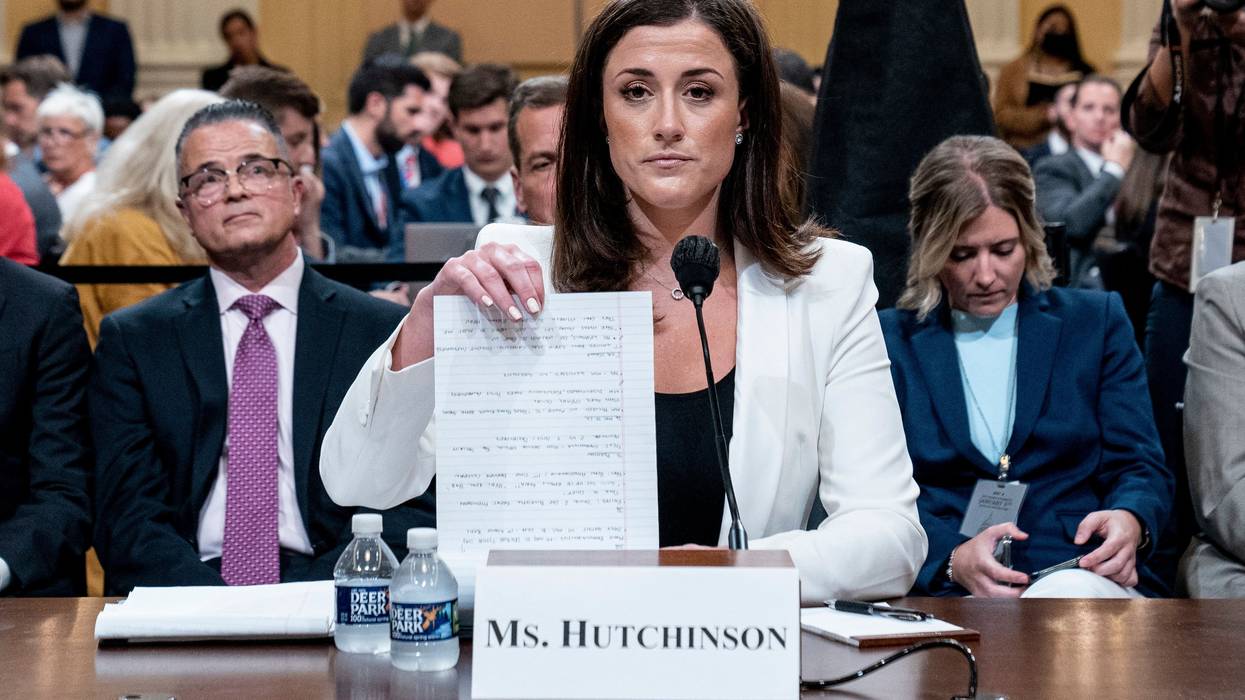
One lawyer called the targeting of ex-White House aide Cassidy Hutchinson "a chilling and corrupt indictment" but also "yet another opportunity for the Trump DOJ to shit its pants in court."
In what appears to be its latest effort to target President Donald Trump's political foes, the US Department of Justice is reportedly seeking criminal charges against former White House aide Cassidy Hutchinson, who served as a star witness in Congress' investigation of the January 6, 2021 Capitol insurrection.
Punchbowl News reported on Thursday that the DOJ is pursuing federal criminal charges against Hutchinson for allegedly making false statements during her bombshell testimony in June 2022, in which she claimed that Trump attempted to assist the rioters as they tried to violently overturn his loss in the 2020 election.
Hutchinson, who was an aide to then-White House chief of staff Mark Meadows, told Congress she overheard Trump demand the removal of metal detectors at his rally near the White House before the riot, despite knowing that some attendees were armed. She quoted him saying, "They're not here to hurt me."
She also relayed information she claimed to have learned secondhand from others in the Trump White House. She said that Anthony Ornato, the deputy White House chief of staff for operations, told her that Trump tried to grab the steering wheel of his SUV away from the Secret Service agent driving it so he could join supporters at the Capitol.
Ornato has since said he does not recall recounting this incident to Hutchinson, and the agents in the vehicle have denied that it took place, according to a subsequent investigation by Republicans in the House of Representatives. However, other witnesses have testified more broadly to Trump's anger that he could not join his supporters at the Capitol.
Hutchinson also said Meadows was reluctant to intervene as rioters threatened to hang then-Vice President Mike Pence. She claimed Meadows told her that Trump believed Pence—who'd refused to assist his efforts to overturn the election result—deserved the threats and that the rioters had done nothing wrong.
Trump has since pardoned every one of the more than 1,500 people convicted of offenses related to the Capitol attack, including those who committed violent felonies.
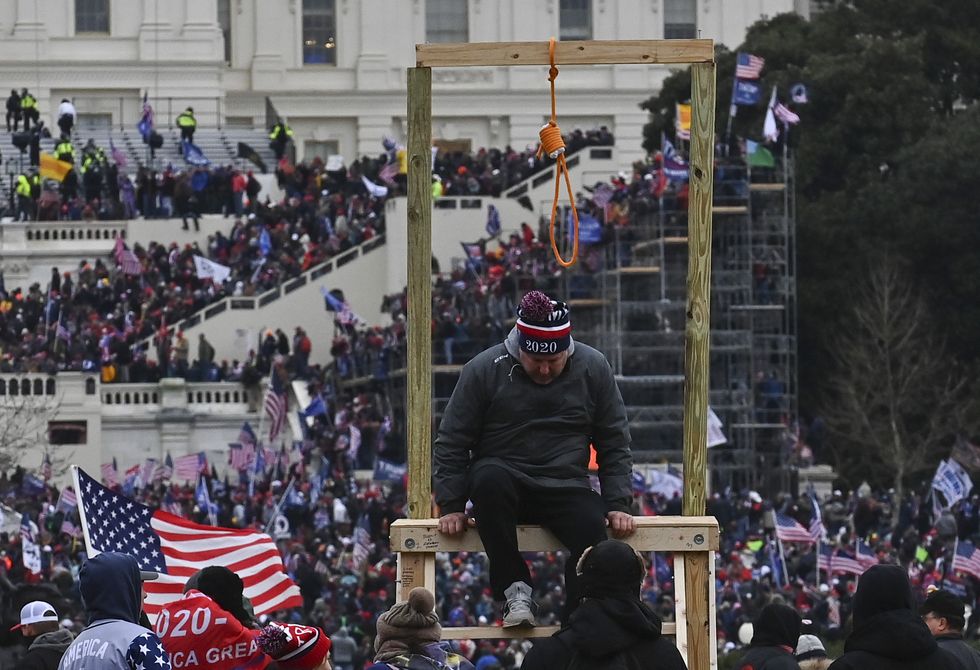 A man climbs down after being photographed with a noose during a protest calling for legislators to overturn the election results in President Donald Trump's favor at the US Capitol on January 6, 2021 in Washington, DC. (Photo by Ricky Carioti/The Washington Post via Getty Images)
Asked about plans to bring charges against Hutchinson, a DOJ spokesperson said, "The department does not confirm or deny the existence of investigations, or the lack thereof."
But the department's pursuit of Hutchinson has been public knowledge since at least April, when The New York Times reported that a criminal investigation into the former White House aide had been opened.
The Times noted that it was highly unusual for such a probe to be undertaken by the Civil Rights Division—which usually handles cases of discrimination—rather than the US attorney for the District of Columbia.
Efforts to prosecute Hutchinson follow attempts by the DOJ to bring charges against the president's other perceived enemies, including former FBI Director James Comey and New York Attorney General Letitia James, both of which have been thrown out of court.
In a post on social media, Andrew Fleischman, a Georgia-based trial and appeals lawyer, decried the targeting of Hutchinson as "a chilling and corrupt indictment of a woman who told the truth," but also "yet another opportunity for the Trump DOJ to shit its pants in court."

"America, we cannot let McCarthy and Carlson become the Orwellian editors of our past or the authoritarian authors of our future," exhorted the Maryland Democrat.
As right-wing politicians and pundits continue to peddle lies and conspiracies related to the January 6, 2021 attack on the U.S. Capitol by supporters of then-President Donald Trump, Democratic Maryland Congressman Jamie Raskin on Wednesday delivered a passionate rebuttal of Republicans' "nonsense."
Speaking on the House floor, Raskin asserted that "it all starts" with "Donald Trump's 'Big Lie'" that the 2020 presidential election was stolen.
He continued: "They say, 'Who knows, maybe he won, maybe he didn't. You say Joe Biden's president, we say Donald Trump's president.' Nonsense!"
"Sixty federal and state courts rejected every claim of electoral fraud and corruption that they put forward. Sixty," Raskin—who was the lead manager for Trump's historic second impeachment—reminded listeners. "They don't have a single court that ever ruled in their favor. Donald Trump lost that election by more than seven million votes, 306-232 in the Electoral College."
"So then... their Big Lie has to stretch all the way over January 6," Raskin said. "We have to disbelieve the evidence of our own eyes and our own ears. We saw them come and descend upon this chamber, this Congress, wounding and injuring 150 of our police officers, breaking people's noses, breaking people's fingers, putting people in the hospital, and already they're back on the news with big lies saying, 'No, no, no, it was a tourist visit.'"
Referring to the Fox News opinion host and the Republican House speaker, Raskin tweeted Wednesday that "Tucker Carlson's assault on the truth about January 6 is unconscionable, but more scandalous yet is Kevin McCarthy's central role in its design. America, we cannot let McCarthy and Carlson become the Orwellian editors of our past or the authoritarian authors of our future.
On Monday evening, Carlson—who according to legal documents said he "passionately hates" Trump even as he publicly amplified the ex-president's lies—dubiously dismissed the Capitol attack as "mostly peaceful chaos."
Carlson's characterization was roundly rejected even by numerous Republican senators including Thom Tillis of North Carolina, who called the false narrative "bullshit."
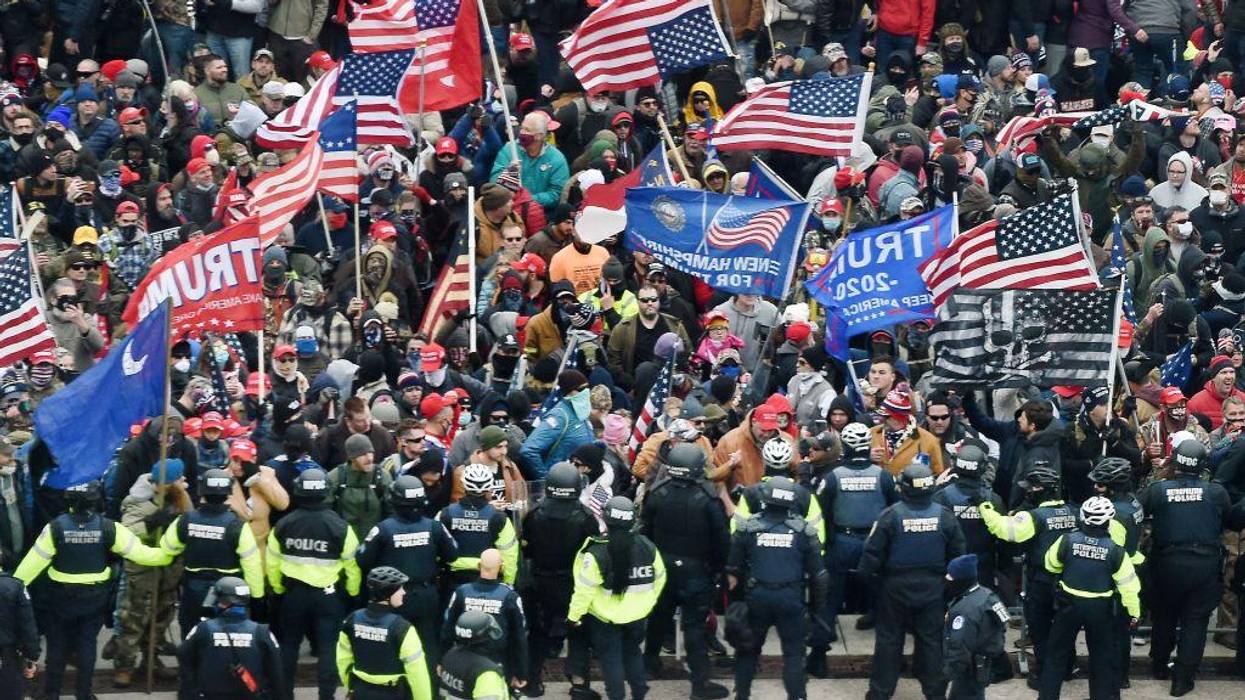
"If we don't confront Christian nationalism then we are leaving ourselves open to future attacks, like what we saw on January 6," said one critic.
In an effort to fill in what they say are critical gaps in the U.S. House select committee's report on the January 6, 2021 attack on the U.S. Capitol, faith leaders are pushing the corporate media and the American public to confront the role Christian nationalism played in the insurrection, warning that ignoring the link could make similar violence more likely in the future.
The committee's report, released last week, laid out extensive evidence showing that former President Donald Trump was the driving force behind the attack aimed at stopping lawmakers from certifying the 2020 presidential election results, but mentioned Christian nationalism just once, despite the fact that many of the Trump supporters who stormed the Capitol openly expressed Christian nationalist beliefs before, during, and after the attack.
As Religion News Service reported last week, some Trump supporters who attempted to overthrow the government carried flags displaying a so-called "Jesus fish" painted red, white, and blue like the American flag along with the words "Proud American Christian." Hundreds took part in what they called a "Jericho March" and prayed for the election results to be overturned the day before the insurrection, and some were heard chanting, "Christ is king" in Washington, D.C. on January 6.
"The symbols of Christian nationalism were on full display not only on January 6 itself, but at numerous rallies leading up to the attack," Amanda Tyler, executive director of the Baptist Joint Committee for Religious Liberty (BJC), told Alicia Menendez on MSNBC on Wednesday.
Christian Nationalism Conspicuously Absent From January 6 Reportwww.youtube.com
The report, however, only noted that supporters of white supremacist Nick Fuentes, who was in Washington on January 6 but has not been accused of breaching the Capitol, have "repeatedly promoted white supremacist and Christian nationalist beliefs."
The inclusion of just a single reference to Christian nationalism—the belief that the government should actively ensure that the U.S. is a Christian nation—was something faith leaders warned against earlier this year when they called on lawmakers to closely examine the role the belief system played in convincing thousands of people to storm the Capitol and continue to question the 2020 election results long after January 6.
In June, Christians Against Christian Nationalism, a project of the BJC, wrote in a letter to the House committee that "Christian nationalism helped motivate and intensify the insurrection" and that lawmakers should "thoroughly investigate the role that Christian nationalism played in the attack."
"This seditious mob was motivated not just by loyalty to Trump, but by an unholy amalgamation of white supremacy and Christianity that has plagued our nation since its inception and is still with us today," wrote Robert P. Jones, president of the Public Religion Research Institute (PRRI), at the time.
As Religion News Service reported last week, a spokesperson for committee member Rep. Liz Cheney (R-Wy.) suggested weeks before the report was released that the congresswoman objected to focusing seriously on Christian nationalism, telling The Washington Post that Cheney "won't sign onto any 'narrative' [that] suggests every American who believes God has blessed America is a white supremacist."
Lawmakers including Cheney, who leaves office next week, "fear that confronting Christian nationalism might be misconstrued as an attack on Christianity or Christians, and nothing could be further from the truth," Tyler told MSNBC. "We are trying to draw attention to what Christian nationalism is... Christian nationalism turns Christianity's gospel of love into a false idol of power. It turns John's gospel teaching us that God so loved the world on its head, saying falsely that God has a special plan for the U.S. or that God loves the U.S. more than any other country, or that God has preordained election results."
Faith leaders are working to explain "why that's not the case," added Tyler, "because if we don't confront Christian nationalism then we are leaving ourselves open to future attacks, like what we saw on January 6."

The report reads like Dostoevsky’s classic novel. Will Donald Trump be brought to justice like the book's dark protagonist?
The most surprising thing about the final report of the U.S. House Select Committee to Investigate the January 6th Attack on the United States Capitol isn’t the mountain of evidence of Donald Trump’s criminality that it contains nor the criminal referrals it makes to the Justice Department, but its readability. According to The New York Times, at least a half dozen publishing houses are releasing their own editions of the 845-page tome. On a December 22 broadcast, MSNBC host Lawrence O’Donnell nailed it when he remarked, “This is the way a great novelist would lay out this story.”
But it isn’t just any novel the report calls to mind. The closest approximation is Fyodor Dostoevsky’s classic psychological drama, Crime and Punishment.
Both the great novel and the report are constructed around a tortured central character who thinks he is above the law. Dostoevsky’s dark protagonist Roidon Raskolnikov kills an elderly pawnbroker and her half-sister and then struggles to convince himself that murder can be justified if committed to demonstrate and secure the power of an extraordinary man. Similarly, the report’s protagonist is the forty-fifth President of the United States, who plots to overthrow his own government in a vain and desperate attempt to cling to power and glory.
I’m not the first commentator to compare Trump to Raskolnikov. New York Times columnist Maureen Dowd beat me to the punch in a 2017 op-ed penned during the Mueller investigation, where she wrote:
“Both men [Trump and Raskolnikov] are naifs who arrive and think they have the right to transgress. Both are endlessly fascinating psychological studies: self-regarding, with Napoleon-style grandiosity, and self-incriminating. Both are consumed with chaotic, feverish thoughts as they are pursued by law enforcement.”
This isn’t to say, of course, that the parallels are exact. Unlike Raskolnikov, for example, Trump will never acknowledge his culpability for the insurrection, which led to the deaths of seven people. The report, after all, isn’t a work of fiction, even if at times it might read like one with chapter headings including “The Big Lie,” “I Just Want to Find 11,780 Votes,” and “Just Call it Corrupt and Leave the Rest to Me.”
And then there is the all-important question of punishment. Raskolnikov ultimately confesses his guilt and is sentenced to prison. Trump, by contrast, remains a free man, and continues to rage on his social media platform—the ludicrously named Truth Social—against his accusers, protesting his innocence and claiming, as always, that he’s the victim of a political witch hunt.
Trump’s prosecution, at least at the federal level (he’s also under serious investigation in the states of Georgia and New York), now rests in the hands of the Justice Department and special counsel Jack Smith. The DOJ has received criminal referrals from the committee for four overlapping federal felonies committed by the former President:
The committee has also referred five of Trump’s former aides and associates to the Justice Department: John Eastman, Mark Meadows, Rudy Giuliani, Kenneth Cheseboro, and Jeffrey Clark. Trump, however, is the only member of the crew who has been referred for insurrection. The report singles out the ex-commander-in-chief on the insurrection charge, stating “the central cause of January 6th was one man, former President Donald Trump.”
Although the referrals are non-binding, Smith is already in the thick of investigating the insurrection and the plot to overturn the 2020 election, presenting evidence to at least two grand juries. The special counsel is also leading the investigation into Trump’s removal of top-secret government documents to his Mar-a-Lago resort in Florida.
Convicting Trump will not be easy, especially on charges related to January 6. Each of the felonies referred to the Department of Justice requires proof of criminal intent. The government will have to establish beyond a reasonable doubt that Trump knew he had lost the election and was acting with a “corrupt purpose” to obstruct the work of the joint session of Congress or, on the conspiracy referral, that he had an intent to defraud the nation with the submission of fake slates of electors.
It will be particularly challenging to prove that Trump incited or assisted the insurrection as Trump would likely mount a First Amendment defense. In its landmark 1969 decision in Brandenburg v. Ohio, the Supreme Court articulated a two-part test for punishing incendiary speech, holding that the First Amendment protects advocating the use of force or lawbreaking “except where such advocacy is directed to inciting or producing imminent lawless action and is likely to incite or produce such action” (emphasis added).
Still, it’s easy to understand why the committee chose to cite Trump for insurrection. Trump knew that members of the crowd who had gathered to hear him talk were armed when he urged them to march to the Capitol to “fight like hell.” And amid the ensuing melee, he accused Pence of cowardice for not using his authority as Vice President to change the outcome of the election, seething in a Tweet, “Mike Pence didn’t have the courage to do what should have been done to protect our Country and our Constitution…USA demands the truth!” Almost immediately after the Tweet was posted, the report notes, “the crowd around the Capitol surged, and more individuals joined the effort to confront police and break further into the building.”
Should Trump be tried and convicted of insurrection, he would face a prison sentence of up to ten years. He would also be barred from holding federal office for life.
So, what are the odds that Trump is finally held to account? Will Jack Smith prove to be Trump’s Porfiry Petrovich, the police investigator who brought Raskolnikov to justice, or will he turn out to be another Robert Mueller? We may have the answer in a matter of months.

Rep. Jamie Raskin, soon to be the top Democrat on the House Oversight Committee, said Sunday that the Electoral College is a "danger" to U.S. democracy and should be abandoned in favor of presidential elections decided by the popular vote.
"The Electoral College now, which has given us five popular vote losers as president in our history, twice in this century alone, has become a danger, not just to democracy, but to the American people," Raskin (D-Md.) said in an appearance on "Face the Nation" Sunday. "It was a danger on January 6. There are so many curving byways and nooks and crannies in the Electoral College that there are opportunities for a lot of strategic mischief."
"We should elect the president the way we elect governors, senators, mayors, representatives, everybody else: Whoever gets the most votes wins," added Raskin, who served on the House select committee that investigated the January 6, 2021 attack on the U.S. Capitol.
Axios reported earlier this year that some members of the January 6 panel wanted "big changes on voting rights—and even to abolish the Electoral College—while others are resisting proposals to overhaul the U.S. election system."
In its final report, the House committee stopped short of calling for the abolition of the Electoral College, something progressives have demanded for years.
The Maryland Democrat's comments came days after Congress approved reforms to the Electoral Count Act, an obscure 1887 law that governs the tallying of Electoral College votes.
"For years, legal scholars have worried the law was poorly written and in need of clarification, and former President Donald Trump and his allies targeted the law's ambiguities in their attempts to overturn the 2020 election," NPR noted last week. "In the time after voting ended in 2020 and results were certified, Trump and his team argued that then-Vice President Mike Pence had the power to interfere with the counting of electoral votes because the law as it currently stands names the vice president as the presiding officer over the joint session of Congress where those votes are counted."
"The update passed by the Senate would clarify that the vice president's role in the proceedings is purely ceremonial," the outlet explained. "Importantly, the measure also would raise the bar for objecting to a state's slate of electors. As it stands now, it takes just one member of the House and one senator to challenge a state's electors and send both chambers into a potentially days-long debate period, even without legitimate concerns."
While welcoming the newly passed reforms, Raskin said Sunday that they won't "solve the fundamental problem."
"We know that the Electoral College doesn't fit anymore, which is why I'm a big supporter of the National Popular Vote Interstate Compact, where it's bubbling up from below," Raskin continued. "There are now 15 or 16 states and the District of Columbia who've said, 'We're going to cast our electors for the winner of the national vote once we get 270 electors in our coalition.'"
The compact—which has the goal of guaranteeing the presidency to "the candidate who receives the most popular votes across all 50 states and the District of Columbia"—has thus far been backed by 16 U.S. jurisdictions with a total of 195 electoral votes.
Last week, Florida State Rep. Michael Gottlieb—a Democrat—filed legislation that would make the Sunshine State the latest to join the compact. The bill is expected to face opposition from Republicans in the state, including Gov. Ron DeSantis—a possible 2024 presidential candidate.
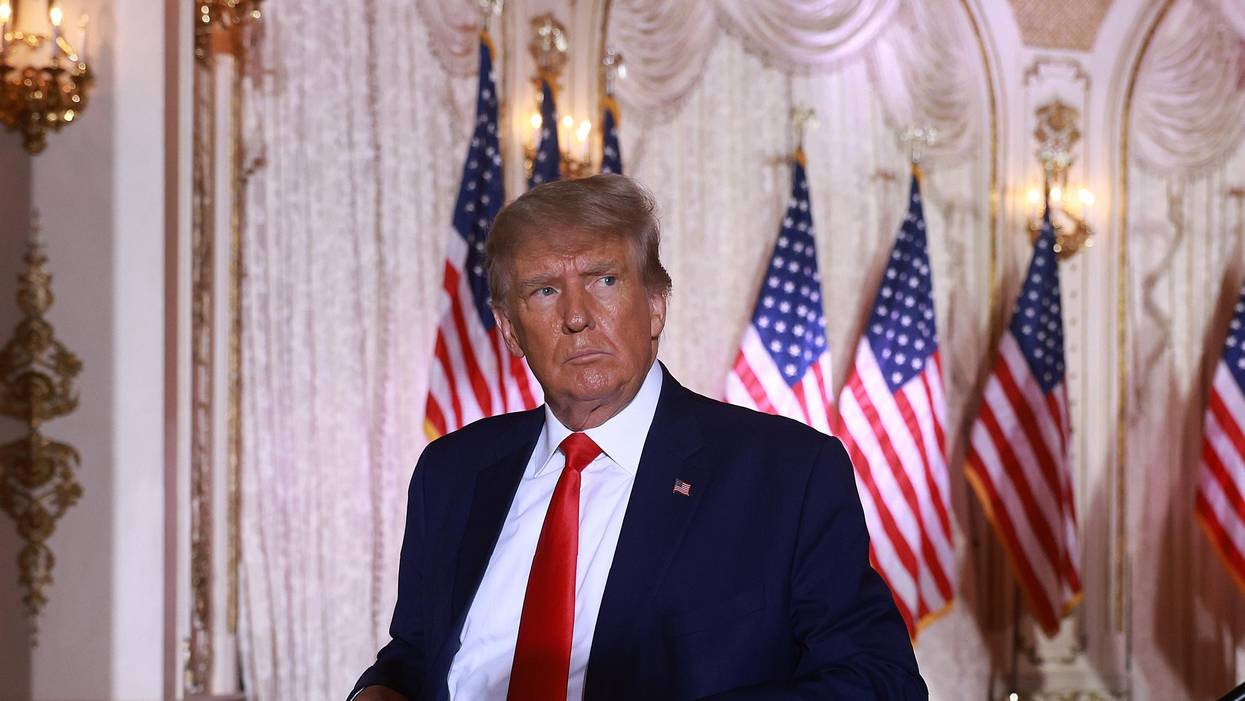
Trump did not start the myth of voter fraud—that has been a partisan staple for two decades now.
Congress has approved a budget that includes essential reforms to the Electoral Count Act. The updates, which have broad bipartisan support, eliminate ambiguities in the electoral count process that former President Trump and his allies seized on as they tried to overturn the 2020 election. Anyone looking to undermine future election results will have fewer options, and that is a victory for our democracy.
The passage comes on the heels of the January 6 committee’s release of its full report. The panel made news by making four criminal referrals for the former president. Senate Minority Leader Mitch McConnell, of all people, put it well in response: “The entire nation knows who is responsible for that day.”
In the wake of the committee’s extraordinary work, an important remaining question is not who caused the insurrection but rather what caused the insurrection.
First, let’s take a moment to appreciate the panel’s achievement. It made clear through riveting hearings and careful leaks that this was not just a rally that got out of control but a vigorously pursued plot to overthrow American democracy. The committee documented extraordinary crimes. We thought we knew it all, but it was gripping.
Such congressional investigations once regularly commanded headlines. The most famously effective was the Senate Watergate committee in 1973. That — together with the Church Committee, which exposed wrongdoing by the FBI and CIA — dominated the news but also led to reforms, from the federal campaign finance laws to the establishment of the joint congressional intelligence committee.
Reform sometimes follows scandal. And there has been no greater scandal than Donald Trump’s effort to block the peaceful transfer of power.
But putting the blame squarely and exclusively on Donald Trump is not enough to protect our democracy. Trump did not start the myth of voter fraud — that has been a partisan staple for two decades now. His attempt to subvert the 2020 election exposed vulnerabilities in our legal and electoral systems. Most of them remain, waiting for a second Donald Trump to come along and exploit them again. Those weaknesses are what caused the January 6 insurrection. The committee’s work could have even longer-lasting benefits if its revelations help spur reform.
It starts with fixing the Electoral Count Act. Trump’s loony reading of the creaky and outdated 19th-century law provided the foundation for his pressure campaign against Vice President Mike Pence. The newly passed reform makes clear that vice presidents have a merely ministerial role and makes it harder for members of Congress to object to duly cast electoral votes. These changes cement that the reading of the electoral votes is a ceremony, nothing more. They and other important fixes to the Electoral Count Act are included in the budget bill.
That bill also includes federal funding to upgrade election infrastructure and keep election officials safe, though not nearly enough. We should never forget that Trump’s pressure campaign did not stop with Pence. Trump personally called state election officials, urging them — without any cogent rationale — to overturn his defeat. Trump’s counsel, Rudy Giuliani, falsely accused local election workers of fraud. As a result of Trump’s campaign against these public servants, election workers in several states were harassed, threatened, and chased from their homes. Going forward, Congress must act decisively to protect election officials in their homes and in their offices, providing a reliable source of funding for much-needed security.
Other changes will require sustained pressure from the American people. National baseline standards for federal elections should be high on that list. For example, Trump’s team argued for the invalidation of Pennsylvania’s slate of electors, on the theory that state officials should not have complied with a state supreme court ruling requiring them to count mail votes received several days after the election but postmarked by Election Day. A spurious argument, but the silence of federal law on when and how mail ballots should be counted gave it unnecessary fuel. With 50 states conducting the election with almost 50 different procedures, close elections will lead to similar claims in the future.
The Constitution unquestionably gives Congress the power to fix this problem. With every state playing by the same rules, there would be less room for allegations of impropriety.
These are just the beginning of the necessary reforms. There should be guaranteed funding for states to conduct reliable post-election audits. Congress should fund state efforts to combat election-related disinformation and restore the protections of the Voting Rights Act to prevent racial discrimination in voting — Trump’s attempt to overturn the 2020 election primarily targeted voters of color. The list goes on.
The January 6 committee performed a vital service. It left us with indelible images. But now that its work is over, focusing solely on Trump himself would be a major mistake. Mending weak points in our election system should be a bipartisan priority. It starts with the Electoral Count Act, but I hope it will not end there.

"None of the events of January 6th would have happened without him," the 845-page report concludes.
The House select committee tasked with investigating the January 6, 2021 attack on the U.S. Capitol released its final report late Thursday, drawing from hundreds of witness interviews and a vast trove of documentary evidence to make the case that former President Donald Trump was the primary cause of the deadly insurrection and the failed attempt to overthrow the government.
"In the committee's hearings, we presented evidence of what ultimately became a multi-part plan to overturn the 2020 presidential election," reads the panel's report, which spans nearly 850 pages. "That evidence has led to an overriding and straightforward conclusion: the central cause of January 6th was one man, former President Donald Trump, whom many others followed. None of the events of January 6th would have happened without him."
As part of its recommendations for congressional action, the committee's report echoes growing calls for lawmakers to consider barring Trump from ever holding public office again, noting that "those who took an oath to protect and defend the Constitution and then, on January 6th, engaged in insurrection can appropriately be disqualified" under Section 3 of the 14th Amendment.
The report caps off an 18-month investigation that Trump and his top associates—who spent months lying about the 2020 election and peddling false claims of fraud—attempted to impede at every step. The January 6 panel released documents Thursday detailing former White House aide Cassidy Hutchinson's testimony that Trump's allies pressured her not to cooperate with the committee.
But despite the obstruction, the committee used its subpoena power to obtain copious witness interviews, statements, and documents—including a draft executive order that would have instructed the Pentagon to seize state voting machines—to build its argument that Trump was ultimately responsible for the events of January 6, a case it laid out in detail over the course of 10 public hearings.
"Each of these actions by Donald Trump was taken in support of a multi-part conspiracy to overturn the lawful results of the 2020 presidential election."
"Without any evidentiary basis and contrary to state and federal law, Donald Trump unlawfully pressured state officials and legislators to change the results of the election in their states," the committee's report states. "Donald Trump oversaw an effort to obtain and transmit false electoral certificates to Congress and the National Archives. Donald Trump pressured members of Congress to object to valid slates of electors from several states. Donald Trump purposely verified false information filed in federal court."
And "based on false allegations that the election was stolen, Donald Trump summoned tens of thousands of supporters to Washington for January 6th," the report continues. "Although these supporters were angry and some were armed, Donald Trump instructed them to march to the Capitol on January 6th to 'take back' their country. Each of these actions by Donald Trump was taken in support of a multi-part conspiracy to overturn the lawful results of the 2020 presidential election."
The panel released its final report as well as supplementary witness interview transcripts days after it recommended that the U.S. Justice Department pursue criminal charges against Trump for inciting insurrection, obstructing Congress, and engaging in a conspiracy to defraud the United States. The DOJ is currently conducting a criminal investigation into the twice-impeached former president, who is running for the White House again in 2024.
House Republicans, many of whom backed Trump's coup attempt, are expected to shut down the January 6 committee once they take control of the chamber next month.
"Every American should be alarmed by how close our nation came to a successful coup orchestrated from inside the Oval Office," said Christina Harvey, executive director of Stand Up America. "Now that the committee has concluded its investigation, Donald Trump and his seditious co-conspirators must be held accountable. No one is above the law—not the president and not the members of Congress who betrayed their oath of office by aiding and defending him."
This story has been updated to include a statement from Stand Up America.
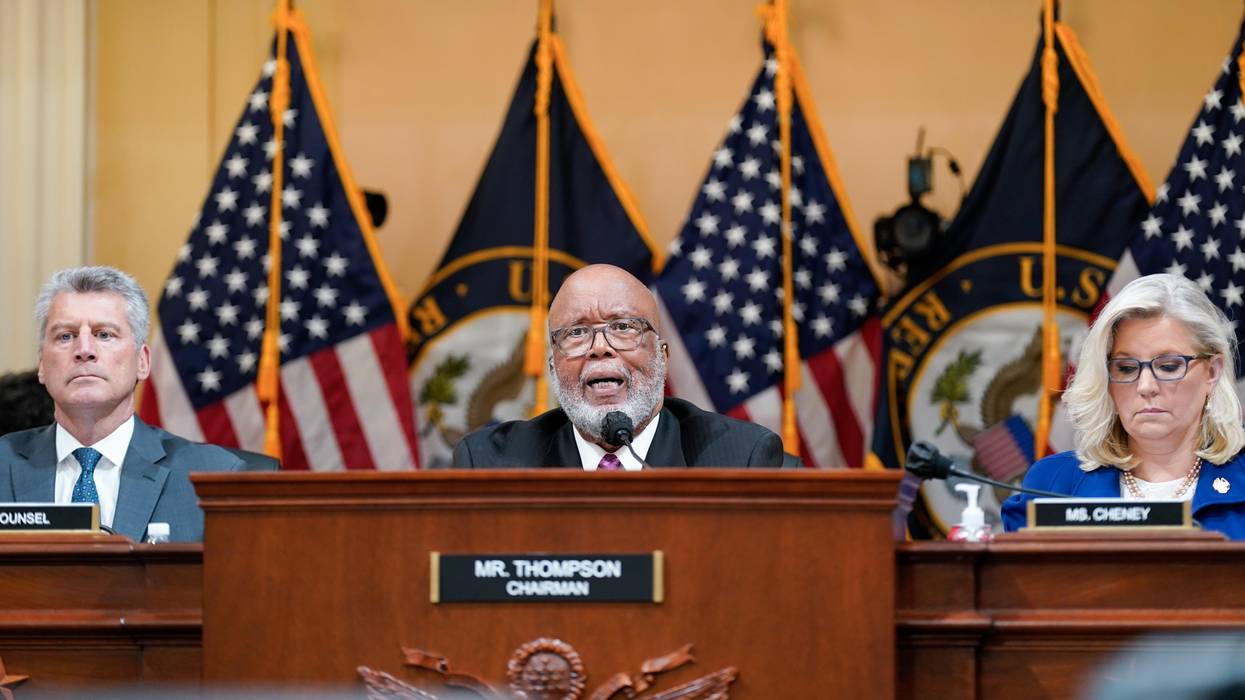
The final public hearing of the Select Committee to Investigate the January 6th Attack on the United States Capitol will be held Monday afternoon, a televised session that will include a vote on issuing criminal referrals against former president Donald Trump to the U.S. Department of Justice.
In public statements and interviews over recent days, committee members have made clear their shared belief that Trump is guilty of criminal conduct related to his involvement in the lead up to the insurrection that took place on January 2, 2021 and his behavior on that day.
"I think the president has violated multiple criminal laws," said Rep. Adam Schiff (D-Calif.) during a Sunday appearance on CNN. "And I think you have to be treated like any other American who breaks the law, and that is, you have to be prosecuted."
While referrals by the committee would carrying no specific legal consequences for Trump, the ultimate question remains whether Attorney General Merrick Garland will file criminal charges against the former president who last month announced he is seeking the presidency in 2024.
Watch Monday's hearing live at 1:00 pm local time in Washington, D.C.:
According to the Washington Post:
The criminal and civil referrals will precede the release of a final report compiled by the committee that will tell the most comprehensive story to date of the events leading up to the attack and Donald Trump's role in fomenting it.
The committee is expected to vote on referring Trump for three charges: obstruction of an official proceeding of Congress, conspiracy to defraud the United States and insurrection. Politico first reported that the three charges would be considered by the panel.
In addition to DOJ referrals for Trump, the committee is also considering consequences over ethics violations for Republican members of Congress who refused to comply with subpoenas issued by the panel.
"None of the subpoenaed members complied," said Rep. Jamie Raskin (D-Md.), a committee member, said during a closed-door meeting on Sunday, according to reporting by NBC News. "And we are now referring four members of Congress for appropriate sanction with the House Ethics Committee for failure to comply."
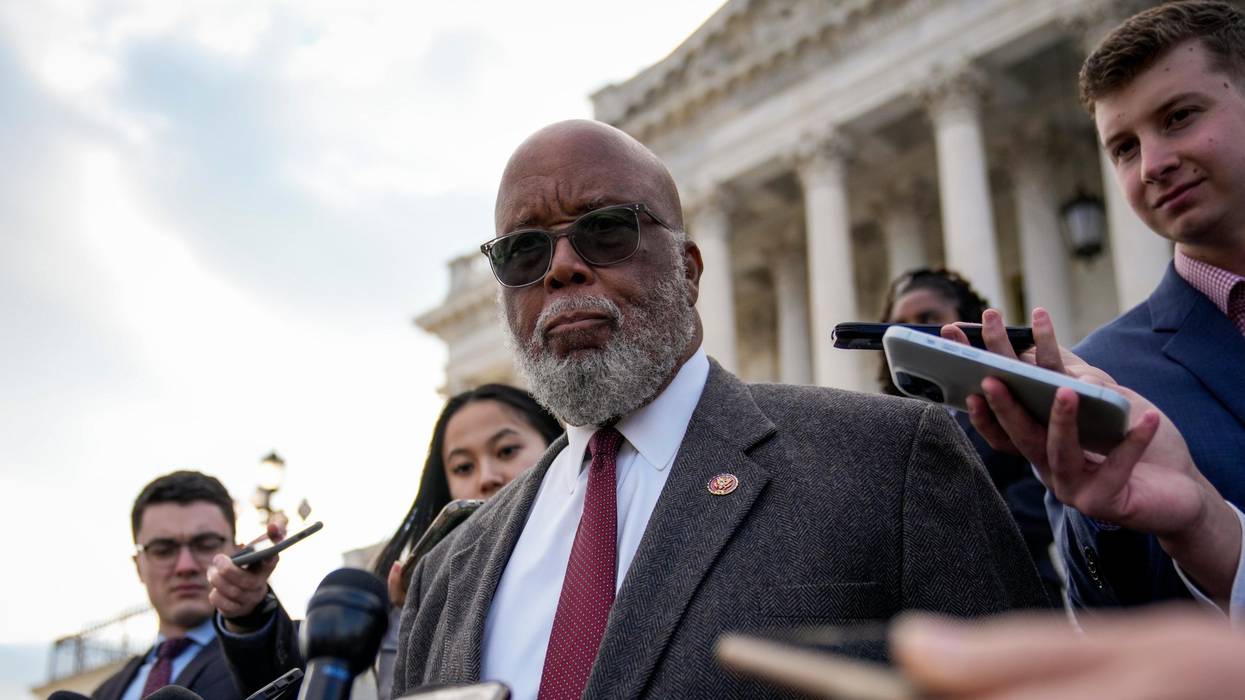
The House Select Committee to Investigate the January 6th Attack on the U.S. Capitol has created a subcommittee to deal with "outstanding issues," including potential criminal referrals to the Department of Justice, the panel's chair confirmed Thursday.
"We need to have a decision as to what we do with the members who did not recognize the subpoenas."
Chair Bennie Thompson (D-Miss.) told journalists at the Capitol that he established the subcommittee, led by Rep. Jamie Raskin (D-Md.), "about a month ago."
The subcommittee's other members are Reps. Adam Schiff (D-Calif.), Zoe Lofgren (D-Calif.), and Liz Cheney (R-Wyo.), the full panel's vice chair. Thompson noted that "they're all lawyers."
Raskin explained that "we're looking at potential referrals or criminal offenses and for civil offenses and for general lawlessness where it might not otherwise be obvious."
"We're looking at criminal and civil referrals for people who have broken the law and may have escaped scrutiny," added Raskin, who previously served as the lead manager for former President Donald Trump's historic second impeachment for inciting the Capitol attack with his "Big Lie" about the 2020 election.
Thompson said that "we need to have a decision as to what we do with the members who did not recognize the subpoenas. It's cleaning up every unfinished piece of work for the committee. And that part of it just fit better in some subcommittee. Let them come back and report, and we'll make a decision."
According to Axios, "Thompson said the panel will also look at how to respond to the DOJ's request for deposition transcripts and other information."
Trump announced his campaign for the 2024 Republican presidential nomination on Tuesday, a day after he failed to comply with a subpoena from the select committee requiring him to appear for a deposition.
Thompson and Cheney said in a statement Monday that though the ex-president "initially suggested that he would testify before the committee, he has since filed a lawsuit asking the courts to protect him from giving testimony. His attorneys have made no attempt to negotiate an appearance of any sort, and his lawsuit parades out many of the same arguments that courts have rejected repeatedly over the last year."
"The truth is that Donald Trump, like several of his closest allies, is hiding from the select committee's investigation and refusing to do what more than a thousand other witnesses have done," they added. "Donald Trump orchestrated a scheme to overturn a presidential election and block the transfer of power. He is obligated to provide answers to the American people. In the days ahead, the committee will evaluate next steps in the litigation and regarding the former president's noncompliance."
The committee members voted unanimously to subpoena Trump at the end of the panel's last public hearing in October--an event that led New York University law professor Ryan Goodman to conclude, "I think they were trying to hand the Justice Department all the evidence on a silver platter."
Goodman was among former federal prosecutors, defense attorneys, and other legal experts who on Thursday published a model prosecution memorandum laying out potential charges against Trump related to his handling of classified government documents since he left office.
Five congressional Republicans--Reps. Andy Biggs (Ariz.), Mo Brooks (Ala.), Jim Jordan (Ohio), Scott Perry (Penn.), and Kevin McCarthy (Calif.), likely the next speaker of the House after the GOP won a majority in last week's midterms--have also ignored subpoenas from the select committee.
With Republicans set to take control of the House in January, the committee is on a tight deadline to conclude its work. Thompson told reporters Thursday that the panel is planning to release its final report next month.
"Our goal is to get it completed soon so we can get it to the printer," he said. "We plan to have our product out sometime in December."
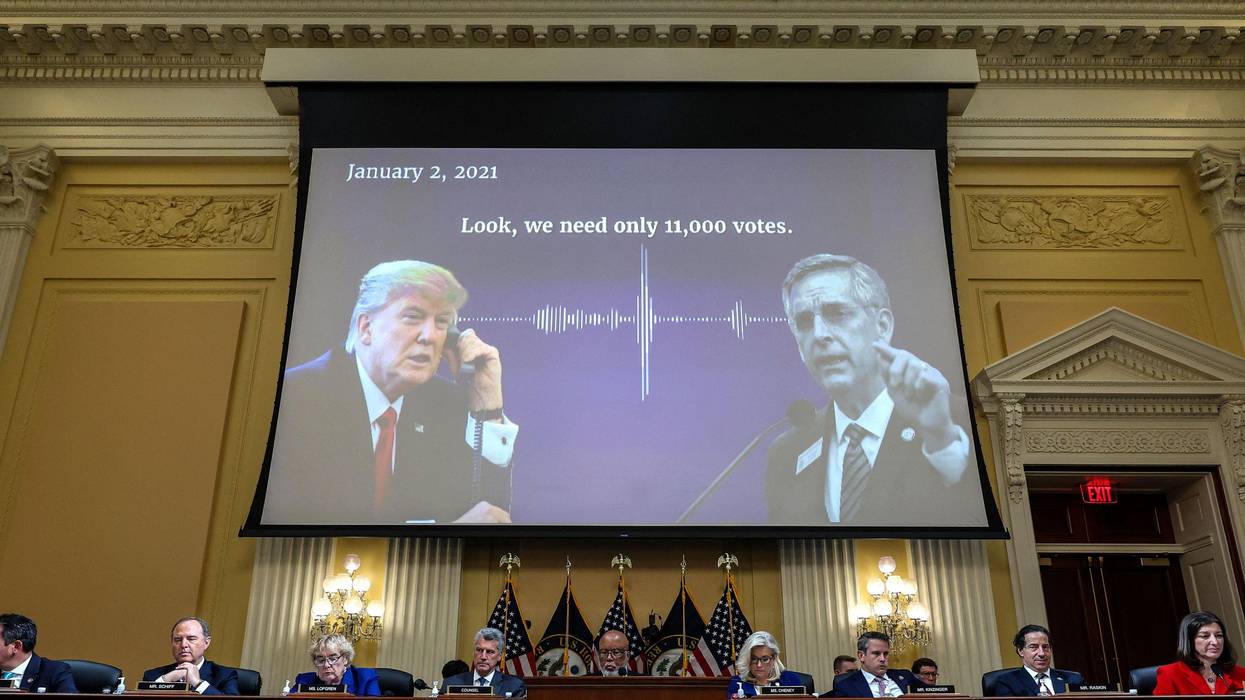
The U.S. House panel probing the January 6, 2021 attack on the U.S. Capitol unanimously voted Thursday to subpoena former President Donald Trump "to provide evidence as part of the committee's investigation."
The panel's hearing--expected to be the last before next month's midterm elections--largely focused on Trump's role in the attack. In what critics now call his "Big Lie," the former president repeatedly claimed, including in a speech the day of the insurrection, that Democrats stole the 2020 election.
Plans for the subpoena vote--which were initially reported by NBC News and Politico--and the result were welcomed by defenders of U.S. democracy.
"A subpoena of a former president shouldn't be taken lightly. Neither should staging an attempted coup to change the outcome of an election," said University of California, Berkeley professor and former U.S. Labor Secretary Robert Reich.
Along with the subpoena vote, the committee showed that "Trump Secret Service was warned that a mob was coming to the Capitol on January 6th to 'kill people' and did nothing to stop it," noted Stand Up America executive director Christina Harvey. "Instead, Trump sicced the violent, armed mob on Congress and his own vice president."
"As shocking as these revelations were, they were also just a reminder of what we've known from the beginning: President Trump was the ringleader of the conspiracy to overturn the 2020 election. He and his allies did everything they could to hold onto power... strong-arming state officials, the Justice Department, and Trump's own vice president," she said.
"Everyone involved in this national embarrassment must be held accountable, and the committee took the first step toward that goal with its subpoena of the former president," Harvey added. "Though it is still unknown if this is the final time we hear from the committee, their work over the past year has proved the threat that Trump and his MAGA followers pose to our democracy and the importance of defeating them in November and beyond."
Common Cause president Karen Hobert Flynn declared following the vote that "Donald Trump remains a clear and present danger to our democracy. The January 6th select committee is right to subpoena the former president. But the committee has shown clearly that the then-president violated his oath of office and committed crimes for which he must be held accountable."
"Trump and his associates waged a weekslong campaign, that appears to have amounted to a criminal conspiracy, to overturn the will of the people and ignore the results of the 2020 election so that he could remain in power," she continued. "Trump and those who participated in this plot must be held accountable to the fullest extent of the law."
She stressed that "Trump must comply with the subpoena from the January 6th select committee because no one, including a former president, is above the law."
Lisa Gilbert, executive vice president of Public Citizen and co-chair of the Not Above the Law Coalition, said that Thursday's hearing "shows more clearly than ever that Trump was the mastermind of the insurrection and the multitudinous efforts to sabotage our democracy."
"The committee's subpoena is an important step to hold Trump accountable for the thwarted coup that he personally led," she added. "He must comply."
The Nation's Elie Mystal was among those who suggested that Trump's compliance is unlikely:
While not directly addressing the subpoena, just after the vote Trump took aim at the select committee and Cassidy Hutchinson--an ex-aide to his former chief of staff who testified to the panel in June--on his Truth Social platform.
Earlier Thursday, Gilbert had highlighted that "thousands of pieces of evidence and testimony from Trump's own staffers and foot soldiers have clearly laid out, fact by fact, what only those closest to him knew to be true: Trump engaged in a criminal conspiracy, knowingly made false claims--including claiming victory in the election--and incited a violent attack on the Capitol in order to overturn the 2020 election."
"Perhaps the most important fact to focus on now is that without accountability for these crimes, these attacks on our country will continue," she warned, noting that "MAGA politicians in state houses across the country are attempting to pass laws that will make future elections easier to steal, election officials are entering the November elections under the specter of harassment, and more and more proponents of the 'Big Lie' are on the ballot nationwide."
After praising the panel for its "admirable job laying out the facts of the unconstitutional threat posed by Trump and his allies," Gilbert argued that "it's time for action. That's why people are joining more than 75 events across the country to amplify the hearing revelations, and fight ongoing threats to our freedoms and our vote. America can't afford more election interference, lies, and sabotage. It's time to take a stand."
The watchdog group Citizens for Responsibility and Ethics in Washington (CREW) tweeted in response to the hearing Thursday that "the evidence of criminal conduct by Trump is so strong that the only option left is for the Department of Justice to indict him."
This post was updated after the committee voted to subpoena the former president.