

SUBSCRIBE TO OUR FREE NEWSLETTER
Daily news & progressive opinion—funded by the people, not the corporations—delivered straight to your inbox.
5
#000000
#FFFFFF
To donate by check, phone, or other method, see our More Ways to Give page.
Daily news & progressive opinion—funded by the people, not the corporations—delivered straight to your inbox.
US President Donald Trump continued his "war on science" on Friday with his budget request for the 2027 fiscal year, which critics have denounced as "grossly irresponsible" for its proposed $1.5 trillion in military spending and "a moral obscenity" because of its cuts to social and scientific programs.
In the lead-up to Trump's request to the Republican-controlled Congress, as he and Israel waged war on Iran, Sean Manning, a Herbert Scoville Jr. Peace Fellow in the Union of Concerned Scientists' Global Security Program, wrote that "if this Bloody New Deal actually passes, it could give unparalleled increases in financial power to defense contractors and support for the political work they already do to influence Congress."
"Sane voices need to act now, building opposition to this unprecedented plan," Manning argued. "Progressives should be unflinching in defining this proposal as a blank check for the same contractors who cannot deliver ships on time, munitions at scale, or clean audits. Pouring funds into a defense sector that has repeatedly failed basic tests of accountability will not miraculously produce innovation."
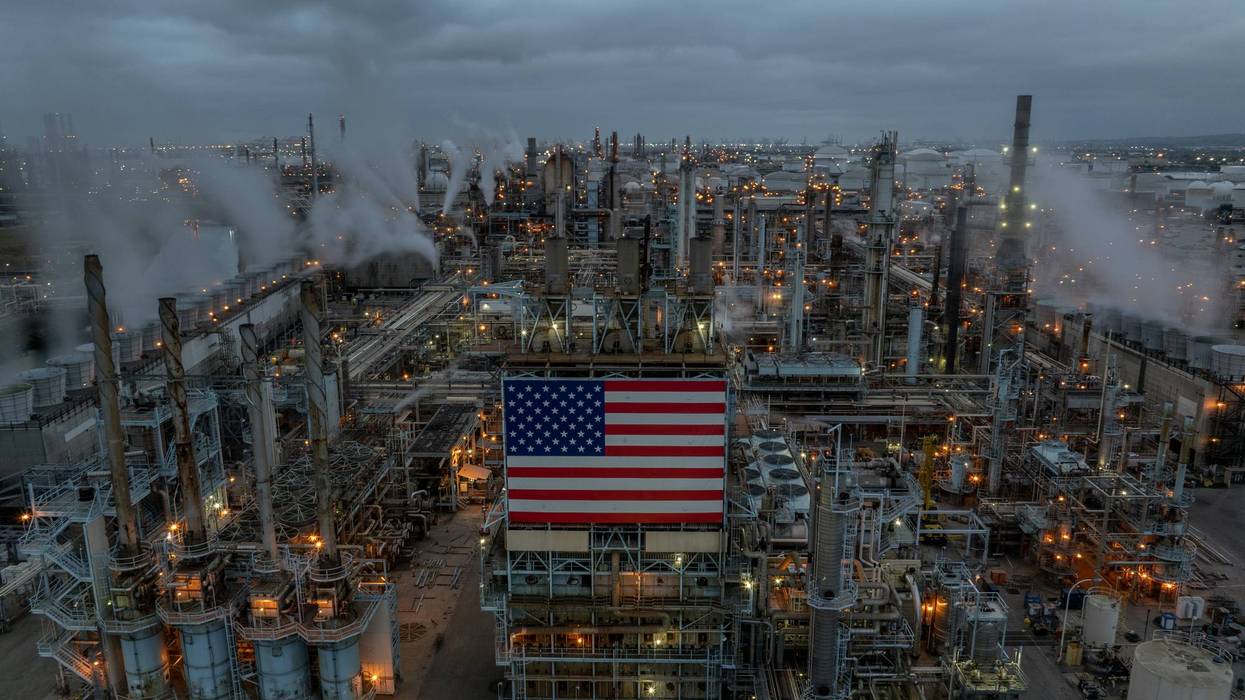
In addition to railing against the budget for the Pentagon—the world's largest institutional climate polluter—after it was officially released on Friday, progressive voices directed attention to some particular proposed cuts and their consequences.
To fund the Pentagon's massive war-making budget, "the Trump administration is requesting the cancellation of billions of dollars in funds for renewable energy, environmental justice, carbon removal, space science, and climate change education," Emily Gardner reported Friday for Eos, the American Geophysical Union's news magazine.
As Katherine Tsantiris, Ocean Conservancy's director of government relations, pointed out, among the targeted federal agencies is the National Oceanic and Atmospheric Administration (NOAA). The proposed cuts, she said, "fly directly in the face of the clear bipartisan support Congress showed earlier this year by protecting funding for this critical agency."
"Slashing NOAA's budget would weaken weather forecasting, disrupt fisheries management, and stall ocean research—putting American lives, livelihoods, and global scientific leadership at risk," Tsantiris continued. "Congress should once again reject these cuts to ensure NOAA has the resources it needs to support our economy, protect our ocean, and keep Americans safe."
Quentin Scott, federal policy director at the Chesapeake Climate Action Network Action Fund, argued that "this proposed budget is exactly what America does NOT need when facing rising energy bills, more frequent extreme weather, and rising insurance rates."
"By gutting funds for climate science and innovation, the budget jeopardizes our ability to understand and respond to the accelerating climate crisis," Scott said. "Defunding climate research at NOAA doesn't make the problem go away—it makes those hazards more dangerous and more expensive. Families across the country are already paying the price through higher utility bills, flooding, and storm damage. This budget would only make those burdens worse."
Big Oil-backed Trump's budget proposal came on the heels of devastating flooding in Hawaii and as high temperatures hit the Western United States. It also followed an annual World Meteorological Organization report on the fossil fuel-driven climate emergency, which last month led UN Secretary-General António Guterres to declare that "every key climate indicator is flashing red."
Devastating.
[image or embed]
— Scott Kardel aka Palomar Skies (@palomarskies.bsky.social) April 3, 2026 at 12:29 PM
Trump also proposed slashing the Environmental Protection Agency's budget—amid calls to oust Administrator Lee Zeldin for "so brazenly" betraying the EPA's core mission to "protect human health and the environment." Trump also proposed cutting the agency's budget. Noting that attack, Climate Action Campaign director Margie Alt described the president's plan as "anything but a serious" one and "a declaration of who this administration is willing to let suffer."
In a nod to some of the rich executives whose campaign cash helped Trump return to power after promising to scrap his predecessor's climate policies and to enact a "drill, baby, drill" agenda, Alt also called it "a reiteration of this president's devotion to fossil fuel interests."
"This budget would slash the EPA budget by 52%, gutting the agency's ability to protect the air our children breathe, the water our families drink, and the communities that already bear the worst of extreme weather and climate change," she said. "It is a deliberately callous choice to remove the protections that keep families safe, healthy, and shielded from the impacts of pollution and climate change."
According to Alt:
This is not just a continuation of last year's rollbacks. It is an escalation of the Trump administration's Polluters First Agenda and their assault on public health safeguards. Since January 2025, among other abuses, this administration has fired 600 National Weather Service staff, proposed eliminating critical climate research institutions, waived mercury pollution standards for 60 dirty power plants, and gutted the Clean Air Act. This budget is the Trump administration's payback for their big oil, coal, and gas friends and contributors. It slashes resources for clean energy, it zeroes out environmental justice, and pushes oil, gas, and coal, at a time when prices for these energy sources are skyrocketing.
Never before have we had an administration that so blatantly treats American lives as expendable, as proven by this budget. Congress must reject this inhumane budget in full. The American people deserve a federal government that protects them, not one that trades their health, their safety, and their futures for big oil, coal, and gas profits.
As Gardner reported, Trump's budget also "proposes consolidating the Endangered Species Act and Marine Mammal Protection Act, but did not provide details outside noting the program would be housed at the Department of the Interior," among other changes and cuts.
Chris Westfall, senior government relations legislative counsel at Defenders of Wildlife, said that "the administration is yet again demanding that an overworked and grossly understaffed federal workforce do more with less. The proposed budget recklessly consolidates US Fish and Wildlife Service and National Marine Fisheries without the needed resources to preserve scientific expertise, opens our lands and waters to extractive industries, and hollows out the already strained workforce that provides crucial conservation work."
"This proposed budget pushes us further in the wrong direction—potentially triggering even more staff layoffs and providing less resources for wildlife conservation, which are pivotal to recovering America's imperiled species," Westfall warned. "Our nation's lands and the wildlife that depend on them for habitat deserve better than to be ignored by agencies that are shells of their former selves."
The president's proposed attack on endangered species came just days after the administration's so-called "God Squad" voted unanimously for an exemption allowing fossil fuel operations in the Gulf of Mexico to ignore policies intended to protect them. In response, Andrew Bowman, president and CEO of Defenders of Wildlife, said that "I cannot stress enough how unprecedented and unlawful this action is."

"The Iran war is exposing the deadly consequences of global fossil fuel dependence."
With the price of oil surging and showing no signs of coming down anytime soon thanks to President Donald Trump's illegal war in Iran, renewable energy advocacy organization 350.org renewed its previous call to slap fossil fuel companies with a windfall profits tax.
In a Friday statement, 350.org noted that the oil supply shortage caused by the Iran war is growing so acute that it's leading to a "global surge" in coal production to meet energy demands.
Specifically, 350.org pointed to both Japan and South Korea lifting their coal consumption limits, as well as Thailand firing up old coal plants that had previously been shut down.
Additionally, the group found that "Indonesia, the world’s largest coal exporter, has reversed planned cuts to production," while "Australia, South Africa, Turkey, and the Philippines are also increasing exports to meet soaring demand."
The group said it expects the increased demand in coal to be a temporary byproduct of the Iran crisis, but warned "it will still impose heavy costs: increased deaths from air pollution, more climate chaos, and a transfer of wealth from consumers to coal producers in the form of windfall profits."
Given this, 350.org executive director Anne Jellema said it was time to impose a windfall profits tax on fossil fuel companies to help fund the continued development of renewable energy sources and provide real long-term relief to global consumers.
"The Iran war is exposing the deadly consequences of global fossil fuel dependence," said Jellema. "Coal producers are making massive profits while governments delay the clean energy transition. It’s a stark reminder why windfall taxes on fossil fuel companies are more relevant than ever."
Jellema added that Trump's Iran war "shows what we have long warned: fossil fuel dependence creates crises, profits for polluters, and suffering for ordinary people," and promoted windfall taxes and accelerated deployment of renewables as "urgent tools to turn this around."
Nations including Germany and Australia are weighing windfall oil taxes during the Iran crisis, and US Sen. Sheldon Whitehouse (D-RI) and Rep. Ro Khanna (D-Calif.) last month reintroduced their the Big Oil Windfall Profits Tax Act, a bill whose stated aim is "to curb profiteering by oil companies and provide Americans relief at the gas pump."
US consumers have been getting hit hard at the gas pump in recent weeks, and Democratic members of the Joint Economic Committee on Thursday released a report showing that Americans have collectively spent $8.4 billion more on gas than they otherwise would have since the beginning of the war.

His reckless attack on Iran will do a hundred times more to promote clean energy worldwide than all the incentives in Biden’s Inflation Reduction Act.
President Donald Trump has an incredibly childish obsession with outdoing his predecessors, who he constantly derides as stupid and corrupt. There is, of course, no evidence for Trump’s charges, like the supposedly terrible economy he inherited from President Joe Biden, but Donald Trump is not a man who feels constrained by reality.
While Trump does everything he can to reverse policies to promote clean energy, overturn trade agreements (including his own), and undermine security pacts, there is one area where Trump looks to substantially outpace the work of his predecessors.
This is in promoting the transition to a non-fossil fuel-based economy. As much as Trump loves oil and coal and seems to relish the prospect of destroying the planet for our kids, his reckless attack on Iran will do a hundred times more to promote clean energy worldwide than all the incentives in Biden’s Inflation Reduction Act.
There is both the direct effect of higher oil and gas prices resulting from the closing of the Straits of Hormuz, but also a more important indirect effect. Trump has shown the world that it is dangerous to rely on imported oil and natural gas as energy sources.
It certainly was not the best way to promote a green transition, but no one can deny that Trump’s war is effective.
This applies not only to imports from the Middle East, which apparently any jerk can shut down on a whim. The risks probably apply even more strongly to reliance on the United States as an exporter, Trump’s preferred outcome.
In his tariff games, Trump showed he can be incredibly arbitrary and capricious. He claimed that countries were “ripping us off” because they sell us stuff. There is nothing resembling logic to Trump’s claim. Do Walmart or Costco rip people off when they buy things from them?
But it gets worse. He imposed 50% tariffs on Brazil’s exports because it prosecuted Trump’s friend for trying to overthrow the government. India also faces 50% tariffs on its exports to the US because its prime minister refused to nominate Trump for a Nobel Peace Prize. And Switzerland got hit with a 39% tariff because Trump didn’t like the way its president talked.
The rest of the world would likely much rather take its risks with countries like Iran and Libya than rely on getting oil and gas from Donald Trump’s America. At least there is usually some logic to when these countries threaten to reduce output or raise prices.
The rise in oil and gas prices following the closure of the Straits is making clean energy far more competitive than was already the case. Even with oil at $60 a barrel, and natural gas correspondingly cheap, the vast majority of electricity coming on line across the globe was renewable. This shift will only accelerate, with oil prices up 70% and natural gas having close to doubled. While prices may fall back some if the Straits are reopened soon, they are unlikely to return to their pre-war levels for several years in almost any circumstances.
And the price of wind and solar energy continues to fall, driven primarily by low-cost Chinese manufacturers. Chinese electric vehicles will also become hugely more popular as a result of Donald Trump’s war. These cars are already cheaper to purchase than comparable traditional cars, and Trump has just added roughly $500 a year to the operating cost of a gas-burning vehicle. Already 60% of the cars sold in China are electric, with EVs holding a comparable share in Europe. The same is the case in many developing countries. The EV share will likely quickly move toward 100% thanks to Trump’s war.
It certainly was not the best way to promote a green transition, but no one can deny that Trump’s war is effective. Who knows how much damage the war will ultimately cause in terms of property destruction, the environment, and lives lost. The latter will include both direct effects from the war and likely much larger indirect effects from higher energy and food prices. But one positive outcome is that we will be moving far more rapidly toward a green economy.