

SUBSCRIBE TO OUR FREE NEWSLETTER
Daily news & progressive opinion—funded by the people, not the corporations—delivered straight to your inbox.
5
#000000
#FFFFFF
To donate by check, phone, or other method, see our More Ways to Give page.
Daily news & progressive opinion—funded by the people, not the corporations—delivered straight to your inbox.
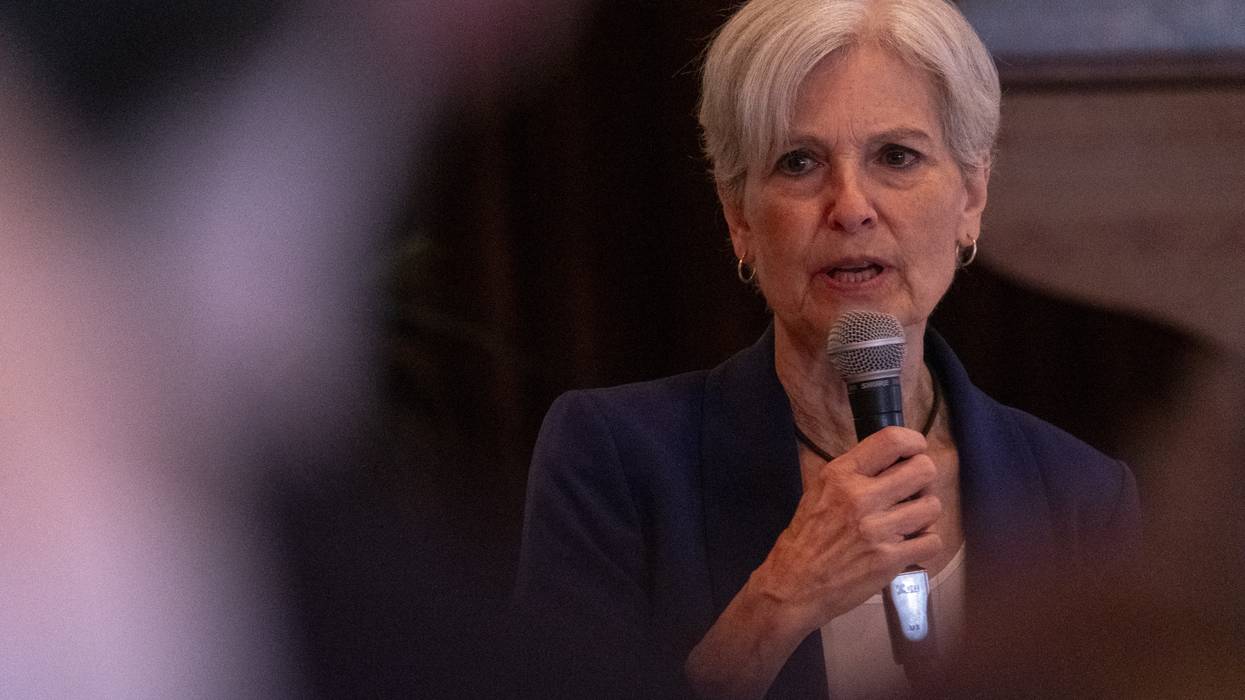
"We are clear that Kamala Harris is the only candidate who can block Donald Trump and his anti-democratic, authoritarian policies from the White House," the left bloc of parties from across Europe said.
Noting that the U.S. Green Party and its presidential nominee, Jill Stein, have strayed far from the values held by Green parties in countries across the globe, a coalition of European lawmakers representing the organization called on Stein to drop out of the U.S. presidential race to help prevent a victory by Republican nominee Donald Trump.
"The stakes of these elections could not be higher," reads an open letter from politicians and parties from countries including Norway, Belgium, France, Ireland. "We are clear that [Democratic Vice President] Kamala Harris is the only candidate who can block Donald Trump and his anti-democratic, authoritarian policies from the White House."
Stein, who has run for president in the last four elections and won 1.4 million votes in 2016, is now polling between 1.1% and 1.4% and is on the ballot in a majority of states, including almost every battleground state.
The European Greens noted that they advocate "for a politics that prioritizes the planet, people, and peace above corporate greed, systemic injustice, and violence."
"The U.S. Greens are no longer a member of the global organization of Green parties," reads the letter, spearheaded by European Greens co-chairs Mélanie Vogel, a French senator, and Thomas Waitz, an Austrian member of European Parliament. "In part this fissure resulted from their relationship with parties with authoritarian leaders, and serious policy differences on key issues including Russia's full-scale assault on Ukraine."
Stein attended a dinner in Russia in 2015 with Russian President Vladimir Putin and has been critical of U.S. support for Ukraine's defense against the Russian invasion that began in 2022.
In mid-October, Stein joined former Seattle City Council member Kshama Sawant at a rally where Sawant acknowledged that Stein has no chance of winning. At an event in Michigan, Sawant said the state was "ground zero to punish Kamala Harris and defeat her" for Harris' support for the Biden administration's policy in Israel and Palestine. The comment suggested to critics that Stein and her supporters view a Trump presidency as preferable to a Harris victory on November 5.
"The U.S. Green Party is attempting to go after the subset of voters on the left who don't like the Democrats," Carl Roberts, a spokesperson for Heinrich-Böll-Stiftung, a political foundation affiliated with the German Green Party, told The Guardian in September. "I think this is quite out of step with other Green parties, who always center environmental concerns in their messaging and campaigns as one of their highest priorities."
Oras Tynkkynen, a member of Finnish Parliament representing the country's Green Party, which signed Friday's letter, said supporting Harris is "the obvious choice" for voters and politicians with "Greens values."
On Friday, the European Greens wrote that the U.S. election is taking place "at a watershed moment in the history of our planet."
"We face a climate crisis that is worsening every year, with heatwaves, floods, and a loss of biodiversity at a rate never seen before. Climate policies require democratic institutions, which we fear would be dismantled if Trump is elected," they wrote. "Right now, the race for the White House is too close for comfort. We call on Jill Stein to withdraw from the race, and endorse Kamala Harris for the presidency of the United States."

Whomever each of us votes for in the presidential election, the campaign to end the genocide in Gaza will continue, and we must grow stronger and smarter and more inclusive until politicians cannot ignore us.
On October 24th, a U.S. presidential candidate told an interviewer, “Our day one agenda… also includes picking up the phone and telling Bibi Netanyahu that the war is over, because it’s basically our proxy war. We control the armaments, the funding, the diplomatic cover, the intelligence, etc., so we can end this in the blink of an eye with a single phone call, which is what Ronald Reagan did when Israel had gone into Lebanon and was massacring thousands of people. So we can do that right now. That’s day one.”
Tragically, the candidate who said that was not Donald Trump or Kamala Harris, but Green Party candidate Jill Stein. Most Americans have been persuaded that Stein cannot win the election, and many believe that voting for her in swing states will help elect Trump by siphoning voters from Harris.
There are many other “third-party” candidates for president, and many of them have good policy proposals for ending the genocidal U.S.-Israeli massacre in Gaza. As the website for Claudia de la Cruz, the presidential candidate for the Party of Socialism and Liberation, explains, “Our tax dollars should be used to meet people's needs -- not pay for the bullets, bombs and missiles used in the massacre in Gaza.”
Whoever wins this election, we must find a way to put peace back on this country’s national agenda, and to make our collective voices heard
Many of the principles and policy proposals of “third-party” and independent candidates are more in line with the views of most Americans than those of Harris or Trump. This is hardly surprising given the widely recognized corruption of the U.S. political system. While Trump cynically flip-flops to appeal to both sides on many questions, and Harris generally avoids committing to policy specifics at all, especially regarding foreign policy, most Americans understand that they are both more beholden to the billionaires and corporate interests who fund their campaigns than to the well-being of working Americans or the future of the planet.
Michael Moore has published a flier titled “This Is America,” which shows that large majorities of Americans support “liberal” positions on 18 different issues, from a ceasefire in Gaza to Medicare For All to getting money out of politics.
Moore implies that this should be reassuring to Democrats and Harris supporters, and it would be if she was running on those positions. But, for the most part, she isn’t. On the other hand, many third party and independent candidates for president are running on those positions, but the anti-democratic U.S. political system ensures that they can’t win, even when most Americans agree with them.
War and militarism are the most deadly and destructive forces in human society, with real world, everyday, physical impacts that kill or maim people and destroy their homes, communities and entire countries. So it is deeply disturbing that the political system in the United States has been corrupted into bipartisan subservience to a military-industrial complex (or MICIMATT, to use a contemporary term) that wields precisely the “unwarranted influence” that President Eisenhower warned us against 64 years ago, and uses its influence to drag us into wars that wreak death and destruction in country after country.
Apart from brief wars to recover small neocolonial outposts in Grenada, Panama and Kuwait, all now many decades ago, the U.S. military has not won a war since 1945. It systematically fails on its own terms, while its nakedly lethal and destructive power only fills graveyards and leaves countries in ruins. Far from being an effective vehicle to project American power, unleashing the brutality of the U.S. war machine has become the fastest, surest way to further undermine America’s international standing in the eyes of our neighbors.
After so many wars under so many administrations of both parties, neither Republicans nor Democrats can claim to be a “lesser evil” on questions of war and peace, let alone a “peace party.”
As with so many of America’s problems, from the expansion of corporate and oligarchic power to the generational decline in living standards, the combined impact of decades of Democratic and Republican government is more dangerous, more lasting and more intractable than the policies of any single administration. On no question is this more obvious than on questions of war and peace.
For decades, there was a small but growing progressive wing in the Democratic Party that voted against record military spending and opposed U.S. wars, occupations and coups. But when Bernie Sanders ran for president and millions of grassroots Democrats rallied around his progressive agenda, the Party leaders and their corporate, plutocratic backers fought back more aggressively to defeat Bernie and the progressives than they ever fought to win elections against the Republicans, or to oppose the war on Iraq or tax cuts for the wealthy.
This year, flush with blood money from the Israel lobby, pro-Israel Democrats defeated two of the most progressive, public-spirited Democratic members of Congress, Cori Bush and Jamaal Bowman.
On the Republican side, in response to the U.S. wars on Iraq and Afghanistan, the libertarian Republican member of Congress Ron Paul led a small group of Republicans to join progressive Democrats in an informal bipartisan peace caucus in Congress. In recent years though, the number of members of either party willing to take any kind of stand for peace has shrunk dramatically. So while there are now over 100 Congressional caucuses, from the Candy Caucus to the Pickleball Caucus, there is still not one for peace.
After the neocons who provided the ideological fuel for Bush’s catastrophic wars reconvened around Hillary Clinton in 2016, President Trump tried to “make America’s military great again” by appointing retired generals to his cabinet and characteristically staking out positions all over the map, from a call to kill the families of “terrorists” to a National Defense Strategy naming Russia and China as the “central challenge to U.S. prosperity and security,” to casting himself as a peacemaker by trying to negotiate a peace treaty with North Korea.
Trump is now running against Biden’s war in Ukraine and trying to have it both ways on Gaza, with undying support for Israel and a promise to end the war immediately. Some Palestinian-Americans are supporting Trump for not being the VP for Genocide Joe, just as other people support Harris for not being Trump.
But most Americans know little about Trump’s actual war policy as president. The unique value of a leader like Trump to the military-industrial complex is that he draws attention to himself and diverts attention away from U.S. atrocities overseas.
In 2017, Trump’s first year in office, he oversaw the climax of Obama’s war against ISIS in Iraq and Syria, which probably killed as many civilians as Israel has massacred in Gaza. In that year alone, the U.S. and its allies dropped over 60,000 bombs and missiles on Iraq, Syria, Afghanistan,Yemen, Libya, Pakistan and Somalia. That was the heaviest bombing since the first Gulf War in 1991, and double the destruction of the “Shock & Awe” bombing of Iraq in 2003.
Most chillingly, the Iraqi forces who defeated the last remnants of ISIS in Mosul’s Old City were ordered to kill all the survivors, fulfilling Trump’s threat to “take out their families.” "We killed them all," an Iraqi soldier told Middle East Eye. "Daesh, men, women and children. We killed everyone." If anyone is counting on Trump to save the people of Gaza from Netanyahu and Biden’s genocide, that should be a reality check.
In other areas, Trump’s back-pedaling on Obama’s diplomatic achievements with Iran and Cuba have led to new crises for both those countries on the eve of this election. By moving the US Embassy to Jerusalem, bribing Arab despots with ‘Abraham’ deals, and encouraging Netanyahu’s Greater Israel ambitions, Trump primed the powder-keg for the genocide in Gaza and the new crisis in the Middle East under Biden.
On the other side, Harris shares responsibility for genocide, arguably the most serious international crime in the book. To make matters worse, she has connived in a grotesque scheme to provide cover for the genocide by pretending to be working for a ceasefire that, as Jill Stein and many others have said, the U.S. could enforce “in the blink of an eye, with a single phone call” if it really wanted to. As for the future, Harris has only committed to making the U.S. military even more “lethal.”
The movement for a Free Palestine and an end to the genocide in Gaza has failed to win the support of the Republican or Democratic presidential campaigns. But this is not a failure on the part of the Palestinian-Americans we have listened to and worked with, who have engaged in brilliant organizing, gradually raised public awareness and won over more Americans to their cause. They are leading the most successful anti-war organizing campaign in America since the Iraq War.
The refusal of Trump or Harris to listen to the calls of Americans whose families are being massacred in Gaza, and now in Lebanon too, is a failure on the part of the corrupt, anti-democratic political system of which Trump and Harris are figureheads, not a failure of activism or organizing.
Whomever each of us votes for in the presidential election, the campaign to end the genocide in Gaza will continue, and we must grow stronger and smarter and more inclusive until politicians cannot ignore us, no matter how much money the Israel lobby and other corrupt interests throw at them, or at their political opponents.
Whomever we vote for, the elephant in the room will still be U.S. militarism and the violence and chaos it inflicts on the world. Whether Trump or Harris is president, the result will be more of the same, unless we do something to change it. As legendary Chinese philosopher Lao Tzu famously said, “If you do not change direction, you may end up where you are heading.”
No American should be condemned for voting for a candidate of their choice, however successfully the Democrats and Republicans have marginalized the very concept of multi-party democracy that the U.S. claims to support in other countries. Whoever wins this election, we must find a way to put peace back on this country’s national agenda, and to make our collective voices heard in ways that cannot be drowned out by oligarchs with big bags of cash.
If you deeply care about the fight for a more healthy and just planet, and if you deeply care about building power, then I believe—regardless of our policy disagreements with VP Harris—that we must support her in this election.
Former U.S. President Donald Trump must be defeated in November. Under his leadership, the country saw some of our darkest days of climate denialism, antidemocratic authoritarianism, and planet destruction. As the leader of a national environmental organization, Friends of the Earth Action, I am certain that the Democratic candidate, Vice President Kamala Harris, is the only one who can defeat Trump.
While I have been dissatisfied with many policies of the Biden-Harris administration, I recognize that there are no other candidates with viable experience and platforms. Jill Stein and the Green Party may seem to be an obvious choice for environmental advocates, yet they have failed to demonstrate that they are a real national party or can build a real national party.
This election comes down to a choice between a catastrophic dictator and a livable future for our planet.
Out of more than 519,000 elected offices in the United States, the Green Party currently holds 142 offices, none of which are statewide or federal offices. Even in California and New York, where there is rank-choice balloting and fusion battling, the Green Party has failed to make headway in electing candidates. The mayor of Oakland, California remains the party’s greatest electoral victory. Clearly this is not a political party worthy of a national ballot.
In contrast, Vice President Kamala Harris is a strong candidate with a climate record. As California attorney general, Kamala Harris stood up to corporate polluters and worked to further environmental justice. In California she vigorously defended multiple state-level consumer, public health, and animal welfare laws. And as vice president, she cast the deciding vote to pass the Inflation Reduction Act, one of the most important federal climate actions to date.
This election comes down to a choice between a catastrophic dictator and a livable future for our planet. Trump did irreparable damage under his first administration, handing favors to Big Oil billionaires and rolling back over 100 environmental rules and protections. Trump has repeatedly proven his presidential bid is solely for selfish gain, and that he will always put his own interests and his rich buddies above the American people.
If you deeply care about the fight for a more healthy and just planet, and if you deeply care about building power, then I believe—regardless of our policy disagreements with Vice President Harris—that we must support her in this election. Third-party candidates threaten to take votes away from Harris by painting themselves as an alternative to Democrats, but they will only spoil votes in Trump’s favor. I urge those who care about climate, democracy, and social justice to reject the Stein smokescreen and instead support Vice President Harris for President of the United States. Vote like the future of our planet depends on it, because it does.
"Every vote for Dr. Jill Stein or Cornel West instead of Kamala Harris makes it more likely that Donald Trump will win," wrote a coalition of leading environmental groups.
A coalition of leading U.S. environmental groups warned Thursday that a third-party vote in next month's election could help usher in climate disaster by improving Republican nominee Donald Trump's chances of victory, a risk they said the planet can't afford as time runs out to avert catastrophic warming.
Voting for Vice President Kamala Harris and her running mate, Minnesota Gov. Tim Walz, in the November 5 election is imperative because they represent "our best chance at making more progress over the next four years," 350 Action, the Center for Biological Diversity Action Fund, Climate Emergency Action, Earthjustice Action, Food and Water Action, Friends of the Earth Action, and other climate groups wrote in an open letter addressed to "potential supporters of Jill Stein or Cornel West."
While the letter thanks Stein, the Green Party candidate, and West, who is running as an Independent, "for raising important issues in this election," the groups argued that Harris "is the only candidate with a record of success addressing climate change," pointing to her tie-breaking vote in support of the Inflation Reduction Act and legal action against oil companies during her tenure as California's attorney general.
Trump, by contrast, "waged the worst White House attack ever against the environment and public health while in office," the groups wrote.
One analysis estimates that a second Trump presidency could result in an additional 4 billion tonnes of carbon dioxide equivalent emissions by 2030, negating recent progress in renewable energy development and inflicting large-scale climate damage. Fossil fuel industry attorneys and lobbyists are already drawing up executive orders for Trump to sign should he prevail on November 5.
"He has made clear that his second term will be even more extreme, drawing from the detailed anti-environment proposals and plans contained in Project 2025," the climate coalition wrote in the open letter. "Every vote for Dr. Jill Stein or Cornel West instead of Kamala Harris makes it more likely that Donald Trump will win."
In a separate social media thread on Thursday, the youth-led Sunrise Movement—a signatory of the new open letter—wrote that "this election will decide the temperature on our planet for thousands of years."
"It will decide if we have a fighting chance to stop the climate crisis or not," the group added. "Voting alone or voting third party won't save us. Let's be honest—financing a genocide, competing on who can be crueler to immigrants, or thumbs-upping fracking is fucked. A Harris presidency won't stop violence. No president ever will."
"But neither will disengaging or throwing away our votes. This election might not save the world but it will set the scene," said Sunrise, which has been working to mobilize young voters in swing states to back Harris. "We have six years to stop the climate crisis and we can't afford to give four of them away to Trump. What your summers look like in 2047, where your family might live in 2063, whether tens of millions of more people become climate refugees or not will be deeply impacted by the election results."
And we have to vote like it because since 1968, no 3rd party candidate has won a single state, let alone the presidency.
So yes—we must vote, and we have to do so much more if we truly plan to win.
— Sunrise Movement 🌅 (@sunrisemvmt) October 24, 2024
Tens of millions of ballots have already been cast in dozens of states across the U.S. ahead of Election Day, with officials reporting record turnout in battlegrounds such as Michigan and Georgia.
Stein and West are among several third-party candidates on the ballot in critical states that could decide the presidential contest. Recent polling has shown that Stein and West are both polling around 1% in the key state of Michigan, where Harris and Trump are in a dead heat.
Michigan has received significant attention this election cycle given that it was the birthplace of the Uncommitted National Movement, which began as a primary campaign effort to push President Joe Biden to halt U.S. support for Israel's assault on the Gaza Strip.
The movement has since shifted its focus to pressuring Harris to back an arms embargo against Israel, something she has declined to do. While Uncommitted opted against endorsing Harris last month, it said it opposes the Republican nominee and warned that "third-party votes in key swing states could help inadvertently deliver a Trump presidency given our country's broken Electoral College system."
"We are going to be voting for the world's climate future even if we are reluctant to admit it."
Stein has dismissed the notion that she's a potential "spoiler" candidate, arguing her supporters would likely opt to stay home instead of vote for Harris or Trump if there was no third-party choice.
But speaking in Michigan earlier this month, Stein supporter Kshama Sawant—a former member of the Seattle City Council—acknowledged that "we are not in a position to win the White House" and said she views the Green Party candidacy as an opportunity to "deny Kamala Harris the state of Michigan."
"And the polls show that most likely Harris cannot win the election without Michigan," Sawant added.
That approach could be devastating for the planet, progressive lawmakers and climate advocates have argued.
"If Donald Trump is elected, the struggle against climate change is over," Sen. Bernie Sanders (I-Vt.) wrote in a social media post on Thursday. "The United States will withdraw from the movement toward sustainable energy."
Kumar Venkat, a carbon footprint analyst, wrote in an op-ed for Common Dreams on Friday that "if elected, it is reasonable to expect that Harris will build on the Biden administration's work and keep the U.S. on the net-zero path."
"Donald Trump has made it exceedingly clear that he does not believe climate change is even a problem," Venkat wrote. "Between Project 2025 pushing for a 'whole-of-government unwinding' of U.S. climate policy and the fossil fuel industry drafting detailed plans to dismantle the Biden administration's climate rules, it is a safe bet that we will no longer be on a trajectory to net-zero emissions if Trump is back in the White House."
"We are going to be voting for the world's climate future," he added, "even if we are reluctant to admit it."

Running for president and keeping an iron grip on the once-noble Green Party has become Stein’s singular mission. And she’s killing the Party — and its once-sterling reputation — in the process.
Jill Stein doesn’t give, as the old saying goes, a flying f*ck about democracy. Instead, she’s all about how famous she can become and how much money she can grift off her repeated presidential campaigns. It’s a damn dangerous game.
Fresh off her 2016 political quacksalvery, in which she handed that year’s election to Donald Trump, this professional grifter — who’s been doing real damage to the Green Party for over a decade — is trying to get Trump back into the White House.
As her Wisconsin campaign manager, Pete Karas, told Politico:
“We need to teach Democrats a lesson.”
Arguably, Democrats have already learned that lesson.
In 2016, Hillary Clinton lost Wisconsin to Trump by 22,748 votes; Stein carried 31,072 votes. In Michigan the story was similar: Clinton lost to Trump by 10,704 votes while Stein carried 51,463. Ditto for Pennsylvania, where Trump won by 44,292 votes and Stein pulled in 49,941 votes.
Had Clinton carried those three states she would have become president.
The Green Party — that I safely voted for in 2000 when I lived in non-swing-state Vermont — deserves a candidate who’ll work to produce real change rather than simply run repeated vanity campaigns that cripple our admittedly flawed electoral system.
Those slim margins may be a distant memory, however, given how hard Stein is pounding on Wisconsin, Michigan, and Pennsylvania Democrats against President Biden’s unfortunate support of Israel’s brutal bombing campaign in Gaza. As Newsweek reported last week:
“In Michigan, a battleground state where the Greens are campaigning hard, and which has a large Arab American community, 40 percent of Muslim voters backed Stein versus just 12 percent for Harris and 18 percent for Trump, according to a late August poll by the Council on American-Islamic Relations (CAIR).
“Michigan has more than 200,000 Muslim voters and 300,000 with Middle Eastern or North African ancestry. Biden won there in 2020 by 154,000 votes, while Trump carried the state with a victory margin of just 10,700—or 0.23 percent—in 2016.
“In Wisconsin, the CAIR poll showed Stein on 44 percent and Harris on 29 percent, while she also leads the Democrat candidate among Muslims voters in Arizona.”
I moderated the 2012 presidential debate between Stein and Libertarian Gary Johnson; she and Johnson both had the smell of cheap political hustlers to me then, a feeling that’s only been reinforced in the years since.
Stein certainly hasn’t done much to advance the stated goals of the Green Party. Back in the day, it was the Greens leading the charge against climate change and in favor of instant runoff voting, having considerable success with the latter.
David Cobb, a Texas environmental attorney, ran on the Green ticket in 2004 and was a regular on my radio program that year. He explicitly told people listening to my show in swing states to vote for John Kerry instead of him, calling it his “safe states” strategy.
He refused to campaign or even appear in battleground states, a statement of both high integrity and real patriotism.
Stein has neither. This is her third run for president (Howie Hawkins was the Green candidate in 2020 and was not on the ballot in most swing states.)
Instead, she’s bragging about how she’s going to hand the 2024 election to Donald Trump. Presumably she’ll be spared the imprisonment that Trump says he’s preparing for the rest of us in politics and the media. As Stein boasted to Newsweek:
“Third Way found that, based on polling averages in battleground states, the 2020 margin of victory for Democrats would be lost in four states — Georgia, Michigan, North Carolina and Wisconsin — because of third party support.
“So they can’t win. There’s a fair amount of data now that suggests the Democrats have lost. Unless they give up their genocide.
“We’re doing outreach all the time to a lot of different groups, but it’s really been the Muslim Americans and Arab Americans who have really taken this campaign on like it’s theirs — like they have enormous ownership over this.”
Running for president and keeping an iron grip on the once-noble Green Party has become Stein’s singular mission. And she’s killing the Party — and its once-sterling reputation — in the process. As Alexandria Ocasio Cortez said:
“If you run for years in a row, and your party has not grown, has not added city council seats, down ballot seats and state electives, that’s bad leadership. And that to me is what’s upsetting.”
As Peter Rothpletz wrote for The New Republic in an article titled Jill Stein Is Killing the Green Party:
“As of July 2024, a mere 143 officeholders in the United States are affiliated with the Green Party. None of them are in statewide or federal offices. In fact, no Green Party candidate has ever won federal office. And Stein’s reign has been a period of indisputable decline, during which time the party’s membership—which peaked in 2004 at 319,000 registered members—has fallen to 234,000 today.”
Stein brought along a Fox “News” film crew when she crashed the 2016 Democratic National Convention in Philadelphia, cementing her reputation as a hustler who’ll hook up with anybody who’ll provide her with fame or fortune.
There are, apparently, no Democrats in America clean or pure or virginal enough for Stein; as Rothpletz reports, she even attacked Bernie Sanders for being a “DC insider” and “corrupted” by corporate money.
Meanwhile, her campaign, theoretically opposed to giant monopolies and defense contractors, has taken money from Google, Lockheed Martin, Amazon, Microsoft, Apple, and McKinsey.
Stein is working hard to win the votes of disaffected Muslims in Michigan and Wisconsin, among other swing states, and could well deny Harris the White House this year just like she so proudly did to Clinton in 2016.
The unfortunate reality is that our system of democracy — created way back in 1789 — essentially requires a two-party system because we have first-past-the-post, winner-take-all elections. The result is that third parties always tear votes away from the major party with which they are most closely philosophically aligned.
And the Electoral College, by creating swing states, amplifies the problem.
Until America adopts proportional representation nationwide (which would require a constitutional amendment) or instant runoff voting (which could be done by law), a vote for a third-party candidate will always damage the party most closely aligned with it. Jill Stein understands this well, but chooses to ignore (or to intentionally exploit) its consequences.
Most other advanced democracies use a parliamentary or proportional representation system where the party that gets, for example, 12 percent of the votes gets 12 percent of the seats in Parliament. This allows for multiple parties and a more vibrant democracy.
However, it wasn’t until the year the Civil War started, 1861, that British philosopher John Stuart Mill published a how-to manual for multi-party parliamentary democracies in his book Considerations On Representative Government.
It was so widely distributed and read that nearly all of the world’s democracies today — all of them countries that became democracies after the late 1860s — use variations on Mill’s proportional representation parliamentary system.
The result for those nations is a plethora of parties representing a broad range of perspectives and priorities, all able to participate in the daily governance of their nation. Nobody gets shut out.
Governing becomes an exercise in coalition building, and nobody is excluded. If you want to get something done politically, you have to pull together a coalition of parties to agree with your policy.
Most European countries, for example, have political parties represented in their parliaments that range from the far left to the extreme right, with many across the spectrum of the middle. There’s even room for single issue parties; for example, several in Europe focus almost exclusively on the environment or immigration.
The result is typically an honest and wide-ranging discussion across society about the topics of the day, rather than a stilted debate among only two parties.
It’s how the Greens became part of today’s governing coalition in Germany, for example, and are able to influence the energy future of that nation. And because of that political diversity in the debates, the decisions made tend to be reasonably progressive: look at the politics and lifestyles in most European nations.
But until America adopts proportional representation nationwide (which would require a constitutional amendment) or instant runoff voting (which could be done by law), a vote for a third-party candidate will always damage the party most closely aligned with it. Jill Stein understands this well, but chooses to ignore (or to intentionally exploit) its consequences.
The Green Party — that I safely voted for in 2000 when I lived in non-swing-state Vermont — deserves a candidate who’ll work to produce real change rather than simply run repeated vanity campaigns that cripple our admittedly flawed electoral system.
It’s time to say “good bye” to Jill Stein and rescue — and then improve — our democratic republic.

Why people, and radicals in particular, fail to grasp the reasoning behind this argument is truly mind-boggling.
One of the most bewildering reactions on the part of certain segments of the U.S. left (whatever that means these days) is that every time there is a crucial election, and the voice of reason dictates casting a ballot in a direction which will help the most to keep out of public office the most extreme, and often enough the positively nuts, candidate in the race, is to scream that this is a case of “the lesser of two evils” thinking and to imply in turn that the one making such an argument is, somehow, a sellout.
Noam Chomsky, of all people, has been the recipient of such brainless reactions for much of his life as he has repeatedly made the argument that voting for a third-party or independent candidate in a swing state would accomplish nothing but increase the possibility of the most extreme and positively nuts candidate winning the election.
Why people, and radicals in particular, fail to grasp the reasoning behind such an argument is truly mind-boggling. Either they don’t understand the nature of U.S. politics, with its winner-take-all election system, or they are simply wrapped up in the “feel-good” factor in politics to even notice such subtleties. But since even a fairly bright elementary student would most likely be able to understand the difference between a winner-take-all election system and proportional representation, it would be logical to conclude that what we have here is nothing less than a display of the politics of feeling good, which basically translates to acting in whatever manner makes one feel good, politically speaking, regardless of the consequences of those actions.
Now, one might say that when the Comintern adopted Stalin’s thinking in the 1920s that “social democracy is objectively the moderate wing of fascism” and proceeded later to lump together Hitler’s Nazi party and the German Social Democratic Party that it was doing so out of conviction that the capitalist world was teetering on the brink of collapse and that the communists would inevitably emerge as the victorious party.
But what is the excuse of the tiny segment of U.S. self-professed radicals who fail to see that in order to advance the program of socialism we must first defeat Trump at the ballot box? Incidentally, this also happens to be the official stance of the Communist Party USA. Yet, one can already hear the argument that U.S. communists must have also fallen victims of the picking a lesser of two evils mental attitude. However, in numerous conversations I've had with radicals (leftists, anarchists, and communists) across Europe, their own thinking was also in line with the reasoning of the Communist Party USA—namely, that priority number one of U.S. progressive voters should be to defeat wannabe dictator Donald Trump in the upcoming U.S. presidential election.
Can this be done by voting in a swing state for someone like Cornel West or Jill Stein when these candidates have zero chance of winning? My chances of being attacked and killed by a shark, which are estimated to be one in 3.75 million, are far greater than either of these two candidates making it to the White House in November 2024.
Oh, but I forgot! Such realizations hardly matter in comparison to how good it might make one feel by voting for a candidate outside of the two existing parties. Who cares if the candidate who would love to turn the U.S. into an autocracy wins the election? The other candidate is simply the lesser of two evils, which is like saying that it makes no difference to live under a political regime that is inadequate in realizing the ideals of a decent society and one that is bent on a process of societal fasticization.
Still, there is something even more bewildering with the lesser-of-two evils dictum that is thrown around by small segments of the left. Generally speaking, as Noam Chomsky has pointed out, there have been two doctrines about voting: the official doctrine, “which holds that politics consists of showing up every few years, pushing a lever, then going back to one’s private pursuits,” and the “left doctrine.” For the latter, “politics consists in constant direct popular engagement in public affairs, including a wide variety of activism on many fronts. Occasionally an event comes up in the formal political arena called an ‘election….’ It’s at most a brief departure from political engagement.”
The third doctrine about voting, which is the “lesser of two evils” principle, has appeared on the political scene rather recently and, as Chomsky highlighted, is “now consuming much debate on the left.” The debate, he went to say, “also falls within the official doctrine, with its laser-like focus on elections.”
Most leftists, radicals and communists know fully well what the Democratic Party represents. Moreover, the recently held Democratic National Convention, with its pathetic effort to reclaim the mantle of "freedom” in a simultaneous display of militaristic jingoism, gave us ample warnings of what lies ahead. It takes no political genius to see that Kamala Harris is yet another centrist and wholly opportunistic Democrat who will change her tune as the circumstances dictate. Or, as the British political philosopher John Gray aptly put it, to recognize that she has “been abruptly transformed by compliant media from a vice-president commonly acknowledged to be barely competent into an uplifting national leader.”
Leftists, radicals and communists living in capitalist societies know that elections are hardly the stuff of political participation that will turn things around. Only grassroots activism can bring about meaningful change. But whenever elections come up, and proportional representation is not in the picture, we hold our nose and vote for the lesser-known threat to what is left of the democracy we have. And then we go back to real activism in order to change society and the world for the better.
It's not complicated.

Whatever flaws you may see in Joe Biden, he is the only actual alternative to Trump’s reign.
Many Americans are unhappy about the likely 2024 choice being offered them for president—Joe Biden versus Donald Trump. However, two third-party alternatives surfaced recently: Jill Stein of the Green Party and West Virginia Senator Joe Manchin, who appears to be seeking the “No Labels Party” nomination.
They join two other non-major-party candidates, anti-vaxxer Robert F. Kennedy, Jr. and left-wing intellectual and activist Cornel West.
These candidates appear to offer voters a broad menu of political ideologies and beliefs from which to choose—from Kennedy’s contention that Americans are enslaved by vaccination record-keeping to Manchin’s claimed centrism to West’s plans for abolishing poverty and Stein’s condemnation of corporate-dominated politics.
Voting for Nader, the candidate who appeared to have stronger liberal credentials, proved to have far-reaching consequences—but the opposite of what most Green Party voters would likely have desired.
One thing that is not on the third-party menu is an opportunity to vote for someone who could actually become president. There isn’t a ghost of a chance Jill Stein, Joe Manchin, Robert F. Kennedy, or Cornel West will be elected.
Nonetheless, their campaigns could have a powerful impact: helping elect Donald Trump. The Green Party achieved an equivalent disaster before.
In 2000, the Green Party fielded a candidate, Ralph Nader, against Republican George W. Bush and Democrat Al Gore. In what turned out to be a remarkably close election, the result turned on Florida.
Nader received 97,488 votes in the state, votes that otherwise would have tilted strongly in favor of Gore: In his book, Crashing the Party, Nader acknowledges that 13% more of his voters would have gone for Gore than for Bush. These 12,700 votes would have given Gore an indisputable victory.
Instead, the vote was close enough for a right-wing Supreme Court to be in a position to halt the voting when Bush was only 537 votes ahead, bestowing Florida—and the presidency—on Bush.
How did voting for the Green Party work out?
Foreign Policy: The neocons around Bush had long targeted Iraq for overthrow. Following 9/11, they lied us into an invasion that led to 4,500 dead American soldiers, more than 165,000 dead Iraqi civilians, and a Middle East in the chaos that spawned ISIS.
Climate change: In Al Gore, we could have had a president in 2001 who really understood the climate threat. Instead, we had the pro-oil Bush presidency, initiating nearly two decades of political stagnation on the emerging climate crisis.
Democracy and Constitutional Rights: Bush got to appoint two right-wing Supreme Court justices, who joined three other Republican Justices to give us the 5-4 decision in the money-rules-all Citizens United case. The two Bush justices were also part of 5-4 majorities in cases that (1). invented a personal constitutional right to own firearms, and (2). eviscerated the Voting Rights Act, precipitating an avalanche of laws disenfranchising large numbers of minority, elderly, and youth voters.
Voting for Nader, the candidate who appeared to have stronger liberal credentials, proved to have far-reaching consequences—but the opposite of what most Green Party voters would likely have desired.
Third party candidates regularly tell us we’re entitled to express our own views in voting. But voting for president is not an exercise in personal expression and it is not like seeking your true love or dream candidate. Voting is what you do to effect the best outcome for your country among the real possibilities.
The GOP has ceased to be a normal party that respects majority rule and the rule of law, and Donald Trump has made clear his intentions of dismantling our democracy. Whatever flaws you may see in Joe Biden, he is the only actual alternative to Trump’s reign.
It’s as simple as this: If you vote for supposed “progressives” Jill Stein or Cornel West, you’re reducing the votes needed to stop Trump.

Oh, how the simplistic certainty resonates.
Russsiagate, recently stoked by Hillary Clinton, comes saturated in ironies, which are usually media-invisible.
The Democrats' winning-but-nonetheless-losing presidential candidate of 2016 loosed some pent-up fury at democracy the other day, as well as annoyance with those who challenge the sacred status quo of the American governing process, when she tried to re-marginalize Tulsi Gabbard and Jill Stein, along with the generic concept of, good Lord, third parties.
Gabbard, a low-polling 2020 Democratic presidential candidate, and an outspoken critic of American militarism, is, Clinton said, likely being groomed as a third-party candidate -- you know, a spoiler, a total and utter nuisance to the official candidate -- by . . . who else? . . . the Russians! And Stein, the Green Party's presidential candidate in 2016, who therefore grabbed a small percentage of progressive votes that rightfully belonged to Clinton, was a "Russian asset."
While Clinton has mostly received negative publicity for these stupid assertions, their crowning oversimplification has remained essentially unchallenged. In case you're not aware of it, let me repeat it for you now: Russia is bad.
What also goes without saying, of course, is that we're good and do good things in the world, righting wrongs wherever they occur; and unlike Russia, we have free elections and respect the opinions of our citizens. But Russia, which, back in the Cold War era, when it was the Union of Soviet Socialist Republics, was an ever-present nuclear threat, has now embraced a new tactic to bring America down: buying ads on Facebook and unleashing social media trolls to "influence" our elections. Is there no end to its villainy?
My sarcasm isn't meant to suggest that the opposite is true: Russia good, America bad. It's simply my exasperation at the groupthink still present in so much of the news flow: the hardening of certain allegations and assumptions into "fact" at the same time that other relevant data is totally dismissed and forgotten. This results in the creation of pseudo-facts, i.e., simplistic certainties, that then turn into the building blocks of our national news. Russian election interference -- its unleashing of hackers and trolls into our social media -- is one such pseudo-fact, which, however strange to the extent that it's real, must be put into a much larger context.
Here's some of that context:
A. The evil Russian trolls who hacked the emails of the Democratic National Committee, giving those emails to WikiLeaks, which then posted some 20,000 of them online, were doing the work the of the free press. The hacked emails exposed the fact that the DNC, which was allegedly neutral about who became the party's candidate (this was the choice of Democratic primary voters), was committed to making sure Clinton was the candidate, not Bernie Sanders, whose grass-roots campaign was threatening to upend her. The U.S. media not only failed to uncover this, but fairly quickly helped turn the entire affair into a matter of Russian election interference, not the DNC's desperate attempt to make sure the party's own voters didn't select the "wrong" candidate."
B. The United States has a long-g-g-g history of interfering in its own elections and hardly needs Russia's help. Furthermore, the alleged Russian interference was fairly minimal: "an infinitesimal, barely detectable fraction of the messaging that Americans were inundated with officially by the campaigns," as Glenn Greenwald pointed out. The Russian posts had an absurdly minimal impact compared to that of the "dark money and super PACs," i.e., the corporate forces at work, making sure their interests remained in power.
C. And then there's the Electoral College, which gave the presidency to Trump without any Russian collusion. This farcical middle finger at the popular vote is part of America's legacy of racism. ". . . to protect their interests in a nation where they were being rapidly outnumbered, Southerners got an Electoral College that included a '3/5ths clause,'" Bob Fitrakis and Harvey Wasserman point out in The Strip and Flip Disaster of America's Stolen Elections. "Slaves (who could not vote themselves) were counted for 3/5ths of a vote for president and in establishing congressional districts." And of course the American racist tradition, which maintained Jim Crow laws for a century, continues to suppress votes as best it can, including minimizing the number of polling places in non-white areas. Surely all this is worth mentioning when election interference comes up.
D. The United States also has a sordid history of interfering (to put it mildly) with elections beyond its own borders. Some infamous examples, pointed out several years ago in the Washington Post, include: ousting Iranian Prime Minister Mohammed Mossadegh in 1953; the CIA's removal of Guatemalan president Jacobo Arbenz in 1954; the assassination of Prime Minister Patrice Lumumba of the Congo in 1961; and the toppling and violent death of Chilean President Salvador Allende in 1973. Not to leave the Russians out, however, the Post pointed out that the two adversaries, the good guys and the commies, "intervened in 117 elections around the world from 1946 to 2000 -- an average of once in every nine competitive elections."
We topple democratically elected leaders and wage wars well beyond "the will of the people." It's not Russian interests that are the problem here, but domestic corporate and military interests, which could easily see democracy itself as a terrible inconvenience to their plans When antiwar voices begin getting dismissed as Russian assets, this looks like an early step on a pathway to hell.

Former Secretary of State Hillary Clinton on Friday made the baseless claim that Dr. Jill Stein, the Green Party's 2016 nominee for president, was a Russian agent--an allegation that was met with derision from Stein and an invitation to debate.
"In light of the latest slanderous allegations from Hillary Clinton, I challenge her to a debate," tweeted Stein.
"It's a shame HRC is peddling conspiracy theories to justify her failure instead of reflecting on real reasons Dems lost in 2016," Stein added.
Clinton, who lost the 2016 presidential election to Donald Trump, made the comments in an interview with David Plouffe on his Campaign HQ podcast.
"She's a Russian asset," said Clinton. "I mean, totally."
The former secretary of state also claimed that Rep. Tulsi Gabbard (D-Hawaii), a hopeful for the Democratic nomination in 2020, was compromised by Russia.
"She's the favorite of the Russians," said Clinton, who also claimed that Gabbard is being set up to run third party. "They have a bunch of sites and bots and other ways of supporting her so far."
The comments didn't sit well with Noah Schachtman, editor-in-chief of The Daily Beast.
"I hope Hillary has solid evidence for this," said Shachtman. "Otherwise, it's an incredibly fucked up thing for someone of her stature to just blurt out."
According to The Washington Post, Clinton has yet to back up her remarks:
Clinton did not provide any evidence for her claim, though a spokesman later insisted to CNN, "This is not some outlandish claim; this is reality."
Progressives responded to Clinton's conspiracy theories with ridicule.
"Hillary's comments about Tulsi just make totally clear how ridiculous the Russia conspiracy crowd has become," said journalist Krystal Ball.
Grayzone journalist Aaron Mate called Clinton's comments "vile" and centered them in the context of the broader narrative of Democrats smearing opponents as "Russian dupes."
"The delusion runs deep," said Mate.
As The Intercept's Glenn Greenwald pointed out, Clinton herself is no stranger to conspiracy theory slurs.
"This is on the level of those who accused Hillary of murdering Vince Foster and running a drug ring out of that Mena runway," said Greenwald. "It's unhinged and shameful--but completely in line with standard Democratic tactics."

In what critics called a "dangerous precedent" and identified as an obvious move to deflect the still serious concerns about allegations that the Trump campaign colluded with Russian officials to influence the 2016 U.S. presidential election, multiple news outlets reported late Monday that the Senate Intelligence Committee is now investigating the campaign of Green Party candidate Jill Stein.
"This smacks of the dangerous underbelly of these investigations. The extent to which they exercise overreach, politicizing, and sensationalism is a danger to democracy, especially in the current climate of all-out war on our First Amendment rights. This is not a time to be attacking the rights of political speech and political association."
--Jill Stein, Green Party presidential candidate
Sen. Richard Burr (R-N.C.), the committee chairman, told reporters Monday that in addition to the campaign of President Donald Trump, the committee has "two other campaigns that we're just starting on." As the Washington Post noted, Burr has indicated previously the committee is looking into Hillary Clinton's campaign.
Dennis Trainor Jr., Stein's former campaign communications director and acting manager, told BuzzFeed News, which first reported the story, that he was contacted Friday about the investigation into Stein's campaign. When Burr was asked by BuzzFeed what the committee was looking for in its probe of the Green Party candidate, he said, "collusion with the Russians."
In 2015, Stein attended a dinner in Moscow that was hosted by the Russian television news network RT--which was also attended by Trump's former national security adviser, Michael Flynn, whose interactions with Russian officials have been a focal point of special counsel Robert Mueller's ongoing investigation. Stein's attendance at the dinner spurred criticism earlier this year, but as Politico reported in June, "Unlike Flynn--whose initially undisclosed $45,000 RT payout landed him in hot water with congressional investigators--Stein has said she was not offered any speaking fee and that she declined the Russian network's offer to cover her travel."
In a statement released Monday, Stein reiterated, "Our communications with Russian indiviuals regarding an invitation to speak on international relations at the RT 10th anniversary media conference will confirm what we stated publicly at that time and since: that we did not accept any payment or even reimbursement for the trip, and that we made the trip with the goal of reaching an international audience and Russian officials with a message of Middle East peace, diplomacy, and cooperation against the urgent threat of climate change, consistent with long-standing Green principles and policies."
"Absurd targeting of Jill Stein once again shows that a central aim of the "Russia investigation" has always been to constrict the range of what is seen as acceptable political opinion: classic dissent-stifling tactic."
--Michael Tracey, journalist
"We strongly support legitimate inquiry into any illegal activity in our elections--including quid pro quo deals, money laundering, corruption and violation of campaign finance laws," the statement continued, while also warning, "we must guard against the potential for these investigations to be used to intimidate and silence principled opposition to the political establishment."
"This smacks of the dangerous underbelly of these investigations," Stein told The Intercept. "The extent to which they exercise overreach, politicizing, and sensationalism is a danger to democracy, especially in the current climate of all-out war on our First Amendment rights. This is not a time to be attacking the rights of political speech and political association."
Stein is fully cooperating with the investigation and Trainor told BuzzFeed she may even post all the documents requested by the commitee on her website, "in an effort to show complete transparency and kind of wage her own war against...what I imagine she thinks is an overblown investigation into collusion." Trainor also said he believes the committee is interested in Stein's appearances on RT, and in "vilifying anyone who's ever appeared on or talked with anyone on the RT network."
News of the "absurd" investigation triggered intense criticism, with journalist Glenn Greenwald noting that several Democrats were "strongly implying if not outright stating she's a Kremlin agent."