SUBSCRIBE TO OUR FREE NEWSLETTER
Daily news & progressive opinion—funded by the people, not the corporations—delivered straight to your inbox.
5
#000000
#FFFFFF
To donate by check, phone, or other method, see our More Ways to Give page.


Daily news & progressive opinion—funded by the people, not the corporations—delivered straight to your inbox.
The anti-poverty charity Oxfam on Tuesday denounced the European Union's updated list of tax havens, which one expert at the group called a "whitewash" for removing one of the world's most infamous offshore safe harbors while exempting offenders in Europe.
"The current list makes the E.U. a hypocrite as major tax havens in Europe like Malta and Luxembourg escape."
The E.U. list of "noncooperative jurisdictions for tax purposes"--first published in 2017 in an effort to address rampant tax evasion--now includes Anguilla, the Bahamas and Turks and Caicos.
American Samoa, Fiji, Guam, Palau, Panama, Samoa, Trinidad and Tobago, the U.S. Virgin Islands, and Vanuatu remain on the list, while Bermuda was removed.
"How can anyone give this list any credibility? Bermuda is one of the world's worst tax havens with its zero corporate tax rate. Yet, the E.U. took it off the list after it made a few woolly promises to reform," said Oxfam E.U. tax expert Chiara Putaturo said in a statement.
"To add insult to injury, major European tax havens like Luxembourg are not on the list because all E.U. countries receive an automatic free pass," she added. "This is not a blacklist, it is a whitewash."
As the Panama Papers, Pandora Papers, OpenLux, and other investigative reports revealed how capitalist enterprises and the global superrich use offshore havens to avoid taxation--often through the use of shell companies--the European Commission last year launched an initiative "to fight against the misuse of shell entities for improper tax purposes."
However, Oxfam and others denounced the initiative--which excluded financial service firms--as inadequate while E.U. proposals to crack down on evasion and fraud have faced formidable obstacles, including from European countries like Luxembourg, Malta, and Ireland that have been called tax havens.
"Nothing has changed," said Putaturo, who argued that the E.U. "should automatically blacklist zero- and low-tax rate countries and hold European countries up to the same level of scrutiny as non-European countries."
Related Content

Noting the "free pass" given to members of the 27-nation bloc, Putaturo said that "the current list makes the E.U. a hypocrite as major tax havens in Europe like Malta and Luxembourg escape the list while countries outside Europe like Eswatini and Botswana risk being blacklisted."
"Stronger criteria could stop the industrial levels of tax dodging by the world's richest and corporates," she added. "Governments and ordinary people are facing the cost-of-living crisis. Ending tax havens could provide the much-needed hundreds of billions in revenue as the world's superrich would have to pay their fair share."
A massive trove of documents, data, and recorded phone calls showing how British company Formations House works to hide money for the superrich is being reported on by journalists all over the world, with the first stories dropping at midnight on Wednesday.
The reporting is being done under the name "29 Leaks," a reference to Formations House's original address at 29 Harley Street in London. The data was leaked to the group Distributed Denial of Secrets over the summer.
"It takes a concerted effort from a large number of people to make substantive headway on an investigation like this, in which a large amount of data needs to be quickly processed and examined," Claire Peters, executive director of the Pursuance Project, told Unicorn Riot on Tuesday.
Peters and Pursuance Project outreach director Annalise Burkhart led a team of reporters from around the world uncovering and detailing the information stored in the huge, roughly 100 GB-sized trove of data.
"Formations House was the perfect example of a 'one-stop shop' for creating legal entities that serve as fronts for fraudulent operations and money laundering," said Burkhart. "In only a matter of days, a client could purchase offshore companies bundled into packages touting minimal compliance requirements, tax-free operations, and anonymity for directors and shareholders."
"It's hard to overstate how notorious and suspicious the firm is," Boing Boing wrote of Formations House when the leak's existence became public in July.
According to Unicorn Riot, reporting from the data will have an international scope:
Formations House has been the subject of international scrutiny for years, and the #29Leaks documents have been under investigation for some time. It is expected that news stories in Central America, Africa and Europe will examine information drawn from this set of leaks. The use of Formations House-managed companies to move money around between offshore and private banking centers like Luxembourg and other parts of the world is among the main themes of this dataset. Other documents expected to be covered in detail show how the African nation of The Gambia is commonly used to create banks and insurance companies on paper for wealthy people in other continents, which Formations House and related parties package and facilitate.
On Tuesday The Times of London showed, via undercover reporting, how Formations House sets up shell companies for its clients.
McClatchy reported on how Formations House helped Iran's national oil company avoid sanctions. The Organized Crime and Corruption Reporting Project detailed schemes across Eastern Europe. The Economic Times, meanwhile, dug into the comapny's Pakistani-British management.
More reporting will come, said the Pursuance Project's Peters.
"There's much more work to be done with this data," said Peters, "we're only at the beginning."
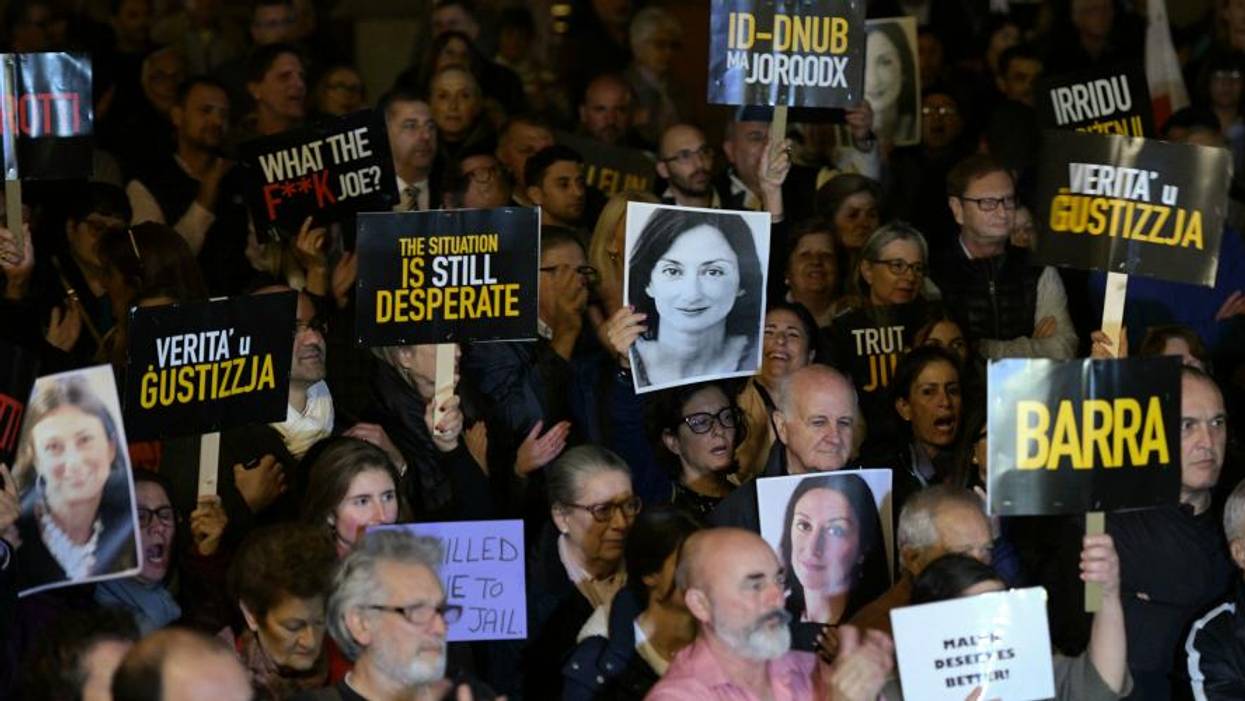
Maltese Prime Minister Joseph Muscat announced Sunday that he intends to step down soon amid protests demanding his immediate resignation, which intensified over the weekend after a businessman who allegedly has ties to the government was charged with complicity in the murder of investigative journalist Daphne Caruana Galizia.
Caruana Galizia, who reported extensively on government corruption and was widely known for her work related to the Panama Papers, was killed by a car bomb explosion near her home in Malta on Oct. 16, 2017. The investigation into her death has drawn global attention to the small Mediterranean island nation. Some of the reporter's surviving relatives are among those who have called for Muscat to leave office.
In a televised address Sunday night, Muscat said that he will resign as leader of Malta's governing Labour Party on Jan. 12 and resign as prime minister "in the days after." Until then, "I will continue to carry out my responsibilities" for both positions, Muscat said, adding that he is "ensuring stability in the leadership of the country."
The outgoing leader--who has not been directly connected to the plot against Caruana Galizia--struck a tone that was described by reporters as "defensive" and "defiant" in some comments about the ongoing murder probe and criticism of Malta's institutions.
"As prime minister, I promised two years ago that justice would be done in the case of the murder of Daphne Caruana Galizia," he said. "Today I am here to tell you that I kept my word." Muscat also said that "our institutions are strong and they function. Shame on anyone who ridicules them as he or she is ridiculing our country."
The Times of Malta reported that although Muscat's address "came just hours after several thousand protestors gathered in Valletta calling for his immediate resignation to ensure justice" for Caruana Galizia, "the prime minister did not make any references to mounting calls to leave at once."
Caruana Galizia's family responded Sunday to Muscat's delayed resignation in a statement which said in part, "His continued tenure as prime minister is intolerable to anyone who cares about justice."
"His role in the investigation into our wife and mother's assassination is unlawful," the family's statement said. "Until he resigns, we will use all legal remedies to ensure Muscat has no further involvement in the investigation and criminal proceedings, other than as a possible suspect."
Muscat's announcement came after prosecutors on Saturday hit a wealthy Maltese businessman with various charges related to Caruana Galizia's murder.
As the New York Times reported:
The arraignment of the businessman, Yorgen Fenech, a member of one of Malta's most prominent and richest families, capped a tumultuous week in which a long-stalled investigation into the murder of the journalist, Daphne Caruana Galizia, suddenly picked up pace, ensnaring senior members of the government and Malta's business elite.
Mr. Fenech, 38, who is suspected of paying three contract killers to carry out the murder, pleaded not guilty. He was arrested on Nov. 19 while trying to flee Malta aboard his yacht. Maltese military personnel halted the vessel as it set out to sea from a marina built by Mr. Fenech's family conglomerate, Tumus Group, and forced it to return to port.
Earlier this week, Fenech--who is seeking a pardon from Maltese President George Vella--claimed to police that Keith Schembri was the real mastermind behind Caruana Galizia's murder. As the Times of Malta explained, "Schembri served as the prime minister's chief of staff until late Monday, when he resigned before being called in for questioning on Tuesday morning. Police officers were spotted seizing items from his Mellieha home later that day."
Along with Schembri, "two ministers who are also suspected of possible involvement in, or knowledge, of the plot" resigned this week, the New York Times reported. However, unlike the Fenech, none of the ex-officials have been charged in the case.
The alleged contract killers--Vince Muscat (who is not related to the prime minister) and brothers Alfred and George Degiorgio--were arrested in December 2017. On Thursday, Reuters published an exclusive report on a "previously untold account of the plot to kill Daphne, a contract killing that earned the killers just 150,000 euros."
According to Reuters, Vince Muscat "revealed these sensational details to the police in April 2018, in the hope of getting a pardon," which the prime minister has so far refused. Details of the confession were obtained by the new agency "last year but were not published until now to avoid damaging the investigation."
Despite Vince Muscat's reported confession, Reuters noted, "the brothers continue to deny Daphne's murder and have declined to answer police questions."
As news broke Thursday morning that Deutsche Bank's German headquarters had been raided in Frankfurt over, numerous observers were quick to note the bank's deep ties to U.S. President Donald Trump.
The bank's offices were reportedly raided in connection with the Panama Papers money laundering investigation. Two employees and several "unidentified people in positions of authority" are suspected of failing to report the laundering of more than $350 million which were kept by the bank in accounts located in the British Virgin Islands.
According to NPR, more than 900 Deutsche Bank clients were able to keep their money on the islands in 2016.
In addition to its ongoing legal troubles, having been fined $600 million just last year for laundering $10 billion in Russian currency, Deutsche Bank has been known in recent years as "the one financial institution that stuck with Donald Trump when virtually all other banks wouldn't touch him," as John Feffer, director of Foreign Policy in Focus, wrote in Common Dreams in July.
As Trump's former top aide Steve Bannon said in early 2018, Special Counsel Robert Mueller's investigation into Trump's campaign will largely deal with the president's finances with the bank.
The probe, he said "goes through Deutsche Bank and all the Kushner shit. They're going to go right through that."
The bank continued to extend credit to Trump after he failed to pay back $330 million on a loan. Deutsche Bank also counts other members of the Trump family, including Ivanka Trump and Jared Kushner, among its clients. The bank opened its own investigation into Trump shortly after he entered office to determine whether its loans to the president had any links to Moscow.
Mueller last year subpoenaed the bank as part of his investigation into Trump's campaign, ignoring the president's "red line" that his finances should be off limits to the probe. The subpoena reportedly led to private calls from Trump to shut down the special counsel's investigation.
"The information that could bring down Trump--and that presumably Robert Mueller is trying to obtain--may be somewhere in the Deutsche Bank files," wrote Feffer earlier this year. "The relevant documents would link the bank's two most questionable financial activities--lending to Trump and washing Russian money."
While the world's richest stash trillions away for themselves, outlandish levels of inequality are increasing the suffering of the poor and hamstringing the global community's ability to address humanity's most pressing concerns.
"We are witnessing some of the greatest challenges the world has ever seen, without the global commitment to deliver change."
--Saad Alfarargi, U.N. Human Rights CouncilThat is the picture painted when pairing new research that shows an estimated $8 trillion--or more than 10 percent of global gross domestic product (GDP)--was stashed in offshore tax havens as of 2015 with a new report by a UN human rights expert that warns impoverished people are "paying a heavy price" for what he calls "negative global trends," including climate change, financial schemes, and privatization programs that "have their harshest impacts on the poorest sections of society."
"People are feeling the impact of the global financial and economic crisis, the energy and climate crisis, and an increasing number of natural disasters," said recently appointed special rapporteur on the right to development, Saad Alfarargi. "Add to that the new global pandemics, corruption, the privatization of public services, austerity, and the aging of the global population, including in developing countries, and the effect is a harsh and worsening impact on the poor."
In his first report to the U.N. Human Rights Council, Alfarargi raises alarms about global trends he has identified as threats to the "right to development," and expresses concern about the "rise of nationalistic tendencies and the related trend to move away from international solidarity and cooperation."
"We are witnessing some of the greatest challenges the world has ever seen, without the global commitment to deliver change," he concludes. "People in developing countries are paying a heavy price for global actions beyond their control."
Meanwhile, according to two papers by economists Annette Alstadsaeter, Niels Johannesen, Gabriel Zucman, the world's superrich are hiding trillions of dollars in tax havens, exacerbating global inequality.
Analyzing the Panama Papers and other leaked documents about tax havens, the researchers looked only at liquid offshore bank deposits--meaning these estimates do not even include investments in equities and real estate.
They found that "accounting for offshore assets increases the level and the rise of top wealth shares seen in tax data, but the magnitude of the effect varies across countries."
"Despite the more prevalent use of tax havens by continental European countries," they write, "we find that wealth is much more concentrated in the United States. In fact, the top 0.01 percent wealth share in the U.S. is as high as in early 20th century Europe." As Business Insider notes, "For the history fans, that's before most of the continent was democratic and right before two world wars. U.S. inequality is now about the same levels where it stood during the Great Depression."
While the researchers plan to use their methodology to develop more accurate estimates of wealth inequality within nations--and acknowledge "offshore wealth is likely to have major implications for the concentration of wealth in many of the world's developing countries"--it's also worth noting that wealthy nations, such as the United States, put tax revenue toward foreign aid, meaning that while tax evasion impacts inequality within nations, there are also global consequences.
"The hard fact is that the U.S. tax code incentivizes tax haven abuse by allowing companies to indefinitely defer taxes on offshore profits until they are 'repatriated.'"
--Matthew Gardner, Institute on Taxation and Economic Policy
A study published last year by U.S. PIRG Education Fund, Citizens for Tax Justice, and the Institute on Taxation and Economic Policy (ITEP) found that 73 percent of Fortune 500 companies used tax havens in 2015, which amounted to $2.5 trillion in offshore profits, or about $717.8 billion in taxes that would have gone to the U.S. government.
That's more than $700 billion that could have gone into government programs to provide assistance to not only to Americans, but also to people in developing nations, through foreign aid. And, as Poncie Rutsch noted in a 2015 NPR piece about U.S. aid, "The U.S. is pretty generous...until you consider how much money it has."
When the Fortune 500 study was published, Matthew Gardner of ITEP pointed to loose government restrictions as a root cause of tax evasion among U.S.-based individuals and corporations.
"The hard fact is that the U.S. tax code incentivizes tax haven abuse by allowing companies to indefinitely defer taxes on offshore profits until they are 'repatriated,'" Gardner said. "The only way to end this kind of tax avoidance is by closing the loopholes in the tax code that enable it."
Troubling tax rules, however, are far from contained to U.S. A 2016 Oxfam report identified the top 15 nations with policies that facilitate tax dodging, and thus "are starving countries of billions of dollars needed to tackle poverty and inequality," as Common Dreams previously reported.
Oxfam researchers estimated that because of corporate tax havens, developing nations lose $100 billion per year, which they say "is more than enough to provide an education for all of the 124 million children currently out of school, and to pay for health interventions that could save the lives of six million children."
The Spaniards went back to the ballot boxes today, six months after their December 20 general elections concluded without a majority winner.
In December, the conservative Partido Popular (Popular Party, PP) and the socialist party (Partido Socialista Obrero Espanol, PSOE) were uprooted from their nearly 40-year hegemony by new parties on the left (Podemos, We Can) and right (Ciudadanos, Citizens) (see Common Dreams, December 21, 2015). They came in first, second, third, and forth, respectively, with the sitting PP government left in charge until either a majority parliamentary coalition could be formed or new elections were held.
Mud and slogan slinging ensued. Multiple rounds of negotiations among the leading parties to form a coalition were held. Meanwhile, a dysfunctional parliament served as a stage for hurling recriminations at each other for the failures of those talks. Rancorous televised debates only exacerbated the polarization, leaving a large portion of the electorate increasingly disenchanted. Finally, King Felipe the Sixth, the arbiter in this constitutional monarchy, threw in the towel and called for new elections.
With 99% of today's (June 26) vote counted, the major difference in the outcome was a gain in overall conservative votes, with a shift of votes from neoliberal newcomer Ciudadanos back to the PP, while, on the left, PSOE lost votes and an leftist alliance lead by Podemos, obtained results similar to their December outcomes.
The PP, which ruled with an absolute majority since deposing the PSOE in 2011, still comes out on top, with 33% of the vote and 137 out of 350 possible seats in the president-determining Congress of Deputies, an improvement of 14 seats since December. Ciudadanos, campaigning as fervently against PP corruption as against Podemos ideology, fell to 32 seats, losing 8, by pulling in just 13% of the vote.
Pre-election polls just a week ago predicted that an alliance of Podemos and its affiliated regional parties with the United Left (Izquierda Unida, IU) and Equo, a reformulated party of Greens, would comfortably supplanted the PSOE at second place and pave the way for leftist coalition at the head of government. But this prediction turned out to be strikingly inaccurate.
The PSOE, in charge when the global crisis pricked the Spanish credit and real estate bubble in 2008, held on to 85 seats with 23% of the vote, 5 seats less than its December result. The Podemos-led alliance, Unidos Podemos (United We Can), took 21% of the vote and 71 seats, essentially equaling the added results of Podemos and the IU when the parties ran separately in December.
Most of the balance of seats were won by either leftist (9 seats) or conservative (8 seats) pro-independence Catalonian parties.
Now the negotiations for a coalition government begin anew, but with the math no less complicated.
Before the elections, the four leading parties pledged to a weary electorate that a third round of elections would not be necessary - that a coalition, however grudgingly, would be formed. But as the leaders of Unidos Podemos and the PSOE appeared before the public this evening to concede their disappointment, there was a palpable pessimism that a progressive coalition government could be an outcome.
Indeed, if the leaders of the top parties honor their pledges not to repeat elections, only a PP-PSOE or a PSOE-Unidos Podemos-Ciudadanos coalition would have sufficient seats for an absolute majority.
After the December vote, a grand coalition of all the leftist parties would have included pro-separatist Catalonian ones, unacceptable to the PSOE. Although those parties could have been left out of the coalition and might have abstained from a parliamentary vote on the presidency, enabling a PSOE-Podemos simple majority, the PSOE opted to reach across ideological lines to conservative newcomer Ciudadanos, with the vain hope that Podemos would join them.
But this was a non-starter for the Podemos leadership, who were unwilling to collaborate with any form of the right, at least not without stronger incentives in terms of top government posts. It was clear they preferred their chances in new elections, with the renewed goal of outflanking the PSOE to become the left's standard bearer.
During the election interlude, new corruption cases surfaced at their usual weekly-or-so pace, old ones took new twists, and the Catalonian independence movement, with a separatist regional government now in power, moved, if only shakily, forward.
Among the scandals, a minister of the PP government was forced to resign due to revelations from the Panama Papers, another PP minister was taped colluding with the Catalonian anti-corruption office to dig up dirt specifically on separatist leaders, and two former PSOE presidents of the autonomous community (like a state in the US) of Andalucia sunk deeper into an ongoing embezzlement case. In another judiciary investigation, the PP was forced to pay a deposit of 1.24 million EUR before further testimony in a case involving undeclared PP finances, with its former party treasurer already in jail.
For all of that, and a joblessness rate second only to EU whipping boy Greece, the economy continued to inch forward in terms of gross domestic product (GDP) and new jobs, bolstering the PP's claim that they were on the right path. However, a leaked letter from sitting President Mariano Rajoy to European Union (EU) Commission head Jean-Claude Juncker gave the lie to their campaign pledge of no further budget cuts. It clearly suggested that more austerity measures would follow a PP win in June, ostensibly to avoid a hefty fine for exceeding the EU-imposed deficit ceiling of 3% of its GDP.
But, for all uproar outside the party, the expose fell on deaf ears within the party's base and Rajoy's poll numbers didn't budge. After all, they may have concluded, what's better than a good, comforting lie? Or, as one PP voter here in the northern autonomous community of Asturias told me, with a dismissive wave of his hand, "Who cares? They all do it!"
And, indeed, the other party leaders did little to polish their public images during the election interlude. Between the acrimonious TV debates and those in the parliament, the polls reflected that a substantial portion of the electorate found most of them disingenuous and uncompromising.
Given the PP's impervious base, it was perhaps the PSOE's Pedro Sanchez and Podemos's Pablo Iglesias who were more tarnished by the frays. Sanchez's initial charm as a new face in the PSOE simply wore thin, as did his party's hardly credible mantra of "vote for change."
Though not as discredited as the French socialists, whose labor reforms have ignited massive strikes and protests across France in recent weeks, many who have fled the PSOE no doubt recall that it was the PSOE that began budget cuts after 2008, at the bidding of the EU, before handing the reins to the PP in 2011.
But it was Iglesias who really had to roll with punches, which came at him from both the left and the right. After railing against the old "caste" systems of the PP and PSOE since the inception of Podemos in 2014, he has been accused by some on the left as being the leader of a "new caste" system, due to his strong-arm handling of the party direction at times. More theatrically, Podemos has been branded a party of Bolivarian revolutionists by both the socialists and the right, based on consulting contracts its founders had with the Chavez Venezuelan government years before the party was formed. The red-baiting surged again after their alliance with the IU, with its origins in the dissolved Communist Party of Spain.
But as local IU secretary Manolo Villar told me at a Unidos Podemos rally here in the industrial port town of Gijon this week, "We are not calling for an anti-capitalist revolution."
And, in fact, it was Obama, not Marx, who was invoked repeatedly by Unidos Podemos to explain a key concept in their economic plan: stimulus spending. But as a Eurozone country, they can't simply print money and sell bonds, as did the US. So where would the money come from?
Unlike any of their rivals - and notoriously the PP - they were very specific and honest about where: increased taxes. They proposed a higher tax rate on the top wage and investment income brackets and fewer tax breaks. A restructuring of the public debt would provide an additional source of funds. Among other projects, the revenue would be invested in public infrastructure, small and large business start-ups, science and technology research, and renewable energy development. It would also be used to provide a suite of economic aide measures for the long-term jobless and very poor, the spending of which would funnel the money back into local economies.
"Change will be slow," Villar told me. "We need to work within the existing institutions. What the United Left has fought for in the past and what we are fighting for now with Podemos is an economy with more justice and dignity for its workers. One could be pessimistic about our chances, but why not be optimistic? As the writer Coelho said, the optimist and the pessimist both die in the end!"
Looking over the wobbly sociopolitical state of the European Union these days - from a faltering Greece to an exiting UK, with a million refugees in between and nationalist fervor on the rise - it certainly looks like its cemeteries will not be short of former pessimists for the foreseeable future.
More than optimism, Podemos's Pablo Iglesias expressed pragmatism in his post-election speech, a need to look critically at the results of their campaign, and to communicate their message better.
That won't be easy.
They must convince a cynical public that - in spite of the dictums of the EU or Standard & Poor - the way forward toward a truly sustainable economy is to roll back the labor and social "reform" laws of the last five years, laws that left workers more vulnerable than ever to the vicissitudes of global financial markets.
They must convince not just their rank-and-file but a majority of Spaniards that investment in renewable energy, research, and education creates jobs, jobs in which workers are not viewed simply as disposable commodities useful for lowering interest rates and maximizing profits, but as participants in a healthy, transparent democracy.
After the Unidos Podemos rally earlier this week, Villar left me with another quote, one from Portuguese Nobel Laureate Jose Saramago, which he said captured the win-or-lose sentiment of progressive struggles:
"Defeat has something positive: it is never final; however, victory has something negative: it is never final."
According to a new study released this week by an alliance of major organizations, the wealth gap keeps growing as the world's richest get richer at the expense of the poor.
The World Wealth Report from Oxfam, Greenpeace, and other groups found that while the total number of millionaires worldwide jumped to 15.4 million—up by nearly 5 million since 2009—more than 702 million people remain in poverty worldwide.
"For every person with more than $30 million, over 4800 people are living in extreme poverty," said Jenny Ricks of the Fight Inequality Alliance. "This gross inequality is a symptom of an unjust and unfair economic system that allows the rich to get richer at the expense of the poor."
Some of the findings include:
The figures were compiled by the wealth management group Capgemini. The report also notes that the firm "failed to predict" the global response to rising inequality and the disparities the Panama Papers exposed, revealing how global leaders use offshore tax havens to hide their wealth and other similar scandals.
As TeleSUR notes, "the issue of inequality accounted for 7 percent of global protests over a seven-year period, according to a 2013 study conducted by the Initiative for Policy Dialogue at Columbia University."
And it's no wonder. Ricks continued, "Last year the wealth of the richest totalled $58.7 trillion, which is over 150 times the size of the economies of all of the world's poorest countries combined. This shows the extent money and power are concentrated in the hands of the wealthiest few."
"The global inequality crisis is undermining the struggle for a fairer and more sustainable world, trampling on the rights of women, workers, and the poorest families," she said.
The findings were published just days before the UK voted to leave the European Union, making the report's final message hard to swallow. The alliance called on global leaders to "reverse cuts to public spending, privatization, tax breaks for the wealthy, and the race to the bottom on human rights."
The law firm at the center of the Panama Papers scandal, Mossack Fonseca, helped many of its American clients evade U.S. tax and transparency laws, according to an investigation by the New York Times published Monday.
Documents including "confidential emails, copies of passports, ledgers of bank transactions and even the various code names used to refer to clients" show that Mossack Fonseca went beyond simply creating shell companies for some of the 2,400 Americans implicated in the leak, the Times reports--instead, the firm "offered a how-to guide of sorts on skirting or evading United States tax and financial disclosure laws."
Reporters Eric Lipton and Julie Creswell write:
These included locating an individual from a "tax-convenient" jurisdiction to be the straw man owner of an offshore account, concealing the true American owner, or encouraging one client it knew was a United States resident to use his foreign passports to open accounts offshore, again to avoid scrutiny from regulators, the documents show.
If the compliance department at one foreign bank contacted by Mossack Fonseca on behalf of its clients started to ask too many questions about who owned the account, the firm simply turned to other, less inquisitive banks.
Other tricks included "selling real estate as a shift of corporate assets, instead of as a piece of property subject to transfer taxes."
The company also opened accounts for American clients with criminal records, despite claims that it refused clients whose financial activities raised "red flags."
Although no criminal charges have been filed in the scandal, tax experts consulted by the Times for the story said they were "surprised at how explicitly Mossack Fonseca had offered advice that appeared carefully crafted to help its clients evade United States tax laws."
In one case, Mossack Fonseca partner Ramses Owens responded to a request from wealthy Washington state businessman William Ponsoldt--who wanted to know how an American citizen could legally get funds offshore and invest them without the knowledge of the U.S. government--by stating, "If we create a Private Foundation and the underlying company for you, the funds become completely private (US cannot know) as soon as the funds are deposited under a bank account or investment account in the name of the underlying company or the private foundation."
"You can take the money in cash, you can do a bad investment; you can purchase something and not receive anything (an expensive piano, an expensive software)," Owens wrote. "You can receive an invoice from Panama or any other location and that would justify some of the outgoing moneys. You can also declare everything to the tax administration. [...] We can only 'suggest,' but the final decision to take the money out of the country is fully yours, and under the professional opinion of someone in USA."
The Panama Papers, published in April, exposed a hidden global network of corruption and tax secrecy shielding the wealth of some of the world's richest and most powerful people.
The Treasury Department released a new rule and several proposals last week that they said are intended to address the problem of corruption and dirty money in secret U.S. shell companies.
A White House news release announced what it called "several important steps to combat money laundering, corruption, and tax evasion, and called upon Congress to take additional action to address these critical issues." (A White House fact sheet is available here.)
The new rules at first glance appear strong. But after examining the details, several watchdog groups are warning that the new regulations and proposals leave open several glaring loopholes, and even practically provide instructions for how to get around the regulations.
The New Rules
Reuters has the story on the new rules, in" U.S. issues rule requiring banks to identify shell company owners":
The Obama administration is issuing a long-delayed rule requiring the financial industry to identify the real owners of companies and proposing a bill that would require companies to report the identities of their owners to the federal government, U.S. officials said on Thursday.
The Customer Due Diligence (CDD) rule, in the works since 2012, and the proposed legislation are meant to hinder criminals from using shell companies to hide ownership and launder money, finance terror, and commit other threats to the global financial system.
[. . .] The final CDD rule will require banks, brokers, mutual funds and other financial institutions to collect and verify the identities of the real people, or "beneficial owners," who own and control companies when those companies open accounts.
The new rule requires banks to do more checking to find out who owns corporations that are getting bank accounts, so "shell corporations" can't hide their owners. According to the White House, the rule will require "financial institutions to know and verify the identities of the natural persons (also known as beneficial owners) who own, control, and profit from companies when those companies open accounts."
Proposed Laws
The Treasury Department is also asking Congress for a law that sets up a central registry tracking who owns corporations, with companies required to provide this information when incorporating. Now there is no such requirement or registry so law enforcement and tax collections are stymied.
According to the Reuters report:
The Treasury is also proposing a regulation that would increase requirements for some foreign-owned companies operating in the United States to report information to the government, which officials said would prevent the use of those companies for tax avoidance purposes.
In addition, the Justice Department is proposing amendments that would strengthen its ability to pursue foreign corruption cases, including issuing subpoenas for records in money laundering investigations, obtaining overseas records, and using classified information in civil cases.
However, there is stronger legislation already before Congress. David Dayen reports at Salon, in "The Obama administration's Panama Papers misfire: Why new rules to curtail global tax avoidance could actually make things worse":
But this legislation already exists. The Incorporation Transparency and Law Enforcement Assistance Act, which has bipartisan sponsors in the House, would do everything the White House claims to want, requiring states and the Treasury Department to collect beneficial ownership information at the time of incorporation, and make that information available to law enforcement. It's unclear why the Administration would need to rewrite what already has been written, and since they've released nothing official about their own draft legislation, it creates suspicions that they are trying to undermine the current effort in Congress, with analogous flaws to the Treasury rule.
Loopholes
The new rules exclude existing shell corporations. Shruti J. Shah, vice president of programs and operations at Transparency International-USA, explains, "The rules also do not extend the requirement to collect beneficial ownership information of accounts established before the rules' implementation date, creating a major gap in the information collected."
So if people are already using shell companies for "money laundering, corruption, and tax evasion" (and never mind financing terrorism, running fraud scams or storing the gains from crimes) they can keep doing so with impunity.
The new rule requiring financial institutions to get names of people or entities owning 25 percent or more of a corporation and the name of one manager (president or chief executive) is like an instruction manual telling shell corporations to register claiming five owners or entities with 20 percent each. They can stay secret. Or they can use trusts, which can continue to hide their beneficiaries. (For more on this see Financial Times, "US tax havens: The new Switzerland.")
As for the significant manager, Bloomberg reports, in "Obama's Disclosure Rule for Shell Companies Weak, Advocates Say":
If all banks have to find out about their account-holders is one person with managerial control, "that could be a law-firm employee," Elise Bean, former chief counsel for the U.S. Senate Permanent Subcommittee on Investigations, said during the call. "That could be someone in the British Virgin Islands, someone in the Isle of Man, and that's really a problem."
Quartz also quotes Bean, in "A design flaw in Obama's new Panama Papers rule could help shell companies dodge cops and taxes":
The internationally accepted definition of beneficial owner--the actual human who truly gains from the company's equity--is altered in the law. Under the new rules, anyone who owns less than 25 percent of the company need not be reported, and the appointed president of a shell company can be listed as the beneficial owner.
"That's kind of the opposite of what the term as has always meant," Elise Bean, the former chief counsel of the Senate Permanent Subcommittee on Investigations, told reporters last week. "At Mossack Fonseca, they could say, 'I'm appointing my law firm employee the president of the shell company, and now under US rules, I can name my employee the beneficial owner of that company.' That just doesn't make sense."
That "law-firm employee" could be, for example, an employee of the firm registering the shell corporation.
In addition, the banks are given two years before they begin checking corporations, giving criminals time to shift and adjust their corporations and funds accordingly.
"Weak"
Bloomberg explains the concerns of watchdog groups:
The advocacy groups raised concerns about the rule's requirement for naming the person who exercises managerial control over a company, rather than the person with effective control. Under the rule, financial institutions must obtain the names of anyone who owns 25 percent or more of an entity and the name of one person who has significant managerial control, such as a president or chief executive.
That means a group of five criminals could comply with the rule, access the U.S. financial systems and still remain anonymous, if they each took a 20 percent share in a shell company and then hired a nominee to be its president, Ostfeld said.
However,
The U.S. Treasury Department, which finalized the rule on Thursday, disputed that criticism. "A nominee or lawyer working on behalf of a company would not satisfy the requirements," the agency said in an emailed statement. The rule calls for naming a person with "significant responsibility to control, manage or direct the company," the statement said.
The Financial Accountability and Corporate Transparency (FACT) Coalition released a statement that read in part:
"The loopholes in the final Treasury rule allow banks to open accounts for companies without having any idea of the identity of the people who ultimately own or control that company. Without this critical information, banks can't determine whether the people behind the company are on a sanctions list, a drug kingpin list, or are public officials who may be stealing from their countries treasury or trying to stash their bribe money in U.S. banks," noted Heather Lowe, legal counsel and director of government affairs at Global Financial Integrity.
Mark Hays, a senior policy adviser at Global Witness, adds: "The rule will allow criminals to list managers of shell companies--for example, an employee of a law firm such as Mossack Fonseca, the Panamanian company exposed in the Panama Papers--as the 'beneficial owner' of a company."
Transparency International-USA expresses their concerns in a news release:
While TI-USA supports the efforts of the U.S. Treasury and specifically FinCEN's efforts to address the need to collect beneficial owner information on the natural persons behind legal entities, the rule has significant gaps.
The rules do not sufficiently capture those who can control an anonymous company because in the definition of "control," it conflates senior management and executive officers of corporate entities with the beneficial owners. Often officials named in leadership positions in anonymous companies are figureheads and control of the entity is exercised through other means- a problem highlighted by the recently released Panama Papers. TI-USA proposes that financial institutions focus on capturing information about individuals who exercise control of the legal entity for their due diligence purposes.
The rules also do not extend the requirement to collect beneficial ownership information to accounts established before the rules' implementation date, creating a major gap in information collected.
Watchdog groups - and law enforcement - have been asking for a crackdown on corporate secrecy for years. The Obama administration sat on these rules. Then after the Panama Papers leak publicized the extent of the problem, they issued rules that many say could actually make the problem worse. What is going on?
If the U.S. does not end its "hypocrisy" and hold itself to the same tax transparency standards as other nations, efforts to reform offshore secrecy will fail, leaders of the UK's overseas territories warned at the global anti-corruption summit in London on Thursday.
The comments--from leaders of the Cayman Islands, Bermuda, and the Isle of Man--came as U.S. Secretary of State John Kerry told those gathered at the summit, "Corruption, writ large, is as much of an enemy [as terrorism], because it destroys nation states, as some of the extremists we are fighting or the other challenges we face."
The summit follows a massive leak of documents known as the Panama Papers which exposed how the world's elite use offshore tax havens to hide their wealth, including British Prime Minister David Cameron, who hosted the conference.
Cayman Islands Premier Alden McLaughlin slammed states such as Delaware--where a majority of U.S.-based shell companies are situated--and said it was "time to put behind us the shades of hypocrisy that have been part and parcel of global discussion of this issue for years and years."
"So long as countries with real commitments on the world stage continue to focus on jurisdictions that are smaller in size while ignoring the larger jurisdictions, the results will be continued failure," McClaughlin said. "This is going to be a complete disaster if you insist that most places in the world have to conform to a particular standard, and you leave principally the United States and a couple of other rogue nations completely out of it. Because all the shady business is going to migrate to Delaware, Wyoming, Panama, you name it."
Six nations attending the conference--Afghanistan, France, the Netherlands, Nigeria, Kenya, and the UK--agreed to set up publicly accessible central registers of company owners and profiteers, also known as "beneficial owners." The registers are set to be reviewed at a follow-up conference in August 2017.
For its part, the Obama administration last week announced new rules that would require financial institutions to verify the beneficial owners of any entity that uses the institution's services. The Treasury Department also proposed a rule that would require certain foreign-owned companies to obtain tax identity numbers from the U.S. Internal Revenue Service (IRS), which means they would have to report ownership and transaction information to the agency.
But anti-corruption and tax policy experts said the measures fell short of true reform. "The measure includes a loophole that could well perpetuate the problem of anonymous shell companies," said Gary Kalman, the executive director of the Financial Accountability and Corporate Transparency (FACT) Coalition. "The loophole is dangerous if exploited by terrorists, human traffickers, and corrupt foreign dictators to launder their money through the U.S. financial system."
The loophole, according to Global Financial Security legal counsel Heather Lowe, would "allow banks to open accounts for companies without having any idea of the identity of the people who ultimately own or control that company. Without this critical information, banks can't determine whether the people behind the company are on a sanctions list, a drug kingpin list, or are public officials who may be stealing from their countries treasury or trying to stash their bribe money in U.S. banks."
Following the release of the Panama Papers, an analysis by the advocacy group Tax Justice Network found that offshore havens have "siphoned" more than $12 trillion from emerging economies worldwide.
Jose Ugaz, chair of Transparency International, said the summit was a "good day for the fight against corruption, but there is more to do."
"Well done to the countries that have shown leadership; but it is hard to credit those who still fail to make sufficient progress. We need to build on trust and a common agenda between governments, business and civil society so that we deliver more than words," Ugaz said. "We need actions to create change."