

SUBSCRIBE TO OUR FREE NEWSLETTER
Daily news & progressive opinion—funded by the people, not the corporations—delivered straight to your inbox.
5
#000000
#FFFFFF
To donate by check, phone, or other method, see our More Ways to Give page.

Daily news & progressive opinion—funded by the people, not the corporations—delivered straight to your inbox.
With the endorsement on April 15 by a majority of the heads of government of its member states, the European Union has finally taken the formal step needed to move ahead with trade negotiations with the United States. The talks may yet blow up over automobile tariffs, airplane subsidies or a dispute about the inclusion of agriculture in the negotiations. The EU says it never agreed to include agriculture; the Trump administration claims that agriculture is included, and powerful members of Congress have asserted there can't be a deal without it.
The U.S. negotiating objectives clearly intend to cover agriculture broadly. The trade negotiation mandate adopted by the EU has two parts, one of which addresses tariffs and the other, domestic regulatory changes. The negotiation instruction on tariffs is limited to industrial goods and specifically excludes "agricultural products." The latter instruction on regulatory cooperation and compatibility, however, does not exclude agriculture.
Thus, we can be sure that food and agriculture will be directly affected by an EU-U.S. trade deal, because any potential carve-out relates only to discussing tariff reductions. As in the New NAFTA, food and agriculture--including product labeling and oversight of food safety, chemical use and emerging technologies--will still be directly affected. This is because both the EU and the U.S. have committed to reducing so-called "non-tariff barriers" through regulatory cooperation measures, conformity assessments and mutual recognition agreements specifically aimed at public protections such as food safety oversight.
In its negotiating objectives announced in January, the U.S. is quite transparent about wanting to block labeling and oversight of currently unregulated newer genetic manipulation techniques, such as gene editing. In the section on food safety the U.S. Trade Representative (USTR) calls for "new and enforceable rules to eliminate unjustified trade restrictions or unjustified commercial requirements (including unjustified labeling) that affect new technologies." The USTR also wants to "establish a mechanism to remove expeditiously unwarranted barriers that block the export of U.S. food and agricultural products in order to obtain more open, equitable, and reciprocal market access."
Public statements by U.S. Agriculture Secretary Sonny Perdue make clear that EU prohibitions on common practices in the U.S., such as using the growth-promoting drug ractopamine in pork production, or chlorine and other chemical rinses to disinfect chicken and vegetables, are the kinds of "unwarranted barriers" he expects a trade deal to lift for U.S. exports to Europe. In recent meetings with members of Congress, Perdue has doubled down on these statements, stating Europe will "pay the price" if it restricts pesticides including RoundUp, which contains the endocrine-disrupting ingredient glyphosate, or if it continues to require stringent oversight of gene editing and other new technologies.
The EU wants what it calls a "conformity assessment" agreement that would require the U.S. to accept EU regulators' determinations--and vice versa--as spelled out in the second part of its negotiating mandate. There are no red lines in this document that would exclude food and agriculture, as is made clear in the accompanying negotiating directives. The only real constraint on the EU's negotiating authority relates to President Trump's threats to impose auto tariffs: The European Commission "may suspend negotiations if the United States adopts trade restrictions against European Union exports on the basis of Section 301 of the 1974 Trade Act or under any other similar United States law." In a previously leaked memo to the European Parliament's Trade Policy Committee the trade directorate explained its approach to the U.S. negotiations in more detail, touting conformity assessments and mutual recognition agreements in order to "provide for mechanisms to avoid an unnecessary duplication of costs" in agreed-upon "areas of economic importance." While the EU insists it will maintain current protections and not agree to conformity measures where there are "important systemic differences," food safety was specifically mentioned as a possible area of agreement in this memo.
What could a trade agreement devoted to conformity assessment mean in practice? Even if the U.S. doesn't export its food safety standards and the EU maintains its current protections--as its politicians insist it will--the negotiations will still result in weaker food safety protections. Why? Lax inspection and compliance oversight will be exported instead. The plan proposed by both U.S. and EU trade negotiators is to rely on each other's systems for inspecting products and certifying compliance. How then will the U.S. system--which relies heavily on chemical treatments to kill contaminants and end-product inspections--guarantee that U.S. products meet the tougher food safety standards of the EU, where farm-to-fork tracking protects against contamination throughout production, slaughter and processing?
Bottom line: The U.S. won't be able to guarantee European consumers that imported food products meet EU standards. In fact, the food safety system overseen by the U.S. government can't even assure U.S. consumers that our food is safe. The U.S. has a broken system that's rapidly deteriorating under the Trump administration. For example, as the New York Times editorial board explains, the administration plans to drastically cut independent government trained and employed inspectors by 40 percent, permit unlimited slaughterhouse line speeds and essentially, allow the industry to regulate itself. The delegation of USDA inspection authority to meat plant employees, who are unable to stop production lines when meat products are contaminated, poses a risk to EU consumers and the reputation of U.S. meat exports. A trade deal that reduces government authority to adopt and enforce protective standards will apply here just as it would in Europe, limiting the ability of future administrations and Congress to reverse the privatization of meat inspection and other food safety measures.
In their joint statement initiating the trade talks, the EU and U.S. presidents announced commencing "a close dialogue on standards in order to ease trade, reduce bureaucratic obstacles, and slash costs." Both the U.S. negotiating objectives and the EU negotiating mandate are premised on the view that maintaining independent regulatory oversight authority after a trade deal is signed is a public burden harming the economy. Yet time and again, just the opposite has proven true. Overlapping oversight can have significant public benefits and helps assure confidence in products in the marketplace and in the economy as a whole.
Take, for example, the Volkswagen emissions testing scandal. U.S. environmental testing (especially at the state government level) discovered widespread cheating by German and other automobile manufacturers that was either overlooked on purpose or left undiscovered by an ineffective EU regulatory system. Had the U.S. and EU already been bound by a trade deal eliminating "duplicative" emissions testing and certification, this fraud on consumers and harm to the environment might never have been uncovered.
Or, consider port of entry checks of food. U.S. sampling of imported meat (what the industry calls a duplicative and unnecessary "barrier to trade" and wants to eliminate through regulatory cooperation) discovered E.coli contamination of Canadian beef, leading to a massive recall. Canadian regulators missed the problem, but because food inspections were required on both sides of the border, a public health crisis was averted. While we don't yet know the full story of the Boeing 737-MAX and the tragic crashes of two of these airplanes, there is general agreement that the U.S. safety certification was rushed and delegated significant responsibilities from the Federal Aviation Administration to the manufacturer. Even recognizing that the EU's Airbus is in competition with the U.S.'s Boeing, is it any wonder that European regulators are rethinking reliance on U.S. regulatory oversight?
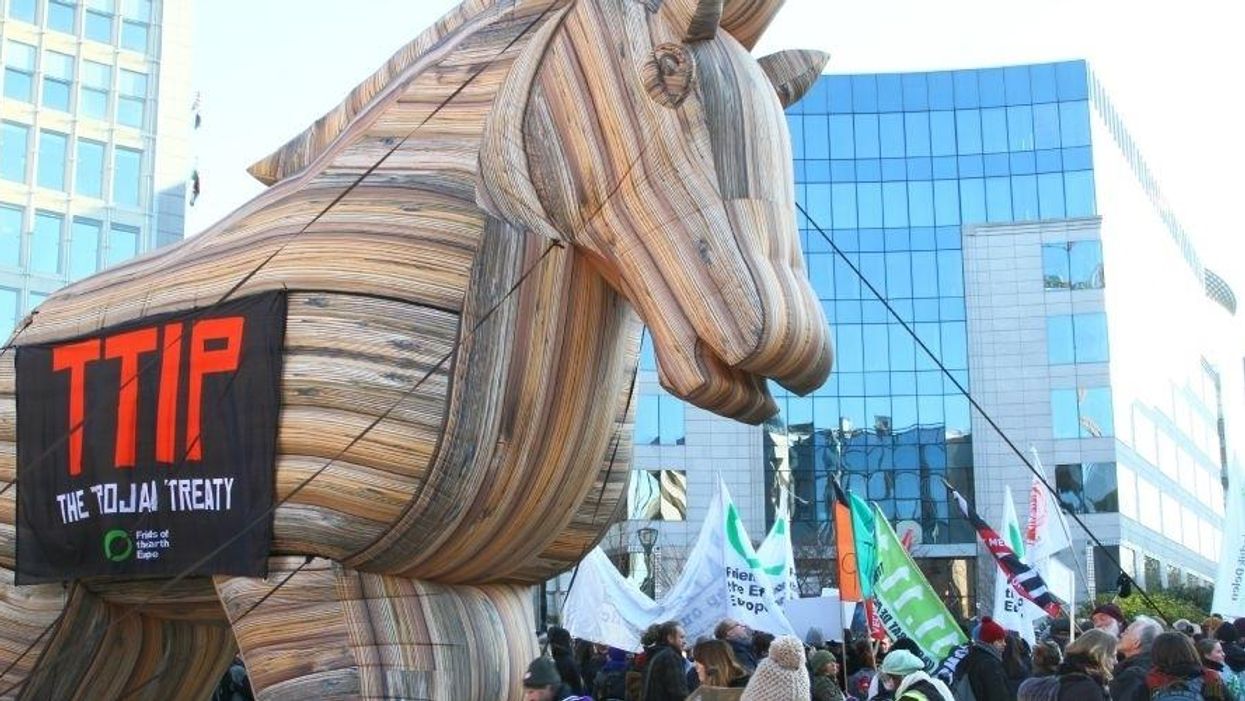
There are several reasons that trade negotiations initiated in the Obama administration for a Transatlantic Trade and Investment Partnership (TTIP) broke down even before the 2016 U.S. elections. As IATP has detailed, consumers and farmers in Europe understood that the proposed agreement was a recipe for lowered standards and a flood of industrial food products that would undermine what remained of smaller-scale, more sustainable farming practices. TTIP remains so toxic that the new EU negotiating mandate specifies "The negotiating directives for the Transatlantic Trade and Investment Partnership must be considered obsolete and no longer relevant."
That may be so, on paper.
But with TTIP's regulatory conformity goals imported into the new negotiating directives on both sides of the Atlantic, without any red lines clearly excluding agriculture, food and health and environmental standards, it looks like we're being asked to buy a trade policy "pig in a poke."
This week the European Parliament finally gets a vote on the Canada-EU trade deal CETA. It's taken years to get to this point, and the vote is likely to be close, reflecting just how contentious global trade policies have become.
Many MEPs are worried about CETA, reflecting the views of millions of European citizens who have been lobbying them to vote it down. They are concerned about the impact it will have on food standards, public services and financial regulation. CETA, like its better known US cousin TTIP is all about deregulation.
There are deep concerns about the 'corporate court' system which will afford so many more corporations special legal process to sue European governments for passing laws they don't like. For all the EU's reforms, environmental regulation, public service nationalisation, financial regulation - all could be challenged, costing the taxpayer on both sides of the Atlantic a fortune.
Despite this, MEPs are wrestling over how to vote. Because in our brave new world, a trade deal with Justin Trudeau's Canada, which shares so many of our values, seems an urgent necessity. Wouldn't it be a reaffirmation of the very liberal international order threatened by Trump? Wouldn't it help us bring together a non-Trump economic bloc?
It's a seductive logic - and enjoyable to give Trump a poke in the eye. But it isn't true. There's nothing more helpful to Trump and the wave of European populism than passing CETA this week.
First CETA would open up Europe to direct challenge by US corporations in special corporate courts. Something like 40,000 of the biggest US corporations have subsidiaries in Canada which could use CETA to sue European governments. This is a game-changer - we've never faced anything like it, and we will get sued for simply passing laws aimed at protecting people and the environment.
Canadian's big mining sector doesn't have any higher 'values' than US big business either. These companies have already shown themselves more than willing to take on governments like Romania, in secret 'courts', under a separate deal, when that government saw fit to halt a mining project built on a site of environmental and historical importance.
For all his rhetoric, Trump is a firm supporter of deregulation and corporate power. A quick look at how US oil, financial, military and pharmaceutical stock rose after Trump's election showed that clearly. Trump is stripping away corporate regulation at a frightening speed. Why would he be against anything that gives US corporations the power to bully foreign countries?
Don't forget - Trump's own interests are involved here. For example, Trump owns quite a lot of land in Scotland and has a history of challenging Scottish regulation which poses any threat to his golfing profits. A corporate court in CETA would help him in future.
Second, CETA has nothing to do with reaffirming European and Canadian values. As a matter of fact, it's all about changing our values. CETA isn't about people at all, but forwarding corporate interests to the point where 'people' barely feature in decision-making. CETA's process of regulatory 'harmonisation' attempts to force regulators to think only about how laws can be as 'minimally trade distorting' as possible. Is that really the pinnacle of European and Canadian 'values'?
Trump claims that corporations have become too mixed up with foreigners, too disinterested in forwarding the interests of the state. We cannot fight this with 'more of the same', by pretending that economic globalisation has been wonderful for everyone and let's have more of it. The idea that trade deals create only 'winners' is totally discredited. But CETA assumes everything is 'win-win' and makes no provision for these losers - even though serious assessments warn that up to 200,000 jobs could be lost and workers relative wages could fall.
This simply helps Trump's rhetoric about salvation to be found in the aggressive nation state, backed to the hilt by corporate power. How do we fight Trumpism? By showing that the solution to devastating corporate trade pacts isn't 'beggar my neighbour' economics, but a trade system based on the needs of society - building public services, creating decent jobs, laws to constrain the most powerful exploiting the least powerful. Without this, everything that Trump represents will grow.
As progressives rally to resist him, Trump is building support in key swing states by fighting for American jobs. He is using the bully pulpit to pressure manufacturers to keep jobs here rather than relocating them to low-wage areas. The list of Trump target companies is growing -- Carrier, Rexnord, Ford, GM, Toyota --- with no end in sight. His message is clear -- either make the product in the U.S. or we'll slap a major tariff on the product if you try to import it back into the U.S.
Progressives are flummoxed about how to respond. Some argue that these Trump moves are nothing but phony PR stunts: Carrier was a bribe, Ford wasn't moving the jobs anyway and so on. New York Times columnist Paul Krugman is leading this charge:
In other words, it may have sounded as if Mr. Trump was doing something substantive by intervening with Carrier [and Ford], but he wasn't. This was fake policy -- a show intended to impress the rubes, not to achieve real results.
But those "rubes" (dictionary definition, "country bumpkins") who believe their jobs were actually saved, "lined up on the factory floor [and] cheered the news [of a new $700 million investment at the Flat Rock Michigan Ford facility.] United Auto Workers Vice President Jimmy Settles, the union's chief negotiator for Ford, told workers he cried when he heard about the investment," reports ABC News.
Krugman correctly points out the number of jobs saved by Trump's tweets is miniscule, but again he is far too dismissive of the workers involved:
Can political pressure change G.M.'s strategy? It hardly matters: Case-by-case intervention from the top is never going to have a significant impact on a $19 trillion economy.
By saying "it hardly matters" Krugman, along with many progressives, are falling right into the Trump Trap: Either they give some credit to Trump's efforts to keep jobs in the U.S., or they ridicule him for trying to do so, and thereby appear not to care about the real flesh and blood workers whose jobs actually are saved.
The net result is that Trump is fully capturing the trade/jobs issue. He can claim that he alone is rewriting the rules of trade and forcing companies to keep jobs here. If progressives don't wake up soon, we can kiss goodbye to Pennsylvania, Ohio, Michigan, Iowa and Wisconsin four years from now.
It wasn't always this way
When the deindustrialization process first began in the 1980s to undermine manufacturing, hundreds of progressive activist groups fought to keep manufacturing facilities from leaving. They tried boycotts, worker buyouts, and even sit-ins. The tactics got more and more creative and the energy put forth by progressives of all stripes was impressive. Collectively, they called for a new industrial policy that would rebuild the manufacturing sector and save decent paying jobs, much as Germany had done.
The Labor Institute where I work was drafted in one such struggle in 1985 at a 3M facility in Freehold, N.J.. The local union president, Stanley Fisher, asked us to write to Bruce Springsteen in their behalf. Springsteen, who had just recorded "My Hometown," (a song about a plant closing in the very same town) responded positively. Over the next year he would donate money, perform for the workers at the Stone Pony in Asbury Park, and provide public support including a support ad with Willie Nelson in the New York Times. This star power turned that struggle into a massive publicity campaign against 3M.
Thanks to Fisher's tireless efforts, we also reached out to Black 3M workers in South Africa -- then still an Apartheid state -- who courageously staged a half-day strike in behalf of the mostly white New Jersey 3M workers. But the campaign ended like so many others: 3M closed the facility.
The main point is this: the fight against plant closings by any and all means necessary has always been a progressive cause. It should be again.
What happened?
Neoliberalism happened. By the time Bill Clinton was elected president both political parties had imbibed the Kool-Aid of tax cuts, deregulation, reductions in government social spending and the undermining of unions. So-called "free-trade" agreements were the centerpiece of the new neoliberal order. All boats were supposed to rise. But instead of good paying jobs, neoliberalism created runaway inequality with no end in sight. The biggest victims were the poor in declining urban areas, displaced manufacturing workers, and Mexican farmers.
Unions that represented manufacturing workers (like the United Steelworkers, the United Autoworkers and the Communications Workers of America) fought like hell against these trade agreements and took every opportunity to protest against unfair trade. But enough Democrats always sided with the Republicans to pass NAFTA and other corporate-friendly trade measures. Meanwhile U.S. manufacturing fell from 20.1 percent of all jobs in 1980 to only 8.8 percent by 2013.
All along, pundits and academics never tired of telling us that it was inevitable. Erroneously, they said the job loss was really caused by automation and skills mismatches between dislocated workers and the new jobs that supposedly were waiting to be filled. Few bothered to look at Germany which has at least the same level of technology but instead developed a booming manufacturing sector. (See here)
Instead both political parties placed all their bets on the rise of high finance. Deregulating Wall Street would make our IRAs and pensions soar (and fill party campaign coffers as well.) It would build a new service economy and lead the U.S. into a new era of prosperity. You know what happened.
Unfortunately, the neoliberal order impacted the work of progressives as well. Working class issues became less important as organizational silos were created around identity and environmental issues. Philanthropic funding for plant closings fights waned. And as good working class jobs become increasingly insecure, manufacturing workers feared that the fight against climate change could cost them their jobs.
Enter Trump
Progressives are struggling to understand what went wrong: Was it the Russians hackers? the FBI surprise? the electoral college? racism, sexism, and xenophobia? Even taken together, these factors do not sufficiently account for how poorly Clinton underperformed Obama: minus 290,000 votes in Pennsylvania, minus 222,000 votes in Wisconsin and a whopping minus 500,000 votes in Michigan. It's difficult to claim that all those who switched from Obama to Trump were racists, misogynists, etc.
The alternative account is that the neoliberal Democratic Party, exemplified by Hillary, had done nothing to save manufacturing jobs (except the GM bailout during the crash). Worse still, Obama, the party's leader, was pushing hard for another corporate-friendly trade bonanza (the Trans-Pacific Partnership Act), and everyone knew Hillary was for it before she was against it.
The election might have turned out very differently if Obama had spent the last eight years blasting the likes of GM, Ford, Carrier and hundreds of other companies for shipping good paying jobs to Mexico. It would have helped if the Democrats had proposed legislation to prevent the off-shoring of good manufacturing jobs. But Obama and the Democratic Party establishment sipped from the same neo-liberal Kool-Aid: They believed in the blessings of corporate trade, and too many working people believed they were wrong.
Jobs for poor Mexican workers versus jobs for higher paid U.S. workers?
The abdication of the jobs issue to Trump also is connected to the mistaken notion that protecting jobs in the U.S. harms low income people in developing countries like Mexico. But NAFTA has failed to help impoverished factory workers and farmers in Mexico, reports the New York Times. It is painfully obvious that the threat of factory relocations has harmed the bargaining power of workers here and abroad. The big NAFTA winners are financial and corporate elites.
How to break free from the Trump Trap
1. Recognize the scope of the problem: The first step is to understand that the off-shoring of jobs to low wage areas is an enormous problem. "Somewhere between 22 and 29 percent of all U.S. jobs are, or will be, potentially off-shorable within a decade or two," reports Princeton economist Alan Blinder.
It is very telling that the government does not keep separate off-shoring data so we don't know exactly how many layoffs are caused by moving jobs abroad. But it is undoubtedly the case that hundreds of thousands of working people are finding out each year that their jobs will be leaving the U.S. to lower wage areas.
2. Renounce the free movement of capital: We need to challenge capital mobility -- the neoliberal holy sacrament that claims nothing ever should limit the ability of capital to move whenever and wherever it wants. Over 40 years ago, Nobel laureate James Tobin argued that this would inevitably lead to the destruction of social programs and the downward pressure of wages. He was right then and still is. We need to say loud and clear that corporations and their Wall Street puppeteers, shall not be allowed to simply pick up and go to another country for the purpose of securing lower wages and fewer health, safety and environmental regulations. There is nothing sacred about the free flow of capital when it devastates community after community.
3. Organize those threatened with off-shoring: Our job is to reach those workers -- millions of them -- with a very simple message: We demand that Donald Trump and Congress save our jobs as well.
This is a golden opportunity for progressive organizing. Unions and community groups should locate these workers, encourage them to sign petitions, recruit them to show up at Trump events, picket the White House, pressure their congressional representatives and fight for their jobs. Also, support should be built for the kind of anti-offshoring legislation Sanders is offering in the Senate.
4. Off-shoring as an environmental issue. Moving jobs to low-wage areas inevitably means moving towards lower regulatory environments. The factories in China, Mexico and Vietnam do not have anything like the environmental and health/safety protections found in the U.S. So not only are we off-shoring jobs, but we are off-shoring pollution, especially carbon emissions. In addition, by shifting jobs abroad and then re-importing the goods back to the U.S., the extra transportation increases the carbon footprint of each product. In short, if you care about climate change, you have to care about the off-shoring of U.S. jobs.
For the first time since neoliberalism infected the minds of the political and media establishments, the issue of off-shoring is on the national agenda. This is the ideal time for unions and progressive organizations to mobilize impacted workers and raise hell.
Resisting Trump is not enough. We have to build a national movement to reclaim the off-shoring issue as our own. Millions of working people and their communities are waiting for leadership. If we don't provide it, Trump will.
Our tour across Europe on Selling Off the Farm Corporate Meat's Takeover Through TTIP and its links to the EU-Canada Comprehensive Economic and Trade Agreement (CETA) launched on November 29 at the European Parliament.
Our tour across Europe on Selling Off the Farm Corporate Meat's Takeover Through TTIP and its links to the EU-Canada Comprehensive Economic and Trade Agreement (CETA) launched on November 29 at the European Parliament. IATP's Senior Advisor, Sharon Treat, Waldemar Fortuna from the Polish organization, IGO and I met with several members of the European Parliament (MEPs), including coordinators of different political parties that will decide CETAs fate in early February.
In the last two years, there has been an unprecedented awakening by ordinary citizens across Europe about the damage that free trade agreements do to policy making in the public interest. People have begun to understand that treaties, such as CETA and the Transatlantic Trade and Investment Partnership (TTIP), give transnational corporations even more power to expand and consolidate than they already possess. Many citizens have begun to challenge key elements of these agreements--such as the provisions that allow these corporations to sue governments for enacting public policies that might dampen their profits.
We set out to highlight key concerns that our research revealed about how agreements such as TTIP (and CETA) undermine their jobs as Parliamentarians, particularly when it comes to issues Europeans really care about like cloning, GMOs, and how meat is produced and processed. It became evident quite quickly that while many agreed or hesitatingly admitted that perhaps TTIP went too far in that realm, they were more than relieved to be able to say that CETA was no problem at all.
While politics in many of their countries involves serious crises in the agriculture sector--crashing dairy prices, rising input costs, a struggling beef production sector, the phasing out of small family farms--many of them believed that the competition with Canada would be beneficial to European farmers. Some Eastern European MEPs felt that joining the EU had transformed their economies in a positive direction, so certainly further opening up to free trade deals with industrialized countries will also be beneficial.
Never mind that CETA contains many of the same provisions that TTIP would, or that the Canadian meat market is not really "Canadian," but rather North American. One of the clear outcomes of the North American Free Trade Agreement (NAFTA) has been the integration of the North American meat and feed industries. As a result, the meat industry can shuttle animals between the U.S., Mexico and Canada to cut costs of production and still market products as made in Canada or the U.S. That is until the U.S. implemented Country of Origin Labeling (COOL) for meat that required processors to state where the animal was born, raised and slaughtered. Ironically, Canada and Mexico, on behalf of the North American Meat Industry, put an end to this much desired consumer demand. They brought a challenge to the World Trade Organization, complaining that the U.S. law goes against free trade, and they won. The congressional lackeys of the meat industry in the U.S. were only too happy to repeal the law.
The European Parliamentarians have failed to understand this dynamic; a free trade deal with Canada on agriculture, particularly meat, is also a deal with the United States because these companies are neither American or Canadian. They are both--and they will soon be European as well. Welcome JBS to Ireland!nbsp;(JBS, by the way, is the world's largest meat processor and also one that has aggressively bought out major brands in the U.S. and worldwide.) What this means is that CETA, like TTIP, will hasten a very different agriculture system than most European farmers and consumers want.
The disconnect between these Parliamentarians and the voters they represent couldn't be more stark--and I was reminded of Donald Trump's election as President. How badly the Democrats had miscalculated the disenfranchisement of Americans from their democracy, how angry they are at corporate control of that country--that they are willing to elect someone, even a corporate tycoon, who says that he will end corporate control, create jobs and end free trade deals that hurt American citizens. I am afraid for the European Parliament and for the European Project, because as long as they continue to ignore the protests and petitions and rightful critiques of these free trade deals, they are likely to repeat the same mistake that has, in part, led to Brexit and Trump.
German Chancellor Angela Merkel said Thursday at a joint press conference with U.S. President Barack Obama that negotiations over the corporate-friendly TransAtlantic Trade and Investment Partnership (TTIP) between Europe and the United States "will not be concluded now" that Donald Trump has been elected to succeed Obama.
It is a victory for the millions of people on both continents who voiced opposition to the massive deal. But social justice campaigners across Europe refuse to give the credit to Trump, saying that thanks to public outcry, the TTIP was "already dead" long before November 8.
Indeed, a coalition of European civil society groups and trade unions just this week warned that Trump merely exploited economic unease in order to win the presidential election, and that "[d]espite his rhetoric, Trump fully believes in deregulation, privatization, and putting profit before people."
"Trade deals like TTIP and [the Comprehensive Economic and Trade Agreement (CETA) between the European Union and Canada] have given oxygen to Trump," read an open letter signed by groups including Global Justice Now and various chapters of the anti-neoliberalist Attac network. "The best way to defeat him is to remove that oxygen--to stop these trade deals and build a democratic economy that works for everyone."
Such deals, the campaigners said, only fuel the inequality that's led to the rise of Trump in the U.S. and far-right populist groups in Europe--and the "politics of racism and hatred" that they represent.
Furthermore, argued economist Thomas Piketty in a piece published Wednesday at the Guardian: "The tragedy is that Trump's program will only strengthen the trend towards inequality."
For example, Piketty wrote, Trump "intends to abolish the health insurance laboriously granted to low-paid workers under Obama and to set the country on a headlong course into fiscal dumping, with a reduction from 35 percent to 15 percent in the rate of federal tax on corporation profits, whereas to date the United States had resisted this trend, already witnessed in Europe."
In turn, he said:
The main lesson for Europe and the world is clear: as a matter of urgency, globalization must be fundamentally re-oriented. The main challenges of our times are the rise in inequality and global warming. We must therefore implement international treaties enabling us to respond to these challenges and to promote a model for fair and sustainable development.
[...] From this point of view,CETA, the E.U.-Canada free trade deal, should be rejected. It is a treaty which belongs to another age. This strictly commercial treaty contains absolutely no restrictive measures concerning fiscal or climate issues. It does, however, contain a considerable reference to the "protection of investors." This enables multinationals to sue states under private arbitration courts, bypassing the public tribunals available to one and all.
[...] It is time to change the political discourse on globalization: trade is a good thing, but fair and sustainable development also demands public services,infrastructure, health and education systems. In turn, these themselves demand fair taxation systems. If we fail to deliver these, Trumpism will prevail.
Social justice groups agree, warning that politicians who "are now more fearful of opposing deals like CETA" are making a mistake.
"This is exactly the wrong lesson to pull from Trump's election," read Wednesday's open letter. "To defeat the politics of racism and hatred represented by Trump and the far right in Europe, we call on politicians to support economic policies which will benefit the majority of people, which eradicate poverty, which create decent jobs, good quality public services, and which halt climate change. The first step they must take is to vote to stop CETA in the coming weeks."
Trump's election also seemed to put a nail in the coffin for the Trans-Pacific Partnership (TPP), though advocacy groups similarly argued over the weekend that grassroots efforts were instrumental in the deal's defeat.
" Donald Trump didn't kill the TPP," said Evan Greer, campaign director for digital rights group Fight for the Future. "We did."
Added Arthur Stamoulis, executive director at Citizens Trade Campaign: "Trump's vision of internationalism is not one of human rights, worker rights, sustainability, and improving standards of living. The President-elect is a man who, among other things, thinks that workers are overpaid, is hostile to unions, denies climate science, and embraces authoritarian regimes."
"We've all got a lot of work to do," Stamoulis said.
One bit of good news came across my computer screen in the days leading up to the termination of this repellant campaign.
It appeared that the Comprehensive Economic and Trade Agreement between Canada and Europe (CETA) was headed for defeat. That good news was soon reversed as treaty advocates made a deal with Belgium on the labeling of feta cheese. However disappointing this setback, it did serve to reignite debate about the corporate trade agreements that have played so large a role in the world economy. CETA is a model for other pending agreements and any critical scrutiny is to the good. CETA itself is not out of the woods as it must be approved by parliamentary votes in the individual European nations before it can take full effect.
There has never been a greater need to quash the global corporate agenda. Government regulation is necessary in order to keep the remaining hydrocarbons below ground. That regulation should include not only the extractive corporations themselves but also the banks that have financed so many of these projects. Movements against the most notorious projects are vital and have been a source of inspiration, but every time one is blocked other options pop up elsewhere. As Naomi Klein puts it, it is like a game of whack a mole.
If agreements like CETA are enacted, adequate regulation will surely have become an occasion for suits under the dispute resolution features. These suits would not directly knock out the regulations but would make regulation prohibitively expensive. And the expense would become even greater were banks subject to the proper regulation. The ability to regulate the banks is crucial not only because it denies them much of the funding for further exploration and exploitation but also because their financial "innovation" produces economic instability and makes environmental planning more difficult. Just as importantly it deprives alternative energy of adequate financing.
Advocates of CETA advance the typical claim that markets possess a super information processing capacity or are ideal self-organizing systems. There are both theoretical and historic reasons to doubt that markets have such capacity. The claim for super rationality rests on very dubious assumptions about financial events following a typical bell shaped distribution curve. As for markets as good long term self-organizing systems one problem is that markets are only one of many self-organizing systems. Climate systems, ocean currents, social movements, financial and labor markets, all display characteristics of self -organizing systems. They have multiple feedback loops occasioning results that are more and different from the sum of the parts. And each is a partially open system interacting with other systems.

If neoliberalism had been true to the theories of one of its key founders, Friedrich Hayek, it would have allowed all the big banks and auto companies to go bankrupt, figuring if they scraped along the bottom long enough a vigorous rebound would be certain. Such logic elicited the famous quip--in the long run we are all dead. An even more sobering thought is the ways political extremism, another potent self-organizing system, would interact with a plunging economy.
Such systems, especially as they increasingly interact, require attention and at the very least the availability of regulatory tools, fiscal stabilizers, and prudential safeguards of one sort or another. Defeating corporate trade agreements is one step toward seeing these tools remain available.
The struggle to enact these agreements has been part of a broad assault on democracy. It is also part of an effort to strengthen an authoritarian state. Neoliberals have understood for many years that they needed one doctrine, classic laissez faire, to preach in public even as they acknowledged in private the need for a strong state to impose market discipline on the rest of us. Neoliberals proclaim the era of big government is over, but they do not hesitate to use government to fund an immense military establishment and arms "modernization," crush labor unions, spy on and disrupt public demonstrations, criminalize those who cannot survive the corporate economy's volatility, enforce intellectual property's requirements. Big government has ended only for those who might need its assistance to survive the travails of corporate capitalism, for whom "welfare as we know it" has been ended.
Of course a government accountable to the people might be reluctant to perform these functions. Not surprisingly leading neoliberal thinkers like Hayek expressed antagonism toward democracy. A number of recent political initiatives, self-reinforcing in nature, should still this concern. That disposition has manifested itself in the processes by which these deals are negotiated, in their secret trials, in court rulings that say money equals speech, in efforts to disenfranchise poor and minority voters, in felony disfranchisement laws, in an "independent" central bank controlled by finance capital, and in the gerrymandering of Congressional districts. All of these agendas become a self-reinforcing machine that in turn strengthens the power and wealth of the corporate players.
Having turned to government to enforce its version of market discipline, neoliberals and those influenced by its practice (if not its public doctrine) turned to government for bailout when the financial crisis hit. Neoliberalism in practice has made our government both more powerful and less accountable. Defeat of these corporate trade treaties is a good step toward restoring our democracy.
One hopes that activists will keep the pressure on an out-going President Obama and (the likely) President-elect Clinton. They should keep in mind the false promises of enhancing labor rights and environmental protection made by another Clinton to steer NAFTA through a reluctant Congress.
Although many candidates have promised they will vote against the new Trans Pacific Partnership, few have offered a positive vision of international trade regulation. Some form of protectionism appears to be Donald Trump's position, but protectionism is a non-starter. Economic self-sufficiency, even for such advanced economies as the U.S. or Great Britain, is impossible. Supply chains are complex and international. Establishing high tariff barriers would drive up the price of most manufactured goods.
While the campaign has thus far done little to illuminate these issues, the recent Verizon strike may offer a preliminary model of alternatives to corporate globalization. An excellent article by Michelle Chen in the May 25 issue of The Nation raises some points that both better explain the fallacies of the corporate globalization model and suggest some contours of a grassroots and rank-and-file model of global trade and development.
Chen's piece counters the contention that some particular skill or aptitude of the Philippine workers led to Verizon's decision to outsource these call center jobs. Workers received $1.78 an hour. More importantly, the company counted on the willingness of the government to ruthlessly repress any effort to unionize in behalf of higher wages. Rather than seeking an optimal distribution of skills, company policy was to drive both wages and government enforcement mechanisms into a race to the bottom. Verizon management imposed the worst features of early twentieth century industrial supervision: "To match US customers' time zones, the delegation learned, workers run on an eternal graveyard shift, regimented by strict call-time performance targets. "
Most heartening in Chen's story is the role of Philippine workers in the successful strike. Forced to handle service calls from disgruntled Verizon customers, their already long hours were stretched whereas the overtime pay for those hours never arrived.
Philippine activists imagine a more ecological and egalitarian form of globalization. They envision " the alternative as a more ethical trade structure, in which the Philippines would invest in sustainable modernization and internal industrialization. To the extent that outside investment is used to foster development, he adds, it should be accompanied by transnational organizing efforts (pdf) in tandem with US unions. "If they have rights to unionize," Concepcion argues, "we should have too." Through these initial online contacts, Concepcion suggested a more durable organizing network could emerge, like "a call center workers of the world alliance...that could bring all those workers with similar jobs in the fight for better conditions." Just as significantly, union activists are invoking larger community concerns, stressing how better worker training, compensation, and working hours can give workers the opportunity to become problem solvers rather than mindless automatons. Customers as well as workers become the beneficiaries.
Ultimately trade needs to become both more free and more local. By this I mean that not only tariff barriers but intellectual property barriers copyrights and patents) need to come down. Ideas should be allowed to flow freely both within and across borders. Capital and natural resources are another matter. For ecological and environmental reasons, the real cost of transit needs to be included in the price of goods.
The communications revolution is something that can and has spread world- wide. The consequences of that spread remain yet to be determined. The very modes of communication that Verizon disseminates and employs to outsource its work can also aid grass roots collaboration to advance these goals. Absent practices and bodies to curb global capital and the relentless fall in global living standards, protectionism may be the least of our worries.
In just under a week, the citizens of the small Belgian state of Wallonia, who dared to challenge the giants of the global big business world and Brussels by blocking the signing of CETA, have been reigned in to order. Europe and Canada will thus go back to the table for the signing, at least provisionally, of the controversial trade agreement. The Wallonia example, however, need not be seen as a failure.
The blocking of the Belgian parliament in effect resulted in the postponement of the summit, scheduled for last Thursday, thus increasing attention on the whole process of democratic negotiations. In addition, the Wallonians also gained a series of assurances, not least that the European Court of Justice will be brought in to determine the legality of the Investor State Dispute Settlement system (ISDS), or ICS regarding disputes with multinationals. A considerable achievement considering that, according to legal experts, the ISDS tribunals would be incompatible with European Law. Now it is up to the Belgian Parliament to come up with a formal position at the next meeting with the Canadian delegation to sign the accord.
"Wallonia has shown the way. Diversity, decentralization, and democracy work for people. Monocultures, centralisation, and dictatorship serve corporate interests." --Vandana Shiva, NavdanyaAs such, the Wallonian experience could radically change the future course of events, as Vandana Shiva, president of Navdanya, explains: "Wallonia has shown the way. Diversity, decentralization, and democracy work for people. Monocultures, centralisation, and dictatorship serve corporate interests. It's time to reclaim our freedoms from corporate rule imposed through so-called 'Free Trade' agreements."
According to Shiva, the Wallonian case is a beacon of light and an example of the path that Europe, as well as the rest of the world, should follow. "Free Trade agreements, beginning with the one written by the East India Company to colonise India, are instruments of slavery, of destruction of people's freedoms and sovereignty. The WTO agreement on TRIPS aimed at patenting life was written by Monsanto and the Agriculture Agreement was written by Cargill. This shows has just two or three giant corporations get together to write rules which take over our national and local economies, and destroy our democracies. CETA, TTIP, TTIP and other new free trade agreements with their ISDS clauses are clear attempts to destroy what remains of our fragile democracies and fragile economies. That is why we must stop them."

CETA, the free-trade treaty between the EU and Canada, would guarantee to over 40,000 big US companies--such as Coca Cola, Mc Donald, and Cargill--the same privileges that TTIP would guarantee, through their Canadian associates. Those involved in the negotiations are now questioning its procedures and what went wrong. In the front row, Alessia Mosca, Member of the European Parliament and member of the EU's Committee on International Trade, states: "There is evidently a democracy issue where and when a small parliament can keep the European Parliament from expressing its position." Public attention seems focused in the right direction, which is on the democratic consensus surrounding a treaty which promises to have a substantial impact on millions of workers' and consumers' lives on either side of the Atlantic. Yet the MEP's statement sits uneasily with civil society organisations' recent claims, namely that of having experienced in their own turn a democratic deficit during the treaty's negotiation.
Having been negotiated behind closed doors and without the involvement of civil society representatives, CETA triggered outrage in European public opinion as millions of citizens took over the squares of major European capitals to oppose a new generation of treaties such as CETA and TTIP. Almost 3.5 million signatures have been collected all over Europe against the new free trade agreements. From the negotiators' point of view, the issue does not so much lie in the quality of the negotiation procedures (which are exclusive and even secret), but rather in the fact that "0.6% of the European population has proven to be an obstacle to an agreement reached by the whole of Europe." In other words: it's all Wallonia's fault, guilty of having declined an ultimatum in the name of quality and transparency for the protection of its citizens.
Meanwhile, the negotiators have already sounded the death knell. According to the negotiators' interpretation, the European Union is bound to pay--in terms of GDP and job losses, as well as loss of credibility and trust in the international market. The staunchest pessimists go as far as to warn that the very future of the European Union is at risk, as Ms. Mosca herself stressed when she stated "Europe has no future, until the okay on CETA is reached." This is a common refrain which we already heard during the Brexit referendum. However, this strategy aimed at influencing democratic decisions through the spread of apocalyptic messages does not seem to work. The strategy of "terror" and "fear" cannot and should not find fertile ground in Europe. The most immediate example of this is the proliferation of vague, approximate data being spoon-fed to a public whose opinion has by now grown used to being wary of easy promises. Moreover, the ruckus raised around the loss of jobs and GDP is based on biased studies, which have been widely criticized and contradicted by independent studies published over the last few months by civil society organizations and by experts in the field.
The issue of propaganda is crucial in the context of this new generation of corporate-friendly treaties. As Nina Holland of the Corporate Europe Observatory, in the "Attack on Democracy" session recently held at the International People's Assembly at The Hague, underlined: "It is from this play on words, from the capacity to manipulate language and the essential European principles, from propaganda tactics used to promote free-trade treaties, that we need to protect ourselves: the principle of precaution does not harm a country's innovation; on the contrary, it promotes the safety of innovation and the freedom of its citizens."
The mobilization of citizens and civil society organizations against CETA, TTIP, and similar deals is thus to be considered a positive European Union experience, as underlined by the "green" Member of European Parliament Bart Staes who stated: "The movement that is growing around free-trade treaties represents a positive historical event because it is unifying Europe in such a moment of divisiveness at the political level. Europe risks falling to pieces." However, the Belgian MEP concluded, "the movement protesting against the new generation of trade treaties (which are anti- democratic by their very essence) is managing to bring together consumer associations and trade unions as well as common citizens."
All in all, then, the best recipe for Europe's comeback on the international scene seems to be exactly this: a solid dose of democracy to lead citizens back into believing in a project of integration, which is crucial for the fate of humanity as a whole.
As E.U. and U.S. officials meet in New York this week for the 15th round of Transatlantic Trade and Investment Partnership (TTIP) negotiations, a new report warns of how the corporate-friendly, increasingly unpopular deal could "lock in" high drug prices and "help entrench a broken medical innovation system."
Specifically, the analysis explains how expanding intellectual property rules and monopoly protections for medicines, which the TTIP seeks to do, is counterproductive at a time when E.U. member states and the U.S. "are facing a looming access to medicines crisis."
According to the report:
TTIP could impede change towards affordability, needs-driven innovation and alternative incentive structures. TTIP may add to existing monopoly protections for medicines; reinforce the current trend of industry claiming trade secret protection to limit access to crucial information on medicines' safety, efficacy and development; rein in the freedom of national governments to make decisions on pricing and reimbursement to ensure affordability; and establish global standards that are harmful for developing countries.
Indeed, "Given the record level of public outrage and debate over skyrocketing medicine prices in the U.S. and Europe, it is inconceivable that a trade agreement attempts to set into stone even more pro-industry rules," said Sophie Bloemen, co-founder of the E.U.-based Commons Network, which released Monday's report (pdf) along with Health Action International, of the Netherlands, and U.S. watchdog group Public Citizen.
Doctors Without Borders/Medecins sans Frontieres has similarly warned that the Trans Pacific Partnership (TPP)--also stalled largely due to public opposition--contains "aggressive intellectual property (IP) rules that would restrict access to affordable, lifesaving medicines for millions of people."
What's more, the groups express concern that the TTIP would create more opportunities "for industry to influence national pharmaceutical policies." As the report reads:
The recently leaked text has confirmed widely held concerns that the Regulatory Cooperation chapter poses a major threat to health, safety, environmental, labor, consumer, civil and political rights, and other regulatory protections. The U.S. proposals in the Regulatory Cooperation chapter seek to export many of the worst features of U.S. rulemaking. If the United States succeeds in its project, large corporations, including pharmaceutical companies, would gain enormous power to block, slow, undermine, and repeal European regulations.
" Big Pharma expects negotiators to serve its corporate profit interests in these talks," said Peter Maybarduk, director of Public Citizen's Access to Medicines program. "Unfortunately, trade agreements have become one more mechanism for drug corporations to expand their monopoly power."
The latest round of TTIP talks, taking place October 3-7 in New York City, comes as trade ministers openly acknowledge faltering support for the secretly negotiated trade deal.
"We call upon all negotiators in New York," said Tessel Mellema, policy advisor at Health Action International, "not to lock Americans and Europeans into pharmaceutical innovation system that has been failing patients, and price gouging governments, for decades."
The architects of the current wave of trade deals have embarked on a desperate ploy to salvage something from the death of their flagship treaty. Sacrificing the Transatlantic Trade and Investment Partnership or TTIP in order to get CETA (the close relation of TTIP, a deal between the EU and Canada) agreed was always going to be a risky strategy. The taste of victory has simply whetted the appetite of the campaign to stop CETA. That campaign is now making real waves.
Late last week in Bratislava, EU officials finally admitted that TTIP would not see the light of day during Obama's term of office and therefore the future of the deal is extremely uncertain. The call from four countries of the EU (including Austria and France) to stop TTIP negotiations and to restart the whole process with a fresh mandate accentuated the death of the deal. Negotiations scheduled for 3 October in New York will be zombie negotiations as they go through the motions in order to save face for Cecelia Malmstrom and Michael Froman, the heads of the trade teams in the EU and US respectively.
So what happened to CETA? Certainly CETA's boat has sprung a few leaks and the trade ministers gathered in the Slovakian capital busied themselves in bailing out the water that has started to threaten this project. This in itself is a huge victory - we never imagined we'd have such an effect on this deal which seemed 'certain' 18 months ago.
At the behest of the German centre-left SPD (Germany's Labour Party) there will be a new annex, or protocol, added to the text designed to allay a few fears, but nothing is changing in the actual working content of the deal and once more the EU machine is trying a cosmetic change while pretending it will make a real difference.
Their key immediate target is to keep the EU/Canada summit on track. It's scheduled for 27 October in Brussels, and there's now been an extra Foreign Affairs Council meeting quickly organised for 18 October. With a meeting of the Committee of Permanent Representatives which is set to formalise a decision on provision application of CETA on 12 October, the places have been set to smooth out any disagreements, to twist the necessary arms and to strike the right deals to ensure a summit that runs without hitches.
Campaigners should take great heart from the current situation. While the victory against TTIP was not completely unexpected, no one thought the trouble CETA is currently experiencing was on the cards. For the first time we see the possibility of killing off CETA, or maybe inflicting substantial damage on the deal to remove the worst aspects of it.
With a huge extra effort, with an increase in lobbying of our MEPs, especially those in the Labour and Conservative parties, we can push this campaign to return a better result than we dared imagine a few short years ago when we started campaigning on TTIP.
If recent mainstream economic reports are to be taken seriously, some of the big brains managing global capitalism these days are starting to lose faith in their neoliberal ideology. Some come close to sounding like virtual heretics -- like Jonathan Ostry, the IMF's deputy director of research and lead author of an article ("Neoliberalism: Oversold?") in the IMF's official publication. He stated, with a childlike innocence: "[s]ome aspects of the neoliberal agenda probably need a rethink. The [2008] crisis said: 'The way we've been thinking can't be right.'" No point, I suppose, in dwelling on the past -- that is, the millions of lives made miserable by decades of IMF structural adjustment programs.
The lack of mea culpas notwithstanding, the IMF bravely identifies two aspects of neoliberal policy for scrutiny: the elimination of capital controls (allowing for capital flight to be used as a political weapon against poor countries) and fiscal austerity. While "cheering" aspects of the "neoliberal agenda," according to the Financial Times, he also acknowledged some "'disquieting conclusions" including that they resulted in "increased inequality that undermined economic growth."
Alarm bells from the UN
That report came out in May but just last week the annual report of the UN Conference on Trade and Development (UNCTAD) has leapt ahead of any cautious "rethinking" and calls for a virtual reversal of the whole neoliberal "edifice." The report contains some of the most alarming warnings UNCTAD has ever issued. And that warning relates, in part, to the near-zero interest rates developed countries are using to try to restart their economies.
There are unintended consequence of low interest rates, says the report: "Alarm bells have been ringing over the explosion of corporate debt levels in emerging economies, which now exceed $25 trillion. Damaging deflationary spirals cannot be ruled out." And later:
"The benefits of a rushed integration into international financial markets post-2008 are fast evaporating. If policymakers fail to mitigate the negative impacts of unchecked global market forces ...a significant share of developing-country debt incurred since 2008 could become unpayable and exert considerable pressure on the financial system."
UNCTAD's analysis also attacks Western governments' obsession with austerity which has starved global demand but it more broadly blames "[t]he entire edifice of liberal market finance..." As far as the UN is concerned, this development is the "third leg" of the global financial crisis -- the first two being the U.S. housing bubble and the second the EU meltdown. Its solution sounds almost revolutionary, according to the London Telegraph:
"The world must jettison neoliberal ideology, and launch a 'global new deal' with a blitz of investment on strategic sectors. ...a return of the 'developmental state,' commanding a potent industrial policy, and backed by severe controls on capital flows."
The report also highlights the fact that global corporations -- which designed the neoliberal Washington Consensus explicitly to reverse the old social contract and the "development state" -- have failed utterly to deliver on the quid pro quo: their promise of growth and prosperity. The global corporate sector is characterized by management captured by "activist funds" which focus almost exclusively on shareholder value, the maximum extraction of profit and mergers and acquisitions rather than the reinvestment of their profits "[i]nto production capacity, jobs, or self-sustaining growth."
A weak corporate sector
This latter criticism describes the Canadian corporate sector in spades. Instead of investing its record profits -- and its tax break windfall in the billions -- it is sitting on over $600 billion idle cash. But the situation with Canadian corporations is actually much worse than in most OECD countries, particularly compared to their main competitors in the U.S. In previous columns I have quoted past studies done by Harvard Business School's Michael E. Porter. He concluded: "The U.S. is just much more entrepreneurial (than Canada)... Research uncovered key weaknesses in the sophistication of (Canadian) company operations and strategy." He went on to describe Canadian business as cautious and risk-averse, unwilling to spend money on research and development, and addicted to exporting almost exclusively to the U.S.
Just this past week Deloitte Canada published a report which took Porter's academic studies a step further by interviewing 1,200 Canadian CEOs regarding their willingness to takes risks and invest in the future of their companies. The results of the study -- entitled The Future Belongs to the Bold -- paint a pathetic picture. The poll concluded: "At a time when Canada needs its businesses to be bolder and more courageous than ever before, almost 90 per cent aren't up to the task." The companies fell into one of several categories: 15 per cent of CEOs were "fearful," 43 per cent were "hesitant," 30 per cent were "evolving," and 11 per cent were "courageous."
The result? "Investments aren't made. New ideas aren't explored. And Canadian companies slowly fall further and further behind." Companies have actually reduced spending on training by 40 per cent since the mid-1990s. As Porter earlier observed, where Canadian companies are successful it is mostly due to access to cheap labour and natural resources.
And this week the Conference Board of Canada published an op-ed in The Globe and Mail decrying the lack of investment in manufacturing innovation, observing:
"[r]esearch and development spending in the sector is generally very low. Indeed, investment has been so weak for a number of years that many manufacturing segments have actually become less capital intensive. The result is an erosion in the global competitiveness of Canadian manufacturing."
Once again we see the folly of placing our economic future in the hands of "fearful" and risk-averse CEOs while giving them every possible advantage from suppressed wages, huge tax cuts and privatization, to deregulation and endless idiotic "trade" deals. Corporate Canada signed a contract and broke it. It should be forced be back to the negotiating table. And this time it should focus on the domestic economy.
The Liberal preoccupation with trade deals looks increasingly ill considered. In yet another warning about the state of global trade, Roberto Azevedo, the World Trade Organization's director-general, declared: "The dramatic slowing of trade growth is serious and should serve as a wake-up call." The question for the Trudeau Liberals is what to do if they do wake up. Instead of more oil and gas infrastructure in a world already awash in both, it should itself be "courageous" and use bold fiscal policy to launch a serious transition away from fossil fuels and at the same time actually take the Paris climate accord seriously. But that would require "rethinking" another neoliberal policy: the reckless tax cuts for the wealthy and corporations which rob federal government coffers of $50 billion every year.