SUBSCRIBE TO OUR FREE NEWSLETTER
Daily news & progressive opinion—funded by the people, not the corporations—delivered straight to your inbox.
5
#000000
#FFFFFF
To donate by check, phone, or other method, see our More Ways to Give page.


Daily news & progressive opinion—funded by the people, not the corporations—delivered straight to your inbox.
The ongoing probe into ties between Russia and affiliates of President Donald Trump was reportedly first spurred by international spy agencies that picked up "suspicious interactions," which they began sharing with the FBI, the Guardian reported on Thursday.
Speaking to a number of unidentified sources, journalists Luke Harding, Stephanie Kirchgaessner, and Nick Hopkins outlined how the international web of surveillance first picked up on "a pattern of connections that were flagged to intelligence officials in the U.S."
They report:
GCHQ first became aware in late 2015 of suspicious "interactions" between figures connected to Trump and known or suspected Russian agents, a source close to UK intelligence said. This intelligence was passed to the US as part of a routine exchange of information, they added.
Over the next six months, until summer 2016, a number of western agencies shared further information on contacts between Trump's inner circle and Russians, sources said. The European countries that passed on electronic intelligence--known as SIGINT--included Germany, Estonia and Poland. Australia, a member of the "Five Eyes" spying alliance that also includes the U.S., U.K., Canada, and New Zealand, also relayed material, one source said.
Another source suggested the Dutch and the French spy agency, the General Directorate for External Security or DGSE, were contributors.
The agencies, according to one source, "were saying: 'There are contacts going on between people close to Mr. Trump and people we believe are Russian intelligence agents. You should be wary of this.' The message was: 'Watch out. There's something not right here.'"
Wary of the Trump administration's recent accusation that the U.K. helped former President Barack Obama "wiretap" Trump during the 2016 presidential campaign, the Guardian specifies that the "alleged conversations were picked up by chance as part of routine surveillance of Russian intelligence assets," and that the GCHQ "was at no point carrying out a targeted operation against Trump or his team."
According to one source, Robert Hannigan, who at the time was director of GCHQ, "passed material in summer 2016 to the CIA chief, John Brennan. The matter was deemed so sensitive it was handled at 'director level.' After an initially slow start, Brennan used GCHQ information and intelligence from other partners to launch a major inter-agency investigation."
This is roughly around the same time that the FBI obtained an order from the Foreign Intelligence Surveillance Act (FISA) court to surveil Trump adviser Carter Page, which the Washington Post broke news of on Wednesday.
The new reporting comes amid a whirlwind of international activity, including reports of recently strained relations with Russia after the U.S. took unilateral military action against its ally, the Syrian government, last week. Observers questioned whether the bombing, which was said to be carried out in retaliation for a deadly chemical gas attack on civilians, was a way for Trump to distract from his mounting domestic problems--including low approval ratings and the ongoing probes.
At this point, the FBI as well as intelligence committees in the U.S. House and U.S. Senate have open investigations into the Russian matter. One of the unnamed sources told the Guardian that at least one of those inquiries may "now have specific concrete and corroborative evidence of collusion...between people in the Trump campaign and agents of [Russian] influence relating to the use of hacked material."
The European Union's highest court on Wednesday issued a landmark ruling against mass surveillance in a judgment that challenges key portions of the U.K.'s so-called "Snooper's charter," a sweeping surveillance bill that was set to become law by the end of the year.
The decision by the Court of Justice of the European Union (CJEU), which directly calls into question both the British law and a similar bill in Sweden, finds that indiscriminate storing of private citizens' communications data is illegal under EU law.
The court's ruling finds that data retention is only allowable when government agencies are investigating a "serious crime," such as terrorism.
The "general and indiscriminate retention" of emails allowed by the the "Investigatory Powers Act," or Snooper's charter, is therefore illegal, the Guardian reports.
"Today's judgment is a major blow against mass surveillance and an important day for privacy," said Camilla Graham Wood, legal officer with the rights organization Privacy International. "It makes clear that blanket and indiscriminate retention of our digital histories -- who we interact with, when and how and where -- can be a very intrusive form of surveillance that needs strict safeguards against abuse and mission creep. Unfortunately, those safeguards are not present in the Investigatory Powers Act, which is why it's a Snooper's Charter."
The Guardian notes:
The finding came in response to a legal challenge initially brought by the Brexit secretary, David Davis, when he was a backbench MP, and Tom Watson, Labour's deputy leader, over the legality of GCHQ's bulk interception of call records and online messages.
Davis and Watson, who were supported by Liberty, the Law Society, the Open Rights Group and Privacy International, had already won a high court victory on the issue, but the government appealed and the case was referred by appeal judges to the [CJEU]. The case will now return to the court of appeal to be resolved in terms of U.K. legislation.
The long-awaited judgment "raises significant questions about whether vast swathes of the [Snooper's charter] should now be repealed," observes Privacy International.
The advocacy group summarizes the key portions called into question by the decision:
"In addition to rejecting generalized retention and narrowing down access to serious crime with independent authorization, the CJEU has further established that as a rule only the data of people suspected of direct involvement in [...] crimes can be accessed," observes the U.K.-based Open Rights Group. "Accessing other people's data must be an exception and also based on specific evidence of how this may help investigations."
Wood added: "The court has rightly recognized that our communications data is no less sensitive than the content of our communications. This is something that the U.K. government has willfully ignored, allowing a large number of public bodies to access our personal data without a warrant. The government must now urgently fix the Investigatory Powers Act, so that access to our data is properly authorized."
The U.K. surveillance bill known as the "Snooper's charter" is poised to become law after passing both houses of Parliament this week. It only needs to be approved by Royal Assent, which is expected to happen by the end of the year.
The Investigatory Powers (IP) Bill is, as transparency advocates describe it, the most extreme surveillance law ever passed by a democracy. Approved amid the chaos of the post-Brexit vote and President-elect Donald Trump's historic upset, the bill has implications that reach far beyond its borders.
Jamie Killock, executive director of the civil liberties organization Open Rights Group, said Thursday, "The passing of the IP Bill will have an impact that goes beyond the U.K.'s shores. It is likely that other countries, including authoritarian regimes with poor human rights records, will use this law to justify their own intrusive surveillance powers."
Open Rights Group summarized the bill's most pertinent provisions:
The bill codifies the statutes revealed in 2013 by National Security Agency (NSA) whistleblower Edward Snowden, "as well as increasing surveillance by the police and other government departments," Killock continued. "There will continue to be a lack of privacy protections for international data sharing arrangements with the U.S. Parliament has also failed to address the implications of the technical integration of GCHQ [the U.K.'s Government Communications Headquarters] and the NSA."
The United Nations privacy chief Joseph Cannataci previously called the bill "worse than scary," saying at an Internet Governance Forum panel in Brazil last week, "It is the golden age of surveillance, [governments have] never had so much data. I am just talking about metadata, I haven't got down to content."
"Mass surveillance is alive and well but governments are finding ways of making that the law of the land," Cannataci said. He also criticized the U.K. media and pro-surveillance members of parliament for what he called "an offensive" to distort the debate and push new powers into law.
"[D]o a media analysis of the way the British establishment is trotting out news about the law and the need for the law and ask yourselves the question 'If this is not orchestrated then what is?'" he said.
Matt Burgess, a Wired UK reporter who has done extensive coverage on the bill, wrote on Twitter that the snooper's charter has "been described as being worse than China's, yet is passed incredibly easily. 2016."
Snowden also wrote, "The U.K. has just legalized the most extreme surveillance in the history of western democracy. It goes farther than many autocracies."
Killock noted in an op-ed for Newsweek last week that "[a]ll of these practices appear to have existed for many years, in secret and without a Parliamentary vote. Hidden creative interpretations of our existing laws allowed so-called 'bulk powers' to gather information about millions of people, secretly tap internal cables belonging to Google or Yahoo! and to hack foreign companies, such as Belgium's national telecoms provider, turning them into [GCHQ] surveillance conduits. The only reason we know, of course, is because of Edward Snowden's actions, revealing what the U.S.'s NSA and Britain's GCHQ were up to."
The bill was passed just a day before Trump selected the hawkish Tea Party Republican Rep. Mike Pompeo to head the CIA. Pompeo is a proponent of mass surveillance who has previously called for Snowden to receive the death penalty.
"You'd think the sheer revocation of democracy and failure of accountability would be enough to outrage British MPs," Killock wrote in Newsweek. "You'd think this shift from targeted phone taps focused on specific known criminals to one of blanket surveillance to start fishing for new suspects would deserve a principled national debate."
"Apparently not."
In what rights campaigners heralded as a "significant" reproach to government overreach, a British court which oversees the nation's intelligence and clandestine services ruled Monday that mass surveillance by agencies--including the bulk collection of private data from unwitting citizens and residents--was unlawfully conducted for nearly two decades.
Called the Investigatory Powers Tribunal, the panel of judges which provides legal oversight and hears challenges submitted against the country's Government Communications Headquarters (GCHQ), as well as the clandestine services known as M15 and M16, said the surveillance regime was "without adequate safeguards or supervision" during secret spying operations over the course of 17 years, from 1998 to 2015. As the Guardian reports:
The tribunal said the regime governing the collection of bulk communications data (BCD) - the who, where, when and what of personal phone and web communications - failed to comply with article 8 protecting the right to privacy of the European convention of human rights (ECHR) between 1998, when it started, and 4 November 2015, when it was made public.
It added that the retention of of bulk personal datasets (BPD) - which might include medical and tax records, individual biographical details, commercial and financial activities, communications and travel data - also failed to comply with article 8 for the decade it was in operation until it was public acknowledged in March 2015.
Privacy International, a surveillance watchdog group which brought the challenge to the tribunal in the summer of 2015, called the tribunal's ruling "one of the most significant indictments of the secret use of the Government's mass surveillance powers since Edward Snowden first began exposing the extent of US and UK spying in 2013."
Further explaining the implications of the ruling, Millie Graham Wood, a legal officer at Privacy International, added: "Today's judgment is a long overdue indictment of UK surveillance agencies riding roughshod over our democracy and secretly spying on a massive scale. There are huge risks associated with the use of bulk communications data. It facilitates the almost instantaneous cataloguing of entire populations' personal data. It is unacceptable that it is only through litigation by a charity that we have learnt the extent of these powers and how they are used. The public and Parliament deserve an explanation as to why everyone's data was collected for over a decade without oversight in place and confirmation that unlawfully obtained personal data will be destroyed."
Though the ruling was welcomed as a rebuke to the spying regime, it was not a striking blow to all methods which groups like Privacy International find problematic.
"While the tribunal found that the mass collection of data lacked adequate oversight," reports The Intercept's Ryan Gallagher, "it did not rule that the surveillance itself was illegal. The judgment found in favor of the government on that front, stating that the use of the Telecommunications Act to harvest the bulk datasets was lawful."
Along with other groups, Privacy International has also filed a challenge to the U.K. bulk surveillance with the Europe Court of Human Rights. That case remains pending.
In a damning expose published Monday, The Intercept reporter Ryan Gallagher dives into the inner workings of National Security Agency's (NSA) largest overseas spying base, the U.K.'s Menwith Hill Station, and reveals concrete evidence that the British government is complicit in the United States' targeted killing program.
Citing top-secret documents obtained from NSA whistleblower Edward Snowden, Gallagher reports, "The files reveal for the first time how the NSA has used the British base to aid 'a significant number of capture-kill operations' across the Middle East and North Africa, fueled by powerful eavesdropping technology."
And given the British government's repeated assertion that activities at Menwith Hill "have always been, and continue to be" carried out with its "knowledge and consent," the findings are all the more damning.
"For years, Reprieve and others have sought clarification from the British government about the role of U.K. bases in the U.S. covert drone program, which has killed large numbers of civilians in countries where we are not at war," Kat Craig, legal director of London-based human rights group Reprieve, told The Intercept. "We were palmed off with platitudes and reassured that any U.S. activities on or involving British bases were fully compliant with domestic and international legal provisions. It now appears that this was far from the truth."
Built in North Yorkshire in the 1950s to spy on Soviet communications, the base experienced a rebirth after the 9/11 attacks and is now used "extensively to tap into communications in otherwise hard-to-reach areas," which includes countries outside of declared war zones, such as Yemen, Pakistan, and Somalia.
Menwith Hill is unique, as far as spy outposts go, because it pioneered programs specifically focused on "eavesdropping on communications as they are being transmitted through the air," which makes it a vital asset in targeting individuals in remote regions, such as northern Africa or the Middle East, who are more reliant on satellite communications.
The documents reveal two major surveillance capabilities at the site: one, called FORNSAT, "uses powerful antennae...to eavesdrop on communications as they are being beamed between foreign satellites"; the second, OVERHEAD, employs "U.S. government satellites orbiting above targeted countries to locate and monitor wireless communications on the ground below--such as cellphone calls and even WiFi traffic."
What's more, Menwith Hill "can harvest data from more than 300 million emails and phone calls a day," Gallagher reports, and--more worrisome--"pinpoint" the exact location of groups or individuals so that they can be captured or killed.
"The programs--with names such as GHOSTHUNTER and GHOSTWOLF--have provided support for conventional British and American military operations in Iraq and Afghanistan," Gallagher reports. "But they have also aided covert missions in countries where the U.S. has not declared war."
Gallagher continues:
The NSA's documents describe GHOSTHUNTER as a means "to locate targets when they log onto the internet." It was first developed in 2006 as "the only capability of its kind" and it enabled "a significant number of capture-kill operations" against alleged terrorists. Only a few specific examples are given, but those cases give a remarkable insight into the extraordinary power of the technology.
Another document detailing the GHOSTWOLF project, according to Gallagher, provides the first concrete evidence directly implicating the U.K. in covert, lethal actions in Yemen.
British human rights lawyer Jemima Stratford QC told Gallagher that these documents show that the operations at Menwith Hill could have violated the European Convention on Human Rights, which specifically states that "no one shall be deprived of his life intentionally" except when found guilty in a court of law.
And Leeds-based Parliament member Fabian Hamilton said, "Any nation-state that uses military means to attack any target, whether it is a terrorist, whether it is legitimate or not, has to be accountable to its electorate for what it does."
"That's the basis of our Parliament, it's the basis of our whole democratic system," Hamilton continued. "How can we say that Menwith can carry out operations of which there is absolutely no accountability to the public? I don't buy this idea that you say the word 'security' and nobody can know anything. We need to know what is being done in our name."
American and British intelligence secretly tapped into live video feeds from Israeli drones and fighter jets, monitoring military operations in Gaza, watching for a potential strike against Iran, and keeping tabs on the drone technology Israel exports around the world.
Under a classified program code-named "Anarchist," the U.K.'s Government Communications Headquarters, or GCHQ, working with the National Security Agency, systematically targeted Israeli drones from a mountaintop on the Mediterranean island of Cyprus. GCHQ files provided by former NSA contractor Edward Snowden include a series of "Anarchist snapshots" -- thumbnail images from videos recorded by drone cameras. The files also show location data mapping the flight paths of the aircraft. In essence, U.S. and British agencies stole a bird's-eye view from the drones.
Several of the snapshots, a subset collected in 2009 and 2010, appear to show drones carrying missiles. Although they are not clear enough to be conclusive, the images offer rare visual evidence to support reports that Israel flies attack drones -- an open secret that the Israeli government won't acknowledge.
"There's a good chance that we are looking at the first images of an armed Israeli drone in the public domain," said Chris Woods, author of Sudden Justice, a history of drone warfare. "They've gone to extraordinary lengths to suppress information on weaponized drones."
The Intercept is publishing a selection of the drone snapshots in an accompanying article.
Read the rest of this article at The Intercept.
Underscoring "gross inadequacies" in the UK intelligence system, the group which oversees British spy services admitted on Wednesday that the government had targeted Amnesty International for surveillance and unlawfully misused its data--a startling turnaround of a ruling made just 10 days earlier, in which the tribunal declared that Government Communications Headquarters (GCHQ) had not spied on the world's largest human rights organization.
On June 22, the Investigatory Powers Tribunal (IPT) ruled that two international NGOs, the Egyptian Initiative for Personal Rights (EIPR) and the Legal Resources Center in South Africa, had been subjected to illegal surveillance by the GCHQ.
But its announcement on Wednesday reveals that it had misidentified (pdf) Amnesty for EIPR. IPT president Michael Burton informed the human rights group of the transgression by email, which he called an "error."
However, the IPT also stated that GCHQ had not violated any laws in spying on the human rights group--only that it had exceeded the time limit on retaining the communications data it intercepted.
"The Tribunal made the finding that there had been a breach by virtue of the exceeding of time limits for retention (and which have now been delivered to the Commissioner for safekeeping, insofar as not destroyed) in fact related to Amnesty International Ltd... and not the Egyptian Initiative for Personal Rights," he wrote.
Amnesty's secretary general, Salil Shetty, had a different word for the revelations: "outrageous."
"After 18 months of litigation and all the denials and subterfuge that entailed, we now have confirmation that we were in fact subjected to UK government mass surveillance," Shetty said on Wednesday. "It's outrageous that what has been often presented as being the domain of despotic rulers has been occurring on British soil, by the British government."
"How can we be expected to carry out our crucial work around the world if human rights defenders and victims of abuses can now credibly believe their confidential correspondence with us is likely to end up in the hands of governments?" Shetty continued.
The IPT's ruling also made no mention of when the surveillance operation took place.
"The revelation that the UK government has been spying on Amnesty International highlights the gross inadequacies in the UK's surveillance legislation," Shetty said. "If they hadn't stored our communications for longer than they were allowed to by internal guidelines, we would never even have known. What's worse, this would have been considered perfectly lawful."
Gauri van Gulik, Amnesty's deputy director for Europe and Central Asia, spoke with The Intercept about the IPT's mistake on Wednesday, stating, "Of course they sat on it for ten days."
"Most important to us is that privacy matters. Privacy matters to us. It's harmed the trust that human rights defenders have in us," van Gulik said. "This has gone too far."
Amnesty's outrage was echoed in comments from all corners of the human rights and privacy sectors.
"Today's farcical developments place into sharp relief the obvious problems with secret tribunals where only one side gets to see, and challenge, the evidence," said Eric King, deputy director of the London-based rights group Privacy International. "Five experienced judges inspected the secret evidence, seemingly didn't understand it, and wrote a judgment that turned out to be untrue. We need to know why and how this happened."
"Any confidence that our current oversight could keep GCHQ in check has evaporated. Only radical reforms will ensure this never happens again," King said.
The IPT ruling regarded a suit filed by Amnesty and nine other nongovernmental organizations against unlawful surveillance by UK agencies.
"This shows the urgent need for significant legal reform, including proper pre-judicial authorization and meaningful oversight of the use of surveillance powers by the UK security services, and an independent inquiry into how and why a UK intelligence agency has been spying on human rights organizations," Amnesty said.
The UK and Australian governments may be complicit in the U.S.'s covert drone campaign in countries outside of recognized war zones, a new analysis of British intelligence documents published Wednesday reveals.
Previously undisclosed files from the UK's Government Communications Headquarters (GCHQ) agency, provided to the Guardian by NSA whistleblower Edward Snowden and analyzed by leading human rights lawyer Jemima Stratford, "raised questions about British complicity in US strikes outside recognized war zones and demonstrated the need for the government to come clean about the UK's role" in the U.S.'s secret targeted killing program, particularly in the case of an airstrike which killed two men in Yemen on March 30, 2012.
The documents, which the Guardian shared with the New York Times, also reveal the existence of a program codenamed "Overhead", operated jointly by the U.S., UK, and Australian governments, which supported the 2012 strike and helped the U.S. develop target-tracking capabilities in both Yemen and Pakistan, crucial elements in the drone program. "Overhead began as a US operation but has operated for decades as a partnership with GCHQ and, more recently, Australian intelligence," write the Guardian's Alice Ross and James Ball.
Also revealed are a series of internal GCHQ newsletters, titled Comet News, which updated the agency's staff on Overhead operations over a two-year period. The memos show how the NSA turned its focus on Yemen as a "surveillance priority," and, for the first time, names one of the men killed in the 2012 strike--Khalid Usama, a doctor who the agencies believed was helping surgically implant explosives into al Qaeda operatives.
Ross and Ball explain:
In the two years of memos seen by the Guardian, this was the only specific strike detailed, raising questions as to why GCHQ's team decided to notify staff about this particular strike among hundreds.
The Guardian asked GCHQ whether this was because UK personnel or bases were involved in the operation. The agency declined to comment, and offered no explanation as to why British staff were briefed on this particular strike.
Other memos refer to one of the British intelligence gathering teams involved in Overhead, codenamed "Widowmaker." The team, based in Pakistan, was tasked to "discover communications intelligence gaps in support of the global war on terror," Ross and Ball write. "Illustrating the close links between the UK, US and Australian intelligence services, Widowmaker personnel are based at Menwith Hill in the north of England, in Denver, Colorado, and in Alice Springs in Australia's Northern Territory."
Stratford, who analyzed the documents for the Guardian, said, "Assuming that the documents which I have seen are genuine, in my view they raise questions about the extent to which UK officials may have had knowledge of, or helped to facilitate, certain US drone strikes which were not carried out in the context of an international armed conflict."
"These documents underline why greater transparency as to UK official policies would help to ensure legality from a domestic and international law perspective," Stratford added.
Ross and Ball continue:
The incident is one of more than 500 covert drone strikes and other attacks launched by the CIA and US special forces since 2002 in Pakistan, Yemen and Somalia - which are not internationally recognised battlefields.
The GCHQ documents also suggest the UK was working to build similar location-tracking capabilities in Pakistan, the country that has seen the majority of covert strikes, to support military operations "in-theatre".
Despite the revelations in the documents, the British government has refused to acknowledge its role in the drone strikes. Again from the reporting:
The Guardian contacted GCHQ with the information contained in this article, and asked a series of questions on the extent of intelligence sharing with the US in connection with targeted killing, and the legal framework for any such activities. The agency declined to comment on specifics.
The Guardian asked Downing Street why it refused to clarify any UK role in US drone strikes. A government spokesperson said: "It is the longstanding policy of successive UK governments not to comment on intelligence operations. We expect all states concerned to act in accordance with international law and take all feasible precautions to avoid civilian casualties when conducting any form of military or counter-terrorist operations."
Human rights organizations have long called for the U.S. to cease its covert drone campaigns. An investigation by the Open Society Justice Foundation, published in April, found that the target killing program in Yemen not only fails to conform to protocols established by U.S. President Barack Obama, but also further destabilizes the region and increases anti-American sentiment overseas.
In its reporting, the New York Times noted:
Last week offered two more examples of the uncertain outcomes of airstrikes. A prominent Algerian terrorist, widely reported dead in a Pentagon strike by F-15s, appears to still be alive. And only several days after a strike in Yemen did American officials learn that an attack had killed the leader of Al Qaeda in the Arabian Peninsula, who was also the No. 2 leader of Al Qaeda's global terror network.
Opposition to the drone campaign also flared in April after the Obama administration confirmed that a secret airstrike had killed two Western hostages. Critics said the deaths highlighted how the program often relies on faulty intelligence.
Jameel Jaffer, legal director at the ACLU, said the drone strikes "make clear that there is a significant gap between the relatively stringent standards the government says it's using and the standards that are actually being used."
With never-before-seen documents accompanied by new reporting on Monday, The Intercept's Glenn Greenwald and Andrew Fishman are offering a more in-depth look than ever into how a secretive unit of the UK's GCHQ surveillance agency used a host of psychological methods and online subterfuge to manipulate the behavior of individuals and groups through the internet and other digital forms of communication.
According to the reporting, the latest documents, which were leaked to journalists by NSA whistleblower Edward Snowden,
demonstrate how the Joint Threat Research Intelligence Group (JTRIG), a unit of the signals intelligence agency Government Communications Headquarters (GCHQ), is involved in efforts against political groups it considers "extremist," Islamist activity in schools, the drug trade, online fraud, and financial scams.
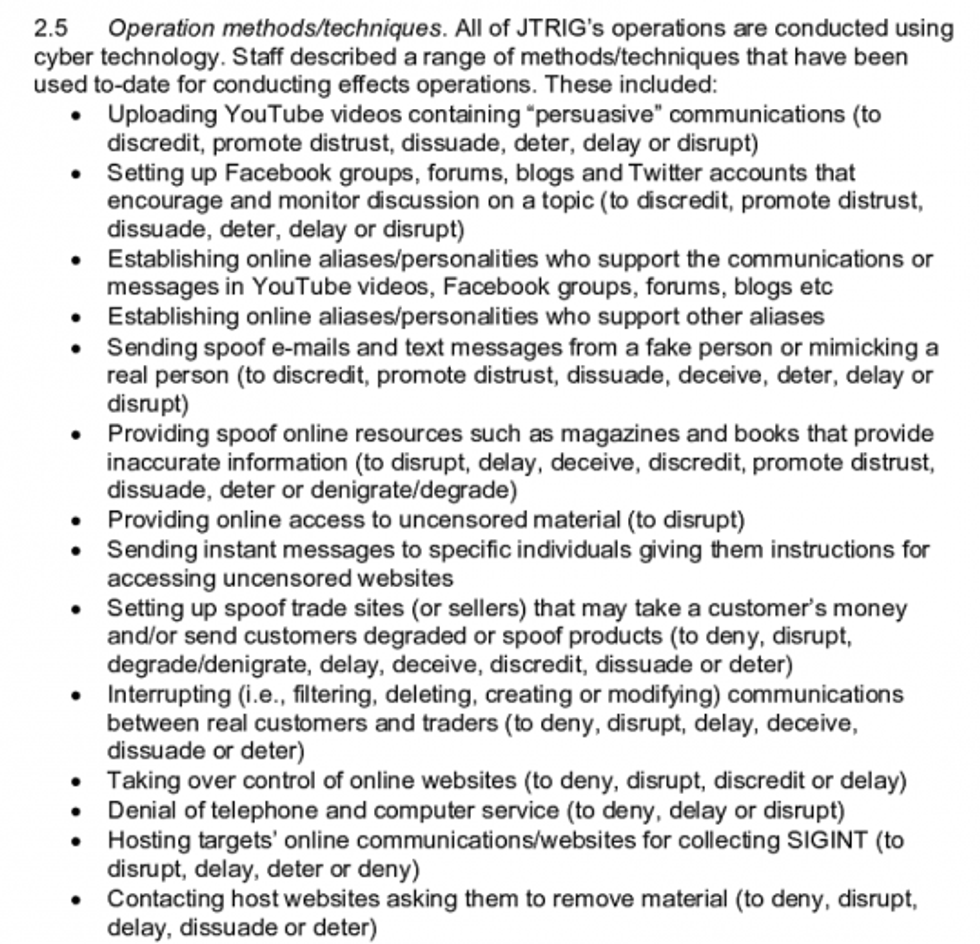
Though its existence was secret until last year, JTRIG quickly developed a distinctive profile in the public understanding after documents from NSA whistleblower Edward Snowden revealed that the unit had engaged in "dirty tricks" like deploying sexual "honey traps" designed to discredit targets, launching denial-of-service attacks to shut down internet chat rooms, pushing veiled propaganda onto social networks, and generally warping discourse online.
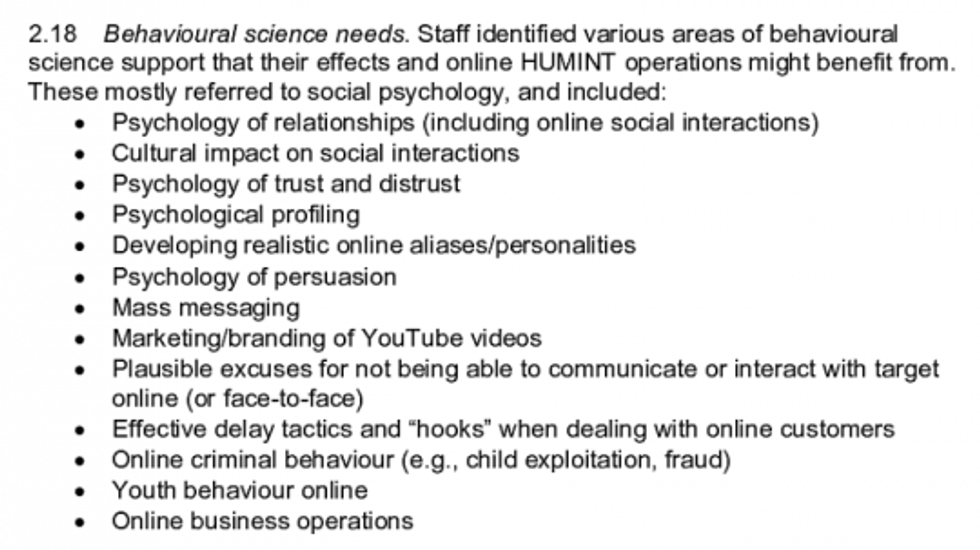
Among the most troubling revelations is a 42-page internal JTRIG memo that describes in detail how the elite unit developed, maintained, and apparently sought to expand its "scientific and psychological research into how human thinking and behavior can be influenced" in order to increase its ability to "manipulate public opinion" via online tools like email, social media, video, discussion forums, and other platforms.
Greenwald and Fishman argue JTRIG's self-documented exploits are most notable because of their "extensive use of propaganda methods and other online tactics of deceit and manipulation" that are not only reserved for "suspected foreign enemies" or criminals, as the agency continues to claim, but have also been used against other groups and individuals that the agency deems threatening or "politically radical."
As Common Dreams reported in February of 2014--when the existence of JTRIG was first made public--the GCHQ has used the unit to develop and deploy a complex series of "dirty tricks," "propaganda," and "false flag" operations designed to spy on selected targets which included not only "suspected terrorists" and "criminals" but also diplomats, journalists, and activists.
Included in the new JTRIG memo is this detailed look at the manipulative online tactics developed by the group:

The reporting also highlights the internal memo's focus on "manipulation" and how the GCHQ hoped to foster both "conformity" and "obedience" among those targeted:

Read The Intercept's full reporting here. And links to the new published documents follow:
A group of human rights organizations has taken the UK government to Europe's top human rights court to challenge what they characterize as "unfettered" and "unprecedented" surveillance practices revealed by NSA whistleblower Edward Snowden.
The ten organizations, which include Privacy International, the American Civil Liberties Union, Amnesty International, Liberty, and Bytes for All, announced their latest legal action against the surveillance on Friday, charging that the PRISM, UPSTREAM, and TEMPORA programs violate rights as outlined in the European Convention on Human Rights (ECHR). The court application (pdf) states that the groups
are concerned with mass bulk interception, collection, inspection, distribution and retention of communications on a vast, unprecedented scale. The process involves hundreds of millions of communications and takes place without any judicial authorization.
The UK Government carries out such activity itself. It also receives the product of such activity carried out by the US Government.
"The UK government's surveillance practices have been allowed to continue unabated and on an unprecedented scale, with major consequences for people's privacy and freedom of expression," Nick Williams, Amnesty International's Legal Counsel, said in a media statement. "No one is above the law and the European Court of Human Rights now has a chance to make that clear," he stated.
The groups' legal effort was prompted by a December ruling by the Investigatory Powers Tribunal (IPT), a watchdog for UK intelligence agencies, which found that the UK's surveillance programs do not violate human rights.
In their application to the Strasbourg court, filed last week, the groups state that the IPT erred in its ruling, as the programs, in fact, violate their Convention-enshrined rights to privacy and freedom of expression, and that the IPT failed to offer the groups a fair hearing.
"It is ridiculous that the government has been allowed to rely on the existence of secret policies and procedures discussed with the Tribunal behind closed doors--to demonstrate that it is being legally transparent," Williams added.
With no further legal avenues within the UK, the groups were forced to go to the European Court of Human Rights--a forum that "has a strong history of ensuring intelligence agencies are compliant with human rights law," stated Carly Nyst, Legal Director of Privacy International. She added that the groups hope that the GCHQ, the NSA's British counterpart, "is finally held accountable for its unfettered spying on the world's communications."
The group also acknowledge that it is only because of Snowden's actions that these surveillance programs have come to light.