

SUBSCRIBE TO OUR FREE NEWSLETTER
Daily news & progressive opinion—funded by the people, not the corporations—delivered straight to your inbox.
5
#000000
#FFFFFF
To donate by check, phone, or other method, see our More Ways to Give page.
Daily news & progressive opinion—funded by the people, not the corporations—delivered straight to your inbox.
Slowly, cautiously, the deficit hawks are daring to come out of the shadows.
These are the well-heeled folks, from conservative think-tanks and political circles, who for decades have successfully pushed governments to impose austerity and social spending cuts on the rest of us, in the name of keeping government deficits small.
With the country reeling from the devastating economic shutdown caused by the coronavirus, these usually cocky deficit hawks haven't yet mustered the nerve to come out fully against what is proving to be immensely popular with the public--a dramatic ramping up of Ottawa's spending to shield Canadians from financial despair.
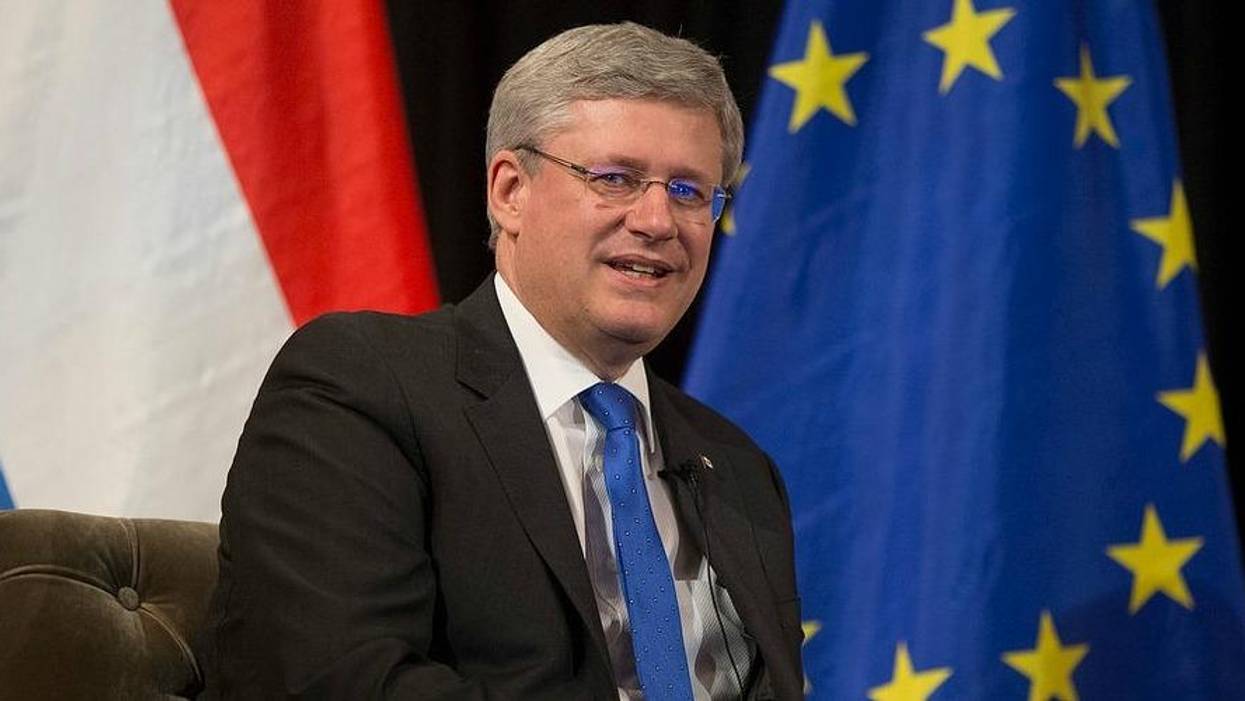
Led by former Conservative Prime Minister Stephen Harper, the deficit-slaying crowd is starting to re-emerge, determined that the pandemic doesn't become the transformative event that could spell the end of the deeply unequal, corporate-dominated economic world they've diligently constructed in recent decades.
But, led by former Conservative Prime Minister Stephen Harper, the deficit-slaying crowd is starting to re-emerge, determined that the pandemic doesn't become the transformative event that could spell the end of the deeply unequal, corporate-dominated economic world they've diligently constructed in recent decades.
After five years of near-silence following his 2015 electoral defeat, Harper took to the Wall Street Journal to proclaim the increased spending "economically ruinous" and to warn that if governments "fail to practice mild austerity proactively, a brutal kind will be thrust upon them."
This is the same language deficit hawks used in the 1990s to frighten Canadians into believing that, unless we drastically cut government spending, we'd hit the "debt wall" -- the perilous point where international investors would no longer lend us money.
Harper insisted in his op-ed that Canada "came close" to defaulting on its debt -- hitting the debt wall -- in the '90s.
It's a scary tale, but not even remotely true.
In fact, even as the carefully stoked deficit hysteria reached a fever-pitch in the mid-'90s, Canada retained the very top credit rating -- Triple A (Aaa)-- indicating that the prestigious Wall Street ratings agencies ranked it one of the safest places in the world to invest.
Below were many countries with credit ratings stretching down to Baa3, and then below them, countries ranked "high-risk." Lower still were dozens of African nations that didn't even get a credit rating; international markets had cut them off long ago.
Now that's the debt wall, but Canada has never been anywhere near it.
The deficit hawks knew this. Yet they still railed against Canada's debt, generating sufficient fear that Canadians accepted the brutal round of social spending cuts delivered by Liberal Finance Minister Paul Martin in 1995.
Since then, the doctrine of small government has prevailed, virtually unchallenged in public debate. Until now.
The deficit hawks are hoping to revive the hysteria they created in the '90s.
But let's not be duped again. This time, let's pay attention to a true debt story--the story of how we ran up a gigantic debt fighting the Second World War and we weren't intimidated by it after the war.
While our debt today is about 35 per cent of GDP, by the end of the Second World War it reached a massive 130 per cent of GDP. "But no one cared!," notes economist Jim Stanford, director of the Centre for Future Work.
We didn't even pay down that debt! On the contrary, we racked up lots more debt in the early postwar decades, as Ottawa invested heavily in infrastructure and expanded the size and scope of government.
The debt kept growing, but the economy grew faster, making the debt burden relatively lighter. By the mid-'70s, our debt amounted to only about 20 per cent of GDP. We never actually paid it off; we just effectively outgrew it, says Stanford.
Those years are sometimes called "the golden age of capitalism" as the economy prospered and a strong middle class emerged.
The deficit hawks can't deny these facts, but they suggest this wouldn't work today.
In fact, with today's record-low borrowing costs--with interest rates effectively close to zero--we're well positioned to run up a huge debt at virtually no cost, allowing us to put Canadians back to work and begin building the infrastructure needed to transition to clean energy.
We could actually be on our way to a very different and promising future. But, count on it, the deficit hawks will soon be circling menacingly overhead, hell-bent on preventing any diversion from the austerity they've confined us to for decades.
I want to start by turning myself into Jason Kenney's investigators.
I admit to being against further oilsands development, making me a person of interest to the sleuths in Kenney's $30-million "war-room" who are tasked with vilifying oilsands critics. Of course, they're really hoping to unmask "foreign-funded special interests," and I don't have a single dollar of foreign backing. Still, I do what I can!
The war room is just one of the Alberta premier's bullying tactics, along with threatening Western separation, as he tries to intimidate critics and pressure the Trudeau government into approving the proposed Teck mine, a vast 293-square-kilometer open-pit mine, which would be the biggest tarsands mine yet.
Given that such an approval would hopelessly compromise any Canadian effort to battle climate change -- which, let's not forget, threatens the world including us here in Canada -- the answer must clearly be no. In the election last fall, two-thirds of the country voted for parties that advocated strong action on climate change.
The fact that this is seen as a difficult decision reveals the Trudeau government's keenness to be accommodating when dealing with opposition, which is coming from the right and backed by powerful business interests.
Meanwhile, there's a willingness to play hardball when opposition is coming from Indigenous people and powerful business interests are against them.
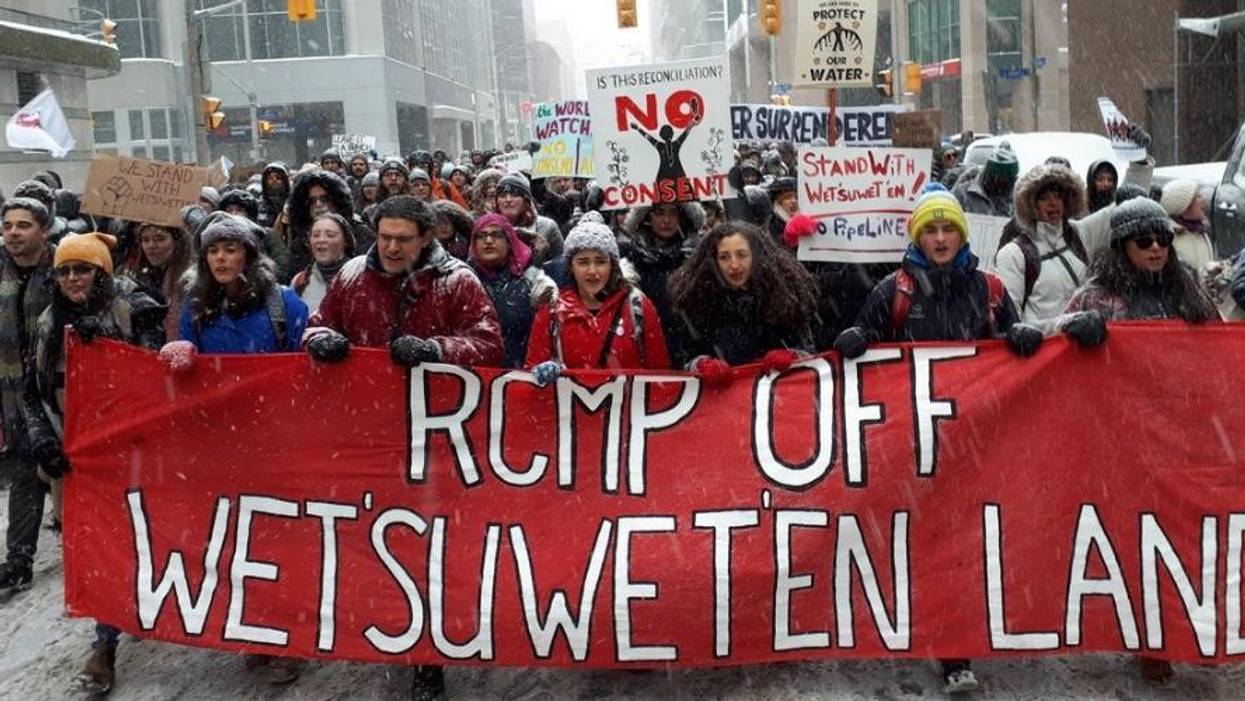
These hardball tactics have been on display in northwestern B.C. in recent weeks as Wet'suwet'en Indigenous protestors, trying to block a pipeline from crossing their land, have been confronted with highly militarized RCMP officers dressed in combat fatigues, bearing assault rifles and police dogs.
Chainsawing through a gate marked "Reconciliation," the RCMP have forcibly removed the occupiers -- that is, people occupying their own land -- amid prayers for Missing and Murdered Indigenous Women and Girls, sparking nationwide protests. Most of the media attention has focused on how disruptive the protests have been to southern train travel.
But the hardball tactics are alarming. The RCMP were prepared to shoot the Indigenous protestors, according to a report last December in the U.K. Guardian. Documents cited in the article show that RCMP commanders argued that "lethal overwatch is req'd" -- a term for deploying an officer able to use lethal force.
What makes the strong-armed clampdown so outrageous is that the natural gas pipeline, approved by the B.C. government and enforced by a court injunction, is to be built across land that has never been ceded. A 1997 Supreme Court of Canada decision ruled the title was held by the Wet'suwet'en hereditary chiefs.
Indigenous people have long been on the receiving end of strong-arm police tactics ordered by Canada's federal and provincial governments, particularly when they stood in the way of colonial settlement or resource extraction. From the late 1800s, Indigenous people were forcibly relocated to reserves, with their children sent to now-notorious residential schools.
In recent years, Canada has extended the national security apparatus to prevent protestors -- often Indigenous people protecting their lands -- from interfering with oil and gas developments.
Casting such protestors as terrorists, Stephen Harper's government -- with qualified support from Justin Trudeau's Liberals -- passed the 2015 Anti-Terrorism Act, which authorized police surveillance and arrest powers against those interfering with "critical infrastructure."
As expected, former Canadian Prime Minister Stephen Harper has announced his resignation from Parliament, saying that he's now gearing up for "for the next chapter of my life."
That chapter, as the Toronto Star reports, includes "launching a global consulting business."
Harper posted the news Friday on his social media accounts, saying, "I leave elected office proud of what our team accomplished together."
For the 57-year-old, the resignation marks the end of "nearly two often-tumultuous decades in public office," Mississauga News reports.
Harper lost power in October in a "devastating election defeat" when his Conservative Party lost to the Justin Trudeau-led Liberal Party.
Since then, the Star adds, he "has only appeared in the Commons for votes since he lost power last fall, and has never spoken in debate as the MP for Calgary Heritage."
The country "shifted to the center-right under Harper," the Associated Press writes, and, as Common Dreams has reported,
During his tenure as Prime Minister, which spanned from 2006-2015, Harper was known internationally for pushing through an aggressive conservative agenda which included: wholesale investment in fossil fuels, including Canadian tar sands; blocking international efforts to combat climate change; dismantling civil liberties through mass surveillance; unflinching support of Israel and attempts to outlaw pro-Palestinian boycott movements; supporting numerous wars overseas; and willfully ignoring the treaty rights of Canadian First Nations, among many other things.
As for his new career, the National Post reports that he "has already lined up an impressive and potentially lucrative post-politics career that includes a new consulting business with international clients, board directorships and joining a speakers' bureau."
Following the election in October, Andrew Mitrovica wrote at Ricochet:
Like millions of Canadians, I'm glad he's gone and taken his tawdry ideas--if you can even call them that--about who Canadians are and what Canada stands for with him into political oblivion. I'm not going to waste a nanosecond pondering his ignominious "place" in this nation's history, his toxic "legacy" or what he's going to do next. Justin Trudeau is like a nicely wrapped confection.
Look, he'll be just fine. Chances are Harper's going to do what other ex-prime ministers have done when voters tell them emphatically to get lost... he will cash in big time. I suspect the make-believe economist will quickly join a high-powered law firm somewhere in Canada or maybe the United States and turn into a make-believe lawyer. He'll also accept lots of invitations to sit on lots of corporate boards that will pay him lots of money to act as a glorified lobbyist.
Like Brian Mulroney and Jean Chretien before him, he'll happily trade in the "noble calling of public service" to become a highly paid gun-for-hire in a pinstriped suit doing lucrative mega business deals with influential politicians and CEOs he befriended along the way. Some elder statesman.
Good riddance, Harper. Don't let the closet doors hit you on the way out of the PMO.
On Twitter, writer and Ricochet founding editor Derrick O'Keefe similarly summed up many progressives' response to the new development:
"Sunny ways" had me going, too. I'll admit it. All the right moves seemed to be getting made. The Dark Lord was beaten into silence, and has just now left the building.
For just one example of a break in the clouds, take organized labour. Justin promised to repeal several appalling pieces of anti-labour legislation:C-4,C-59, C-377 and C-525. The previous government (with Liberal support) effectively abolished pay equity in the Public Service: Trudeau struck a committee on pay equity, whose first recommendation was that this unconstitutional legislation be binned.
There has been more, much more. Our new PM quickly assembled a gender-equal Cabinet. Stalinoid monstrosities -- the Mother Canada monument in Cape Breton and the "Monument to the Victims of Communism" to be plopped on the Supreme Court lawn -- were axed. The risible "Office of Religious Freedom" disappeared. A gender-neutral national anthem was approved. Proposals for electoral reform would be drafted by a Parliamentary committee, one without a Liberal majority on it.
Foolishly, even at my age, and in spite of my politics screaming at me to wake the hell up, I dared to dream. Justin was wearing a lovely new multi-coloured cloak. I might even have sought a selfie with him, claiming later that it was meant to be ironic.
But I have rightfully earned my cynicism over many decades, and it recently began to kick me like a horse. A decision not to build a couple of monuments, words in an anthem, closing a pointless office that wasted revenues, none of this ran very deep. Whatever comes out of the committee studying electoral reform will still need a Liberal imprimatur before being put into effect. And what good is a gender-balanced Cabinet if the same bad policies of the previous government continue to be implemented by it?
The Liberals are uncommonly good at lathering cosmetics over an ugly agenda just as extreme as Stephen Harper's -- one, in fact, virtually indistinguishable from it.
Take those anti-labour Bills that still has us union types all jiggy. They were classic Harper overreach. They violated the Charter of Rights and Freedoms every indefensible which way, and after the January 2015 "Labour Trilogy"of Supreme Court cases, they became even more constitutionally untenable. They were doomed, in a word, once they reached the Supreme Court. Better to repeal this garbage legislation now rather than spend considerable taxpayers' coin fighting impossible court battles.
What happened to the changes in the secret-police Bill C-51 that we were promised? Canadians have been having their Charter rights breached ever since the passage of this Harper-era legislation (supported by the Liberals). Judges in secret courtrooms are still approving violations of the Charter without ever hearing from the other side. Not a move from the Liberals, though, other than some toothless Parliamentary "oversight" that kicks in long after the bad decisions have already been made by low-level operatives.
Trudeau quickly proceeded to rubber-stamp two Harper trade deals: the TPP, which will throw countless workers out of their jobs, and CETA, which will enrich Big Pharma to the cost of ordinary Canadians struggling to cover the grossly inflated costs of drugs.
He approved a $15 billion deal with one of the most evil regimes in the world -- Saudi Arabia -- to supply that government with military vehicles to be used against the Saudi people and very likely against Yemeni civilians as well. And now we're warmongering with Russia by sending troops to its borders. Remember how we raised our eyebrows when Harper got shirty about Canadian airspace? Sabre-rattling! Chest-puffing! Harper must be smiling ruefully to himself in his Calgary redoubt.
Despite a promise to re-open service offices, Trudeau has resumed Harper's scorched-earth attack on wounded Canadian veterans, even putting one of the former Prime Minister's key hatchetmen in charge of the assault.He recently ordered that the "mincome" experiment, which has been a proven success in reducing poverty, not even be permitted to be studied by the House of Commons Standing Committee on Finance.
For reasons known best to the Liberal inner circle, a right-to-die bill was watered down to the point that a number of Canadians have been condemned to lives of unremitting physical agony. A prominent Liberal who has spent time and effort researching this issue was mocked at the recent Liberal Convention by the snotty Carolyn Bennett, who called her "the professor from Fredericton." (Does that anti-intellectual smell seem familiar?) A proposal to set up a national organ registry to make things easier for transplant recipients was nixed without debate by the Liberals.
And remember the Afghan detainee issue -- where Canadians were allegedly handing over Afghan prisoners to be tortured? The Liberals nearly brought down the Harper government over that, clamouring with moral indignation. Now they are in power, however, the cover-up continues. There will be no third-party inquiry.
The targeting of progressive charities by the Canada Revenue Agency, begun by Harper, is continuing, at tremendous cost to the victims, and the Liberals have rubbed salt in the wounds by awarding a promotion to the witchfinder-in-chief. The Unitarian Church, for one, has already had to spend tens of thousands of dollars, with no end in sight, to defend itself against aggressive CRA auditors who demand that references to "social justice" be removed from the church's charter.
Even Harper took more than a mere few months to implement much of his Maximum Program. Trudeau, on the other hand, has been racing at warp speed to commit countless indecencies upon vulnerable Canadians and ordinary people in other lands. The difference? He smiles and takes selfies while he's doing it.
And, judging from the polls, folks are still being taken in. Or, perhaps some Conservatives -- the smart ones -- are part of these approval stats, as they notice that so many of the policies they like are continuing to be implemented, even more quickly than before. The now-neutered NDP raises barely a whisper about any of this, but still sends regular begging letters, which these days don't mention any issues at all. The Conservative Opposition scrambles to find a political foothold anywhere, watching their own program progress non-stop, complete with their trademark cruelty, but now wearing a handsome, hip young disguise.
It's not that the new Emperor isn't wearing clothes. The very opposite is true: he is utterly resplendent. And that's the problem.
Environmentalists and Indigenous rights advocates celebrated on Thursday after a judge in a landmark ruling overturned the Canadian government's 2014 approval of a controversial pipeline project.
The court found (pdf) that the government had not done enough to consult with First Nations communities that would be impacted by building the Northern Gateway pipeline, approved under then-Prime Minister Stephen Harper.
The decision "confirms that the environmental assessment of major pipeline projects was badly eroded by the previous government's dismantling of environmental laws," said Barry Robinson, an attorney for the environmental law firm Ecojustice, which brought the case.
Caitlyn Vernon, a spokesperson for the Sierra Club, told CBC, "Today is a good day for the B.C. coast, climate, and salmon rivers. By overturning federal approval of Northern Gateway, the courts have put yet another nail in the coffin of this pipeline and tankers project."
"First Nations, local communities, and environmental interests said 'no' to Enbridge 12 years ago when it first proposed the project. And now that 'no' has the backing of the courts," Robinson said.
The pipeline would have transported tar sands crude from Alberta to Kitimat, British Columbia. Opponents have long warned that it would expand the use of dangerous fossil fuels, delay the implementation of clean energy, and increase dangers faced by the environment and impacted communities, including possible violation of First Nations treaty rights.
Critics have also pointed out that Northern Gateway's parent company, Enbridge, has a history of environmental destruction, including a massive pipeline rupture that spilled close to one million gallons of crude oil into Michigan's Kalamazoo River and Talmadge Creek in 2010--eventually forcing the company to pay $75 million in cleanup costs.
Karen Wristen, executive director of Living Oceans Society, one of the plaintiffs in the legal challenge, said Thursday, "We know from Enbridge's own shoddy public safety record that tar sands oil spills have devastating consequences. Today's decision is a victory across the board: for the wildlife living in this marine environment and for the communities living at its shores."
The social advocacy group Council of Canadians congratulated the First Nations communities and all other groups involved in the court case. The organization's executive director, Maude Barlow, has previously called the opposition movement against Northern Gateway "one of the most important fights we have right now."
The court ruling also denotes an early victory for Alberta Premier Rachel Notley, who campaigned on a promise of ushering in climate-friendly policies, telling voters after a landslide victory in May 2015 that "change has finally come to Alberta. New people, new ideas, and a fresh start for our great province."
Brian Mulroney will surely be best remembered for the suitcase full of thousand dollar bills he received in a New York hotel room.
The riveting image of the former prime minister accepting wads of cash from a notorious lobbyist -- admitted by Mulroney under cross-examination at a 2009 public inquiry -- was so eye-popping that it completely eclipsed another fascinating aspect of the story: the sweetheart tax deal Mulroney got from the Canada Revenue Agency after he failed to report the cash.
Although Mulroney had hidden the cash payments (totalling $225,000) from tax authorities for six years, his lawyers managed to cut a deal that allowed the former PM to avoid any fines or penalties, and only required him to pay half the taxes he would have paid if he'd obeyed the tax laws -- laws that chumps like you and me are legally obliged to obey.
It certainly looked like favouritism to a former PM. But another possibility is now emerging: that's just the CRA's standard kid-glove treatment for the wealthy and powerful.
That conclusion is harder to avoid in light of recent revelations that 26 wealthy Canadians were offered full amnesty from prosecution or penalty after they were caught hiding at least $130 million in offshore tax schemes set up by the giant accounting firm KPMG.
We only know about this sweetheart amnesty offer due to intrepid reporting by the CBC's Harvey Cashore.
Intriguingly, CRA officials insisted the 26 wealthy tax dodgers keep the sugar-coated deal secret, indicating they realized it would annoy ordinary Canadians who think of tax haven countries mostly as exotic places to vacation, if only they had the money.
KPMG also appears to have gotten off scot-free, even though internal memos show that the firm planned to collect 15 per cent of all taxes dodged.
The KPMG amnesty case -- currently being studied by a House of Commons committee -- is emerging as a test of whether Justin Trudeau's team really is a new-style, transparent government or just another bunch of cronies with cosy ties to Bay St.
The KPMG amnesty was put in place under the Harper government. So this would seem like a perfect opportunity for Trudeau to show a new toughness against rich tax dodgers by using the government's full investigative powers to unmask this and other shady offshore scams.
But, so far at least, the Liberal-dominated committee has failed to show any such toughness, or interest in aggressively probing the booming tax-avoidance industry -- even after revelations earlier this week that KPMG advised clients to use its tax haven schemes to hide money from ex-spouses during contentious divorce battles.
Its tameness stands in stark contrast to the aggressive probing of the tax avoidance industry by a parliamentary committee in Britain and a congressional committee in the U.S.
The KPMG scam is undoubtedly just the tip of a gigantic tax-avoidance iceberg. Canadians for Tax Fairness, a labour-sponsored group, calculates Canada loses more than $7 billion a year in revenue due to wealthy individuals and corporations using tax havens.
Under the Harper government, this sort of tax avoidance by the rich tended to be viewed as a benign activity, a victimless crime, part of the notion that taxes are inherently bad. But, of course, that's only true if you're willing to go without schools, hospitals, roads, bridges, pensions and other public goods that require tax revenue.
The flourishing, highly lucrative tax avoidance business can also be blamed for the complexity of the tax system, so frequently bemoaned by right-wingers.
Our tax laws wouldn't need to be nearly so complicated if it weren't for an industry of hyper-clever sharks constantly devising ways to drive a truck through them on behalf of their wealthy clients.
Ultimately, it boils down to a question of fairness. Why should Brian Mulroney and his ilk manage to avoid the heavy hand of our tax laws?
I guess CRA has some good reasons for being lenient with the wealthy and the powerful. And no doubt they'd be just as understanding with other Canadians.
Hell, at the end of April, I calculated how much tax I owed, and then sent the CRA a cheque -- for exactly half that amount. I haven't heard back yet, but I'm sure they'll be fine with that.
There's no question that Stephen Harper, Canada's former prime minister, will be leaving a legacy when he quits parliament this summer.
A political mastermind, he united the country's fractious right in 2003 when his Conservative Party of Canada (CPC) was born. In 2006, he led it to the first of its three successive electoral victories. Canada was his for nine years - at least until Justin Trudeau's Liberals trounced his government last October.
The party is still holding together seven months after he stepped down from the party leadership. Canadians are united as well - in celebrating his departure.
So Harper's legacy is more of a gift to Conservatives than to Canadians.
Memories of Harper years
Which is probably why, last Thursday, as Harper exited stage right at the Conservative convention in Vancouver, delegates were galvanised by the "look forward" theme that night...
But then, looking back would only dredge up memories of the Harper years: promoting pipelines for his beloved tarsands (but failing to get them built), attacking constitutional rights, running roughshod over parliament
These are years best left buried.
All the same, the 3,000 convention-goers cheered Harper's brief and remarkably empty farewell speech extolling "the future of this party". They watched the obligatory tribute video.
And because it's the social media age, many took to their smartphones to broadcast the party-generated hashtag: #ThankYouStephenHarper.
But, as one prescient pundit immediately tweeted, "An official #ThankYouStephenHarper hashtag? This won't end well... #cpc16 #cdnpoli"
Within minutes, the hashtag was trending, continuing for days. But not how party strategists had hoped. Conservatives hoping to erase the Harper record instead had it flashing on the nation's screens.
The jokes kept coming.
Tweeters thanked Harper for inspiring Muslims, First Nations peoples and youth to vote in unexpected numbers - just to cast him out.
Canadians expressed gratitude for the reminder that, well after high school, science matters. That's because Harper had muzzled government scientists so they couldn't bog down his environmental devastation.
He also abolished the data-rich longform census that allowed policymakers to make decisions based on evidence, not ideology. What's more, he shut down Department of Fisheries and Oceans libraries, resulting in the trashing of priceless environmental data.
Freedom of dissent
Tweeters thanked the Harper government for renewing their appreciation for freedom of dissent.
During the 2010 G20 Summit in Toronto, for example, about 1,000 citizens - mostly innocent bystanders - were locked into makeshift cages. It was the biggest mass arrest in Canadian history.
Hardly surprising, then, that Harper also passed unconstitutional laws that would later be overturned by the Supreme Court.
He even tried to pervert elections with his Orwellian-named Fair Elections Act.
Internationally, Harper's legacy to Canada was to change it from peacemaker to bit player in Ukraine, Libya and against ISIL (also known as ISIS).
In 2010, for the first time in six decades, Canada lost its bid for a seat on the UN Security Council.
Then there was Israel. Canada went from "honest broker" between Israelis and Palestinians to, in Benjamin Netanyahu's words, "a great friend of Israel and the Jewish people".
To show what a great friend Canada was, Ottawa cut funding to the United Nations Relief and Works Agency for Palestine Refugees in the Near East (UNRWA). It killed Rights and Democracy, a Canadian NGO that it deemed to be anti-Israel. It defunded the social justice organisation KAIROS, denouncing it as anti-Semitic.
As for the Canadian International Development Agency (CIDA), it was repurposed. Instead of providing foreign aid to developing countries, it became a marketing arm of Canada's notorious mining companies which are often charged with trampling on human rights in the Global South.
Even Harper's pet project, his "Saving Every Woman, Every Child" international maternal health programme, pandered to his social conservative and evangelical Christian base.
None of the billions of dollars he pledged to "reduce the preventable deaths of women and children in developing countries" would go to family planning.
That despite the fact that countless women all over the world can't care for a fifth, sixth or seventh child, or are brutally raped in conflicts or are too young or too frail to survive pregnancy.
Under constant attack
But women's rights were under constant attack. The long-gun registry, which helped prevent women being shot by their partners, was gleefully killed. As for the hundreds of murdered and missing aboriginal women, Harper said an inquiry was "not really high on our radar".
His reputation as a brilliant financial steward was not deserved. He bumped up the national debt by $150bn, bequeathed a deficit to the Liberals, and hitched the Canadian dollar to the price of oil. Now the still-raging fires around Fort McMurray, Alberta's tarsands central, are expected to lower the GDP.
To the very end, and throughout the bitter election campaign, the Harper Conservatives sowed ethnic division and Islamaphobia. Harper distinguished between ethnic citizens and "old-stock Canadians".
His ministers promised a "barbaric cultural practices" hotline so that "Canadian values" could be preserved.
And when a woman from Pakistan fought to be naturalised as a Canadian citizen while in niqab, Harper took her to court again and again - only to lose. She swore her citizenship oath in niqab, just in time to vote Harper out.
So now he's reportedly off to form his own foreign policy think-tank with former political aides, and to disappear into the corporate boardroom woodwork.
As retired Conservative senator Marjory LeBreton told a Canadian news magazine, "You'll never see him hanging around Ottawa worrying about his legacy."
Oh, but he sure did leave one.
Just not the kind that most Canadians accept with real #thanks.
News that former Canadian Prime Minister Stephen Harper would be leaving politics presumably to "make his fortune" was met with derision and delight from his many critics who say that the conservative MP "destroyed the social fabric of Canada."
Harper is expected to resign from federal politics before Parliament resumes in the fall. According to the Globe and Mail, which broke the news Wednesday, he plans to "pursue new interests on corporate boards and the establishment of a foreign policy institute," which, according to an undisclosed source, "won't be academic or domestic-policy focused...but directed largely at global 'big picture' issues."
And one former policy director speculated that those issues will likely include free trade, in addition to Harper's "geopolitical thinking" in regards to human rights, democracy, and "standing up to authoritarian regimes."
During his tenure as Prime Minister, which spanned from 2006-2015, Harper was known internationally for pushing through an aggressive conservative agenda which included: wholesale investment in fossil fuels, including Canadian tar sands; blocking international efforts to combat climate change; dismantling civil liberties through mass surveillance; unflinching support of Israel and attempts to outlaw pro-Palestinian boycott movements; supporting numerous wars overseas; and willfully ignoring the treaty rights of Canadian First Nations, among many other things.
After word of his imminent departure broke, critics took to social media to speculate about what may be next for the man accused of turning Canada into a "climate villain."
Sparking outcry from environmentalist and Indigenous groups, Justin Trudeau took a pro-oil stance and argued for more controversial pipelines to carry Canada's dirty tar sands oil to coastal ports in comments at a sustainability conference in Vancouver on Wednesday.
"We want the low-carbon economy that continues to provide good jobs and great opportunities for all Canadians," said Canada's Liberal prime minister, as Elizabeth McSheffrey reported in the National Observer. "To get there, we need to make smart strategic investments in clean growth and new infrastructure, but we must also continue to generate wealth from our abundant natural resources to fund this transition to a low-carbon economy."
However, Green party leader Elizabeth May said at the same conference, "If you have an economic strategy for the oilsands that are premised on high volumes of export on the low-value product, you both ship jobs off-shore and drive up greenhouse gases. Those are inconsistent aims."
The Global Series 16 conference centers on sustainability and business, describing itself as "North America's Largest Environmental Business Summit." All of Canada's premiers are attending the talks on sustainability and business from March 2-3.
In contrast to the prime minister's attempt to make an economic argument for pipelines, social justice group the Council of Canadians noted that "the average renewable energy investment creates four times as many jobs as the same investment in the fossil fuel economy," as the group called for more renewable energy jobs on Thursday.
The prime minister's statements were made only months after he declared, "Canada is back, my good friends," to delegates at the COP21 climate conference in Paris in November. This signaled what activists hoped would be a transition to a more sustainable Canada as he signed the historic commitment to keep global warming below 1.5 degrees Celsius.
Trudeau's party's campaign was built on the Liberals' opposition to his pro-oil predecessor, Stephen Harper, who heartily supported the nation's controversial tar sands industry that critics saw as primarily responsible for the country's failure to uphold the terms of previous climate change agreements.
During his campaign, Trudeau emphasized his condemnation of the Northern Gateway pipeline, which would have transported tar sands oil to the B.C. coast. However, activists still lobbied Trudeau to take a stricter position on pipelines after his party ousted Harper's Conservatives in October, as the young prime minister's stance was unclear.
Trudeau did announce harsher environmental reviews for the projects in December. Still, his promises appeared to lack teeth when a federal audit uncovered "systematic failures" within the country's National Energy Board that conducts the pipeline approval process.
The prime minister's talk in Vancouver this week marked a shift from the grand promises made in Paris: "The choice between pipelines and wind turbines is a false one," Trudeau argued, according to the Vancouver Sun. "We need both to reach our goal."
After his talk, the National Observer reported, Trudeau refused to answer reporters' questions about the growth in tar sands mining that would inevitably be fueled by the construction of new pipelines.
A Ricochet editorial charged Thursday:
The prime minister is wrong. Hard choices must be made, between the interests of fossil fuel corporations and the possibility of a decent collective future for Canadians and people all over the world.
First Nations also criticized Trudeau on Wednesday. According to the Aboriginal Peoples Television Network (APTN), Aboriginal leaders stormed out of a climate meeting with the prime minister after it "fell to shambles. " Athabasca Chipewyan First Nation Chief Allan Adam lamented that "the meeting didn't include any talks of taking care of mother earth," APTN reported, and "instead, the focus was placed on economic development and transitioning to a green economy."
On Thursday, the prime minister will meet with Canada's premiers to create a national climate plan. A 350.org campaign manager argued that Canada can achieve a 100% renewable energy economy that honors Indigenous rights, but "only if the government listens to people, not pipeline companies and big polluters."
Justin Trudeau is fond of saying, "Canada is back," and in some genuinely gratifying ways, this seems to be the case. But by far, the most important and substantive evidence for this claim is still missing: an indication that the new government is willing to seriously address the issue upon which a genuine return to normal rests. That issue is how we recover from nearly twenty years of systematic looting of the national treasury through reckless tax cuts for high-income earners and large corporations.
Don't get me wrong. I feel the same relief as every other Canadian that public scientists can now speak their minds, that Stephen Harper's war-mongering is history, that we are no longer a pariah on the world stage, overnight that there is at least hope that Ottawa will take aboriginal concerns seriously and that ministers with a passion for their portfolios are more likely to deliver the goods.
However, these initiatives are the low-hanging fruit of the "Canada is back" mantra because they do not cost much money. So far, the only commitment to address the enormous social and other deficits over two decades is a modest tax increase for the highest-income earners. Otherwise, the cupboard is bare, and past Liberal governments helped make it so.
To reverse this ideological recklessness, Justin Trudeau must demonstrate an extraordinary challenge to his party's 20-year commitment to smaller government. The jury is out on whether he wants to —and if he does, whether he is up to the task. One thing is certain: without sustained public pressure, Trudeau's Liberals would be content with administering the fiscal status quo they inherited from Harper.
The first test
Their first test is on the table right now. I am referring to a report produced by the group Canadians for Tax Fairness, or C4TF (disclosure: I am on the board), detailing the Harper government's extensive damage to the Canada Revenue Agency (CRA). The report is unprecedented in that it was produced with the cooperation of 28 (current and recently retired) tax auditors, fraud investigators, and managers of the CRA. According to C4TF, many of them had approached the group over recent years with revelations of Conservative changes that weakened the agency's ability to collect revenue owed to the government.
Detailed in the report are several allegations by the employees, including:
The CRA responded to the allegations in the report by quoting high employee satisfaction surveys and identifying plans to increase "large audit" spending by 12 percent.
In terms of lost revenue, the key finding in the report was the government's systematic gutting of the tax division responsible for investigating offshore tax havens and recovering the revenue lost to the resulting tax evasion and avoidance. C4TF estimates that at least $199 billion in Canadian wealth is hidden in tax havens around the world, resulting in the loss of up to $10 billion in revenue annually.
The report calls on the Trudeau government to fundamentally change the CRA's priorities -- away from harassing charities, NGOs, and ordinary taxpayers making errors and onto the wealthy and large corporations where the vast majority of revenue is lost.
The media, however, is not focusing on the billions in lost revenue and the damage done to the CRA detailed in the report, and instead is highlighting the issue of how the 28 CRA employees who gave information have allegedly violated the ethics rules that they agreed to as part of the oath of office they signed. There is whistleblower legislation, but it does not protect employees who openly criticize public policy.
The Ottawa Citizen quoted Donald Savois, an expert in the area, calling on the government to investigate what he sees as a breach of ethics. It should have written an editorial calling for the government to fix the CRA.
Talking the talk
There are some encouraging signs that the government might prioritize the issue, though it comes not from the economic ministries. Foreign Affairs Minister Stephane Dion has made the most encouraging comments: "I'd like to address the global economy. It seems like each time we address a problem, like the circulation of funds, businesses use tax havens and do things in our countries, but they don't pay taxes. It's an enormous problem. Whenever [it comes up], I'm told, 'Well, that's up to the international level to resolve.' I'd like to see what Canada could do."
Dion is an influential minister concerning Trudeau. Still, Finance Minister Bill Morneau will ultimately decide how much of a priority to make of the tax haven issue. He is aware of it and under enormous pressure to find revenue that doesn't require raising taxes, stating: "We're going to work on this issue and other issues, and through that work, we would expect that we'll ensure that Canadians and Canadian businesses both large and small will pay their appropriate rate of tax."
Morneau has already changed Canada's position regarding corporate tax dodging. The practice of transnational corporations of transfer pricing and tax shifting -- shifting profits made in higher tax countries to low tax locations -- robs global governments of between $100 and $240 billion a year. The new government signed an international agreement negotiated by the OECD and the G20 called Base Erosion and Profit Shifting, aimed at forcing corporations to pay taxes in the countries where the profits are made. Canada ranks as the third largest loser in the G20 in terms of the amount of untaxed corporate revenue.
The government's apparent willingness to go after tax cheats -- corporate and individual -- is good news. But this is just one step in terms of achieving tax justice and fairness and in recovering the over $60 billion a year lost through tax cuts. Letting the need for a genuine national conversation about taxes slip to the back burner would be a mistake. Now that we have a government that says it believes in governing, the question of comprehensive progressive tax reform needs to be front and centre.